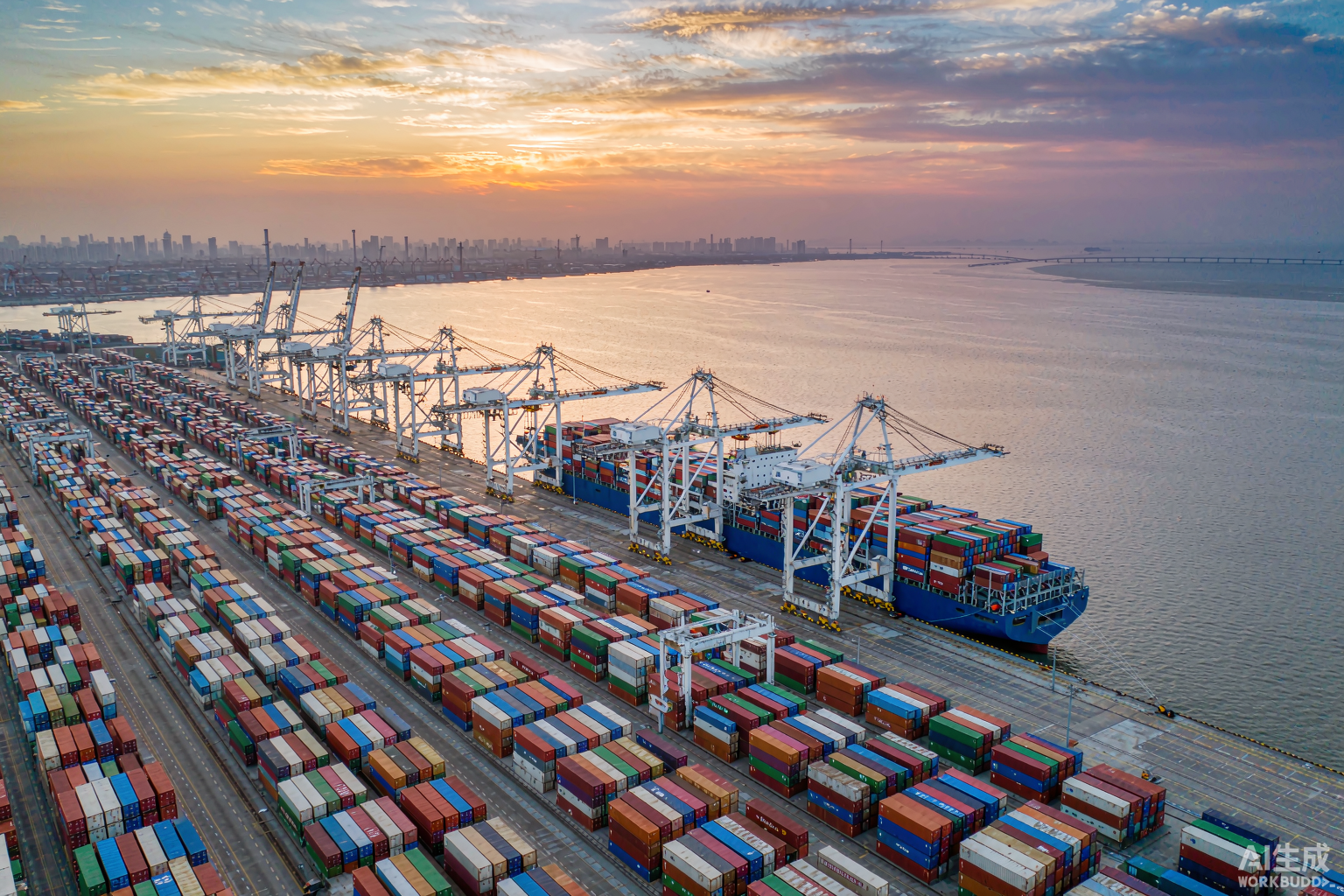
Ocean Alliance extended to 2032, Gemini at 90%+ reliability, Premier through 2030 and MSC operating solo — the four-pole landscape is reshaping port calls and space. With Suez transits projected to reach 80% of pre-diversion levels by Feb 2027, this guide pairs the latest October rates (WCI USD 4,351) and port congestion with eight booking and contracting actions for fabric exporters.
From the second half of 2026, the "four-pole structure" of global container shipping has taken shape — and it is now reshaping the booking and delivery rhythm of roller blind and window-covering fabric exports. Since the dissolution of the 2M alliance in February 2025 and the arrival of the Gemini Cooperation and the Premier Alliance, the liner market has evolved from "three alliances" into a four-pole structure: two alliances, one large independent carrier, and one extended alliance. For window-covering fabric exporters and overseas buyers shipping from China to Europe, the Middle East, North America and Australia, understanding who operates which service, which ports are hubs, and which services are returning to Suez is no longer a logistics-department detail — it directly affects transit cost, delivery reliability and negotiating leverage.
In this article, Shaoxing Wanbo Import & Export Co., Ltd. draws on the latest October 2026 data to explain, for exporters and buyers of roller blind fabric, curtains, sheer, jacquard, coated fabric, high-shrinkage fabric, woven fabric, sofa fabric and carpets, the structure of the four-pole landscape, the latest progress of the Suez return, the freight-rate and port picture, and actionable booking and contracting strategies. Note that rates and routings change daily; this article is intended to explain structure, not to replace a live quotation.
1. The 2027 Four-Pole Landscape: Who Operates What, and Where
1. Ocean Alliance — the largest by capacity and coverage. Comprising COSCO Shipping (including OOCL), CMA CGM and Evergreen, it has operated since 2017 and has extended its cooperation through 2032. By industry estimates its fleet exceeds 9.5 million TEU, roughly 28–29% of global capacity, the largest of the four groupings. With the most complete trans-Pacific and Asia–Europe coverage, it offers the greatest number of direct calls on the China–US and China–Europe trunk lanes. For window-covering fabric, Ocean Alliance is one of the primary carrier choices on the trans-Pacific eastbound and Asia–Europe westbound trades.
2. Gemini Cooperation — the reliability benchmark. Formed by Maersk and Hapag-Lloyd in February 2025, it uses a hub-and-spoke network that reduces trunk-lane port calls and consolidates cargo through hub ports to improve schedule reliability. Industry data show that Gemini has sustained reliability at or above 90% through its first 18 months, reaching as high as 93% in some months of 2026 — among the strongest in the industry — and refined its network in April 2026 by adding port calls. Its fleet is around 340–365 ships, roughly 3.4–3.7 million TEU, with a market share of about 21–22%. For time-sensitive project orders and retail replenishment, Gemini's reliability advantage is worth prioritising.
3. Premier Alliance — lean and direct. Formed by ONE, HMM and Yang Ming in February 2025 (formerly THE Alliance), its cooperation runs to February 2030, with a fleet of about 3.8 million TEU and a market share of roughly 11.5–12%. It focuses on direct services on the Asia–Europe and trans-Pacific trunk lanes and cooperates with MSC on Asia–Europe capacity.
4. MSC — the world's largest carrier, going it alone. After ending the 2M partnership with Maersk in January 2025, MSC chose to operate independently, with a fleet of more than 7 million TEU, an orderbook of about 2.1 million TEU, and a market share of around 20%, offering over 1,500 direct port-pair combinations and enormous flexibility. For window-covering fabric buyers needing multiple destination ports and multi-category mixed loading, MSC's direct coverage is an important option.
2. The Suez Return: The Two Sides of Moving from Diversion Back to Transit
The return is accelerating. Industry reporting indicates that the Premier Alliance has announced restoring Suez transits on its Southeast Asia–North Europe FE1 and Indian Subcontinent–North Europe IOX/INX services, shortening the FE1 round voyage from 13 weeks to 11 and IOX/INX from 13 to 10. Maersk and Hapag-Lloyd (Gemini) have also announced the return of four jointly operated services — AE5, AE11, AE12 and ME2 — to Suez. MSC's Jade service has also returned, calling at Saudi Arabia's King Abdullah Port, while CMA CGM, COSCO Shipping and ONE have restored selected services. A Drewry report published in October 2026 projects Suez container transits reaching about 80% of pre-diversion levels by February 2027, and expects traffic to hold around that level thereafter, as carriers retain the option of switching back to the Cape of Good Hope.
But the economics of the return are not simple. Drewry's analysis shows that for a 24,000 TEU ship, using Suez rather than the Cape reduces the round voyage from about 29,711 to 21,878 nautical miles and from 124 to 97 days — saving 27 days and about 7,833 nautical miles, and cutting operating cost from about USD 18 million to 17 million per round voyage, roughly 6%. Per container slot, that is a saving of only about USD 43 — which explains why the return is "driven more by transit time, vessel utilisation and competitive pressure than by voyage cost alone." More critically, for a ship valued at USD 225 million, a war-risk premium of 0.3% of hull value adds about USD 1.35 million for two passages through the risk area; at 1%, it reaches USD 4.5 million — enough to erase the saving. Canal fee discounts partly offset this: a 15% discount saves about USD 365,000 and a 25% discount about USD 600,000. The conclusion: the Suez return brings "capacity release plus transit-time improvement," but if Red Sea risk reverses, routings could switch again — buyers and exporters must stay flexible.
3. The Latest Freight and Port Picture (October 2026)
Freight: Europe-bound keeps falling, US-bound stays high. According to the Drewry World Container Index (WCI), the composite stood at USD 4,351 per 40ft container on 8 October 2026, down 2% week on week. Shanghai–Rotterdam was USD 3,337 and Shanghai–Genoa USD 3,696, with Asia–Europe down for 13 consecutive weeks; Shanghai–Los Angeles was USD 7,624 and Shanghai–New York USD 10,220, keeping the trans-Pacific high. The market has produced a rare "rate canyon": the Asia–US versus Asia–Europe spread widened to a premium of roughly 130%. Xeneta chief analyst Peter Sand noted the Mediterranean and North Europe lanes have fallen 43% and 34% respectively since July, though "the market has not yet found its floor."
Ports: congestion at a four-year high. Industry monitoring puts congestion at about 12% of global container capacity, a four-year high; global schedule reliability fell to 49.9% in August and to just 32.3% in Asia, with late vessels arriving an average of 6.81 days behind schedule. Asian ports have not fully cleared backlogs caused by Typhoon Dolphin (August) and Typhoon Saudel (September), with transshipment hubs such as Singapore and Colombo under particular pressure.
Capacity and policy: a capacity wave meets pending policy. The global orderbook sits at a historic high (about 42% of the existing fleet), and 2027 capacity growth is expected to outpace demand, with BIMCO projecting about +9% capacity growth in 2027. On policy, the US–China trade truce has been extended to 10 January 2027, but the suspension of Section 301 port fees on Chinese ships expires on 9 November 2026 unless USTR issues a new notice.
4. Five Practical Effects of the Four-Pole Landscape on Fabric Export
- Port calls and transshipment paths change. Gemini's hub-and-spoke network means more cargo moves via hub ports, with fewer direct calls but better reliability. Buyers must recheck whether their destination has become a "transshipment arrival" and adjust arrival-time expectations accordingly.
- Services returning to Suez shorten voyages. Once Asia–Europe services restore Suez, transit can be shortened by 7–10 days — critical for catching festive selling windows.
- Reliability differences become a carrier-selection criterion. Gemini has sustained reliability above 90%, while the industry overall sits below 50%. For time-sensitive retail orders, choosing a high-reliability alliance's product (such as Gemini-related services) can materially reduce stock-out risk.
- Space and contracts must be negotiated by alliance, not by a single line. Within an alliance, different service loops differ greatly in capacity and reliability; contracts should specify "which service loop the cargo actually runs on."
- The rate canyon creates both arbitrage and risk. With the Asia–Europe versus Asia–US gap widening, some buyers redistribute via European distribution centres — but this adds regional regulatory and tax-compliance requirements.
5. Eight Booking and Contracting Recommendations for Exporters and Buyers
- Confirm which service loop your cargo runs on. Don't just look at the alliance name — ask for the specific service code (e.g. FE1, IOX, AE5, ME2) and verify whether it currently uses Suez.
- Cross-check multiple indices. Reference Drewry WCI, Freightos FBX, Xeneta and SCFI together to avoid being misled by a single quote; clarify quote validity and rate-adjustment clauses.
- Balance contract and spot. Lock baseline volume on long-term contracts and keep flexibility for the incremental volume — in a market of "capacity wave plus pending policy," one-directional bets are risky.
- Build a buffer for congestion. With 12% of global capacity absorbed by congestion, destination pickup and inland distribution typically run 3–7 days late in peak season; build 7–10 days into contract delivery dates.
- Watch the Section 301 port-fee deadline. Around 9 November 2026, monitor USTR notices closely and assess the impact on China–US lane cost and space.
- Verify war-risk and diversion clauses. Under FOB/CIF, confirm whether the policy covers war risk, geographic exclusions, the extended voyage arising from Cape of Good Hope routing, and general average.
- Use high-reliability services for key SKUs. For best-sellers that must be on shelf on time, prioritise a high-reliability alliance service, and pay a premium for certainty if necessary.
- Prepare clearance and certification documents early. Beyond capacity and routing volatility, destination compliance (such as the EU's DPP/ESPR and flame-retardant standards) is a common source of peak-season delays; have documents ready in advance.
6. Why Wanbo: Turning Routing Uncertainty into Supply-Chain Certainty
Shaoxing Wanbo Import & Export Co., Ltd. is based in Keqiao, Shaoxing, China's textile hub, and has specialised in roller blind and curtain fabric export for years. Its range covers roller blind fabric, curtain fabric, sheer, jacquard, high-shrinkage, woven, coated fabric, sofa fabric and carpets. Faced with routing and rate volatility under the four-pole landscape, Wanbo gives overseas buyers three forms of support:
- One-stop multi-category mixed containers: roller blind, sheer, sofa and carpet combined in one container, spreading unit logistics cost and reducing multi-supplier coordination.
- Flexible shipping solutions: based on space and routing conditions, we advise on combinations of FCL, LCL and batch shipment to balance delivery time and cost.
- Documentation and compliance support: test reports and certification assistance for flame retardancy, blackout and colour fastness, aligned with destination customs and project supervision to reduce clearance-delay risk.
In 2027, the shipping market will swing repeatedly between a "capacity wave" and geopolitical variables. Rather than passively absorbing rate volatility, work with a supplier that understands routing structure and can pre-arrange production and flexibly combine cargo. Contact Shaoxing Wanbo for the latest pattern catalogue, samples and booking advice. Only by understanding the alliance landscape can you turn an uncontrollable route into a controllable delivery date.