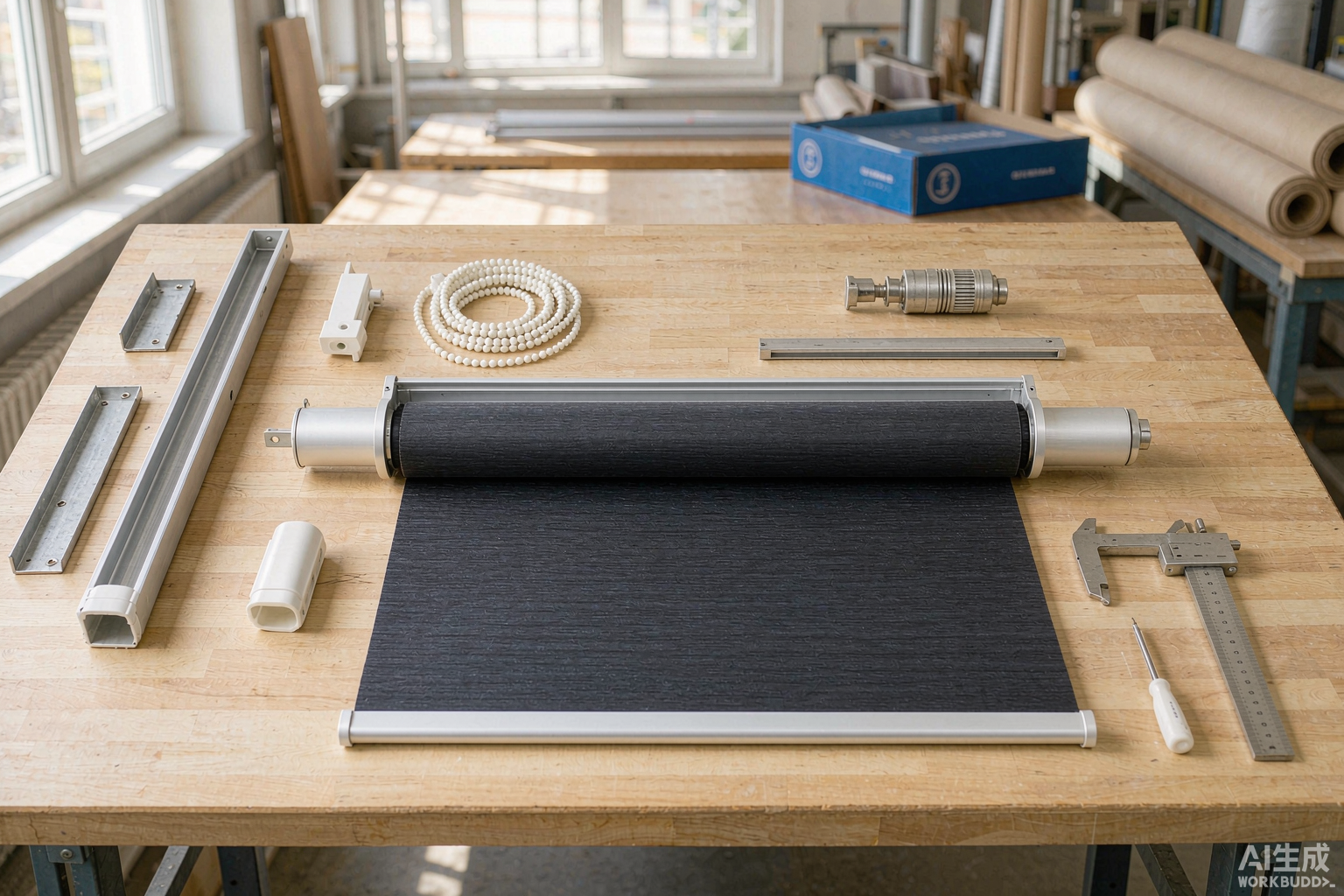
The same fabric sold as a roll and as a finished blind are two businesses. This piece unpacks the ledger across three delivery models — fabric rolls, window-by-window KD kits and full finished containers — with BOM ranges for a 1.5×2.0 m manual roller blind, EN 13120 / EN 16433 / EN 16434 and ANSI/WCMA A100.1-2022 compliance points, 40HQ loading efficiency, spare-part strategy and a 12-SKU best-seller set.
The same roll of fabric sold as a roll and sold as a finished blind are two different businesses. The first is quoted per metre, loaded by weight and earns the spread on weaving and coating. The second is quoted per unit, loaded by cubic metre and earns the spread on assembly, certification and delivery. Through the second half of 2026 a growing number of overseas buyers have been asking the same question: if the fabric comes from China and the components come from China, why not assemble locally — or simply buy the finished blind from the factory? The answer is an arithmetic one, not a matter of preference. This article unpacks the cost structure, certification thresholds, container efficiency and after-sales liability of the three routes: fabric, knock-down kit, finished blind.
1. Three models, one decision
Model A — fabric only. The buyer cuts, sews and tubes the fabric locally. Advantages: low cube, low freight-to-value ratio, low capital tied up, and duty assessed under fabric chapters, usually lower. Disadvantages: local fabrication capability decides everything. European workrooms are booked out and expensive; in much of the Middle East and Africa there is no reliable workroom at all, so the buyer ends up with fabric and no product. This model suits distributors who already run a workroom and traders who resell by the roll.
Model B — knock-down kit (KD). The factory cuts to size, edge-seals, and packs one window per carton: fabric, tube, brackets, end caps, clutch, bead chain, bottom rail, screws and installation instructions. Locally the buyer only screws, inserts and hangs. This has been the fastest-growing route of the past two years because it compresses volume to roughly that of fabric plus short tubes, keeps certification responsibility on the factory side, and leaves only final assembly labour local — while allowing the buyer to claim local assembly and to flex on both lead time and duty. The risk is that cutting tolerance, edge sealing and kit completeness all move upstream: one missing end cap and the whole window cannot be installed.
Model C — finished blinds, full container. The factory assembles, tests, labels and colour-boxes everything; the buyer sells or installs straight out of the carton. Highest margin, strongest customer lock-in, and the only route that works directly with e-commerce and project orders. The cost: large cube, expensive freight, the heaviest certification and after-sales burden, and dead stock the moment one SKU stops selling. This model suits distributors with channels and installers who can carry inventory, plus hotel and office projects delivered window by window.
None of the three is better in the abstract. The test reduces to three questions: does your market have reliable fabrication capacity, is your order flow project-driven or retail-driven, and how much inventory and after-sales can you carry? The answers pick the model.
2. BOM breakdown: where the money goes in a 1.5 × 2.0 m manual roller blind
Take a 1.5 m wide, 2.0 m drop manual roller blind — about 3.0 m² of fabric, or 3.3 m² including 10% cutting waste. The ex-works cost structure typically looks like this. The percentages come from actual order structures at Wanbo and should be read as experience ranges; specific projects move with fabric weight, component grade and order volume.
Fabric, 40%–55%. This is the only line that can be moved materially through specification. A blackout coated fabric at 280–320 g/m² and a standard dim-out at 200–240 g/m² can differ by 30% in cost inside the same finished blind, while the retail price difference is often under 10%. Which is exactly why upgrading the fabric is the most efficient margin lever in the finished-goods business. Sheers and screen fabrics (3%–5% openness) are cheaper per metre and lighter per square metre, and are the volume play.
Hardware, 20%–28%. Aluminium tube (25/32/38 mm), brackets, end caps, clutch with gearing and limits, bead chain, bottom rail with weight and end plugs, screws and anchors. The spread here is enormous: a budget component set and a set that survives cycle testing can differ by more than 2× in cost. And most after-sales failures are not fabric failures — they are slipping clutches, cracked end caps and snapped chains. Money saved on components comes back later as after-sales cost.
Packaging, 5%–8%. Colour box, inner protection, instructions, fittings bag, master carton. Export packaging for finished blinds must do three things at once: resist compression under container stacking, resist moisture from ocean condensation, and present well at retail. Doing all three rarely costs less than 5% of product value.
Labour, 8%–12%. Cutting, edge sealing, tubing, adjustment, packing. The share looks modest, but labour is where yield is decided — the cost of reworking one finished blind is typically three to five times its labour cost, because rework means disassembly, replacement material and repacking.
Certification and testing amortisation, 2%–4%; waste, 2%–3%. Negligible in fabric-only export, hard cost in finished export, and diluted by volume — which is precisely why small finished-goods orders never look cheap on paper.
On that structure, a 1.5 × 2.0 m blackout manual roller blind lands at roughly USD 18–26 ex-works (fabric at USD 3.2–4.5/m²), while the same product sells to distributors in Europe, the Middle East and North America at USD 45–90. That spread is the space “from roll to unit” describes — and the reason local assembly can exist as a business at all.
3. Process and quality control: the six places finished blinds fail
Quality problems in finished blinds concentrate in assembly, not in the fabric. First, cutting tolerance: width is normally held to ±2 mm; beyond that you get light gaps at the edges or fabric rubbing the wall. Second, edge sealing: cold cutting is cheap but frays; hot knife and ultrasonic sealing close the yarn cross-section and are mandatory for blackout products. Coated fabric also needs the sealing temperature controlled — too hot and the coating hardens and takes creases when rolled. Third, fabric-to-tube bonding: double-sided tape plus a tube groove is standard, but the tape’s initial tack and temperature resistance decide whether it still holds in year three. In hot climates — the Gulf, West Africa — this single item matters more than any other.
Fourth, roll-up flatness: uneven tension left to right makes the blind cone as it rolls, and the customer notices on the first lift. Fifth, drop versus tube diameter: a 2.0 m wide blackout coated fabric above 300 g/m² on a 25 mm tube will visibly sag; 32 mm, sometimes 38 mm, is required. Sixth, end-cap concentricity and bottom-rail weight: off-centre caps produce noise and wear, and an under-weighted rail lets the fabric swing in air movement.
Four factory tests cover most of it: a cycle test (500 to 1,000 up-and-down cycles per customer requirement, recording jamming, noise and coning); dimensional and concentricity sampling; visual inspection for stains, creases, shade variation and sealing burrs; and carton drop and stacking tests. Do all four and the after-sales rate usually comes in under 2% — and in the finished-goods business, profit is essentially after-sales rate multiplied by unit cost.
4. Certification: EN 13120 in Europe, ANSI/WCMA in the US — two different tickets
On the European side the anchor is EN 13120, the performance requirement including safety for internal blinds. Two companion standards sit under it: EN 16433 sets the test method for protection against strangulation on the complete blind (including the child head probe), and EN 16434 sets requirements and test methods for the safety devices themselves — tension devices, breakaway devices, accumulation devices, inner cord stops. The 2014 edition of EN 16434 was confirmed as still valid on review in March 2025. Operating points: a cord or bead chain loop must not create a strangulation hazard; a continuous loop system must have a tension device that is permanently fitted at the factory and keeps constant tension on the loop, otherwise the product cannot be used; and the instructions plus technical dealer information must state the operating length and the installation height. On fire, European projects usually reference EN 13501-1 classes (for example B-s1,d0), tested under EN ISO 11925-2 (small flame) and EN 13823 (single burning item). Fabric, lining and plastic components are tested separately, and the complete blind is classified at the lowest result.
On the US side there is a change that must be stated precisely. Stock products fall under the mandatory federal rule 16 CFR 1261: cordless, inaccessible cords, or operating cords no longer than 8 inches in any position. Custom products were covered by 16 CFR 1260, but that rule was vacated in 2023 by the US Court of Appeals for the Fifth Circuit in WCMA v. CPSC, on the ground that the Commission had not satisfied the cost-benefit analysis requirement. Custom products therefore reverted to the consensus standard ANSI/WCMA A100.1-2022, applicable to products manufactured on or after 1 June 2024: free-hanging operating cords and tilt cords eliminated, multiple cords feeding a single connector prohibited, continuous loop systems requiring a factory-fitted tension device that holds at least 5 lbf without releasing, and labels and instructions updated accordingly. Note that “voluntary” does not mean optional: mainstream US retail, marketplaces and insurers all work to A100.1-2022, so non-compliant product effectively cannot reach legitimate channels.
In the Middle East and North Africa, Saudi Arabia runs SASO/SABER; many African markets require pre-shipment conformity inspection; Australia and New Zealand maintain separate mandatory cord-safety requirements for corded window coverings. Certification for finished goods is a one-off investment plus per-batch maintenance — which is why certification must sit before product selection, not after the order. Pick the target market, then the product structure, then the price.
5. Container efficiency: the freight arithmetic of finished blinds
A 40ft high cube measures roughly 12.0 × 2.35 × 2.69 m, about 76 m³ of theoretical volume, of which 85%–90% is normally usable. Rolled fabric is dense: a 40HQ typically loads 20–24 tonnes, translating to roughly 55–65 m³. A finished 1.5 × 2.0 m blind in its colour box measures about 1.6 × 0.18 × 0.16 m, or 0.046 m³ per unit. In theory a 40HQ takes over 1,400 units; in practice stacking strength, weight limits and mixed loading bring it to 900–1,100. At equal cargo value, finished goods occupy two to four times the transport volume of fabric — which is why finished export suits high-value products, nearby markets and project orders, while distant markets suit the KD kit.
Three loading moves that save money immediately. First, group by window width and nest units of the same width band to cut voids. Second, put short tubes inside the load — insert tubes under 1.2 m into carton voids or bundle them separately. Third, consolidate the fittings bag into one master carton instead of dropping an instruction sheet and screw pack into every box. In KD mode there is a fourth: load fabric rolls and short tubes separately, rolls in the heavy zone and tubes in the light zone, which lowers the centre of gravity and adds payload.
6. After-sales and spare parts: the real moat
After-sales cost in finished export is routinely underestimated by half. Failures in order of frequency: clutch slipping or jamming, bead chain snapping or jumping, end-cap cracking, tube deformation, fabric debonding, bottom rail dropping. The spare-parts policy that answers this is shipping 3%–5% of order volume as spares inside the container — clutches and end caps at 2%, bead chain at 3%, bottom rail and brackets at 1%. That costs under 1% of cargo value and turns an after-sales case from “wait for the next sailing” into “replace next week”. Spares travelling with the container are an order of magnitude cheaper than air-freighting replacements, and this is the most concrete difference between a real finished-goods supplier and a pure trader.
The other overlooked item is the boundary of the warranty. Finished blinds are normally warranted in three tiers: fabric (colour fastness, debonding, coating delamination) for one to three years; hardware (clutch, tube) for one to two years; motors for one to five years depending on brand. Defining the three tiers, the acceptance criteria (for example ΔE ≤ 1.5, cycle count) and the exclusions (improper installation, oversize or overweight panels, salt-laden coastal environments) prevents far more disputes than a blanket “two-year warranty”.
7. The 2027 best-seller set: how to build 12 SKUs
The greatest risk in finished or KD business is SKU sprawl. A workable starting structure is four functional directions × three colour families = 12 SKUs:
- Blackout coated roller fabric, 280–320 g/m², three-pass black yarn. Bedrooms and hotels, works in the Gulf, Europe and North America alike, and remains the most dependable cash-flow product.
- Blackout plus acoustic composite, 400 g/m² and above. The highest premium sits in European street-facing residential and office retrofit — sell decibels reduced, not “blackout percentage”.
- Linen-look blackout. The retail favourite in Northern and Western Europe: linen appearance, full blackout performance, and the easiest story to tell on an e-commerce page.
- Sheers and screen fabrics, 3%–5% openness. Office and curtain-wall demand; bundle with motorisation and the average order value doubles.
- Zebra and Shangri-La style fabrics. Retail hits in the Gulf and Southeast Asia; the stripe-shifting visual is made for social content.
- Jacquard and chenille upholstery, 400 g/m² and above. Mix into the same container as blinds to dilute freight and raise value per box.
Colour by market: the Gulf leans champagne, camel and charcoal; Europe leans greige, sand and deep green; North America leans charcoal, ivory and navy. Three colour families across four functional directions gives a minimum range that can be listed, replenished and controlled. Do not launch with twenty colours — finished-goods businesses die of inventory, not of missing SKUs.
8. Twelve actions to implement
- Choose the model before discussing price: A if you have a workroom, B if you have installers, C if you have channel and inventory capacity. Do not run all three as an experiment.
- Screen customers with the three questions — fabrication capability, order type, inventory tolerance — because the answers define the quotation structure.
- Treat the fabric share as a margin lever: moving to three-pass blackout raises cost by about 30% and selling price by about 50%, the easiest increase to justify.
- Do not economise on components; clutch and end-cap grade decides the three-year after-sales rate and your reputation.
- Match edge sealing to the market: hot knife or ultrasonic for blackout, cold cut acceptable for standard dim-out where cost matters.
- Write the width tolerance into the contract (±2 mm) with an out-of-tolerance rejection standard, so arrival disputes do not arise.
- Standardise four factory tests — cycle, dimension and concentricity, visual, carton stacking — and issue the report to the customer.
- Certify before you select: EN 13120/EN 16433/EN 16434 for Europe; confirm the ANSI/WCMA A100.1-2022 and 16 CFR 1261 boundary for the US.
- In KD mode, make kit completeness a KPI: one bag per window, labelled by window type, with a missing-part rate below 0.5%.
- Load by window width, insert short tubes into voids, consolidate fittings — 10%–15% more per container is a direct price cut.
- Ship 3%–5% spares with every container; turn after-sales from “wait for a vessel” into “replace next week”.
- Write the warranty in three tiers with criteria and exclusions, and define responsibility for installation error and environmental exposure.
In closing: moving from roll to unit does not earn the hard labour of assembly. It earns the part where the supplier absorbs uncertainty on the customer’s behalf — certification, kit completeness, container loading, spares, warranty. Each of those is painful for a buyer to do alone and routine for a supplier who does it every week. Wanbo runs a complete chain in Shaoxing Keqiao from weaving and coating to finished-goods assembly, supplying blackout coated roller fabric, sheer curtaining, jacquard, high-shrinkage, coated woven, sofa fabric and carpets, and delivering in three forms to match the market: fabric rolls, window-by-window KD kits, and finished blinds ready to install, with EN 13120 and ANSI/WCMA compliance documentation, loading plans and spare-part packs. If you are weighing local assembly against importing finished blinds, send us your window schedule and target market and we will return a cost comparison across all three routes.