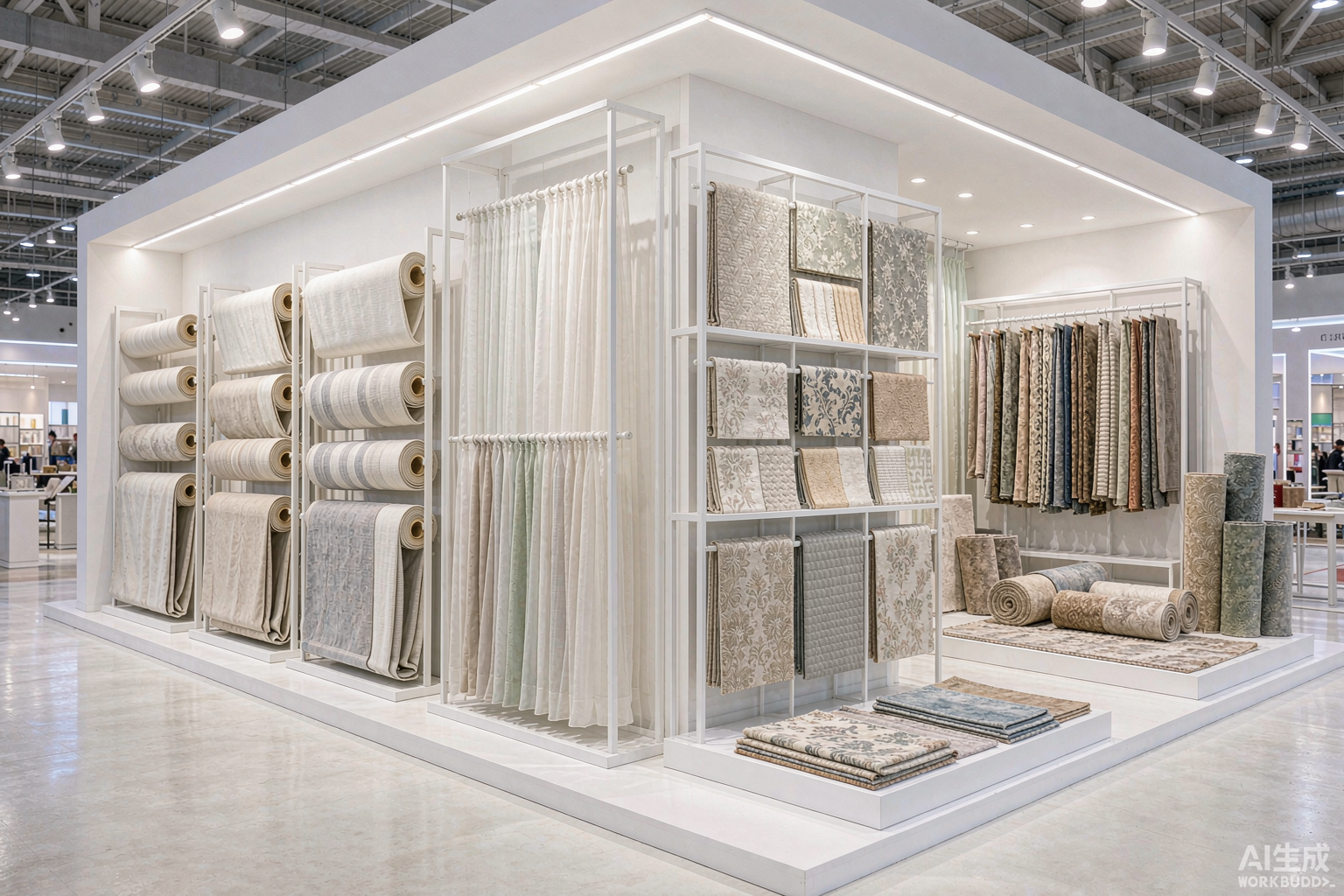
The Shanghai home-textile show runs concurrently with apparel, fabric, yarn and knitting fairs in one venue — a total footprint near 400,000 m2. Complete selection, benchmarking and supplier screening in one trip, with eight best-seller fabric directions for 2027 and a 90-day post-show conversion rhythm.
If you can only schedule one sourcing trip to China this season — and you need fabric, yarn, finished goods and accessories all in the same week — 10-12 March 2027 in Shanghai is very likely the highest-yield three days on the calendar: the China International Home Textiles and Accessories Expo (Spring Edition) — known industry-wide as Intertextile Shanghai Home Textiles — runs concurrently and in the same venue with four specialised shows covering apparel fabrics, garments, yarn and knitting, forming a five-show mega platform with a total exhibition footprint approaching 400,000 square metres. For overseas buyers sourcing roller-shade fabric, curtain fabric, voile, sofa upholstery and rugs, that means one visa application, one trip and one floor plan to complete your spring 2027 selection, price comparison and supplier screening in a single pass.
This is not a generic etiquette guide. It is an executable route: the show structure, a hall-by-zone walk plan, the 2027 best-seller checklist, the ten questions that make supplier quotes comparable, and the 90-day post-show conversion rhythm.
1. Read the Platform First: Where the Home Textile Show Sits in the Textile Chain
Launched in 1995 and jointly hosted by the Sub-Council of Textile Industry of CCPIT, the China Home Textile Association and Messe Frankfurt (Hong Kong), the Shanghai Home Textile Show is the largest and most influential home-textile trade fair in the Asia-Pacific region and the second-largest event in Messe Frankfurt's global home-textile series after Heimtextil in Frankfurt. The home-textile dedicated space is about 27,000 square metres; according to third-party trade-fair platforms, recent editions have drawn roughly 340-450 exhibitors and 24,000-42,000 visitors (the platforms differ in methodology; the organiser's final figures prevail).
The structural change is what matters more. Taking the autumn 2025 edition as an example, exhibitors numbered close to 900 from about 20 countries and regions, professional visitors exceeded 35,000, and overseas buyers approached 5,000 from 116 countries and regions, with buyer-group numbers growing about 73% year on year. Sourcing teams from IKEA, Walmart, H&M Home, Culp, JD.com and Xiaomi were all on site. This is not a retail bazaar — it is a B2B platform where purchasing decision-makers concentrate, and where the buyer mix is dominated by importers, distributors and project buyers.
2. One Trip, Five Shows: Why the Route Saves Days
The core value of the 2027 spring edition is the concurrent structure. At the same dates, in the same venue complex — the National Exhibition and Convention Center (NECC, Hongqiao), 333 Songze Avenue, Qingpu District, Shanghai — the home textile show runs alongside:
- Intertextile Shanghai Apparel Fabrics (Spring/Summer) — apparel-focused, but the frontier of functional fabrics, coatings, printing and finishing appears here first;
- Yarn Expo Spring — looking at yarn is looking at the origin of next season's fabric cost and hand-feel; high-shrinkage yarn, recycled polyester and differentiated fibres all have upstream sources here;
- PH Value / China International Knitting Expo — the structure and weight evolution of knitted curtain and sofa fabrics;
- CHIC (China International Fashion & Apparel Fair) — if you also run a retail soft-furnishing or home-décor channel, this is where channel and brand buyers concentrate.
A route that has proven itself: walk the home textile show's target-category booths in the morning; spend two hours at Yarn Expo in the afternoon reading upstream cost signals; then return to the apparel-fabric show on day three to collect functional-fabric technical documentation. The five-show benefit is not “seeing more” — it is being able to benchmark the midstream, upstream and downstream of fabric pricing within one calendar week.
3. Designing the Walk Through the Twelve Home Textile Zones
The home textile show covers twelve product areas: bedding, towels, curtains, sofa fabric, carpets, wallcoverings, decorative fabrics, functional fabrics, sun-shading products, textile auxiliaries, digital printing, and fibre art & design. For window-treatment and soft-furnishing buyers, walk in this order:
- Sun-shading products and curtains: roller-shade fabric, blackout coated fabric, sunscreen fabric, honeycomb and zebra blinds finished goods — your main battlefield; reserve a full day;
- Decorative and functional fabrics: the concentrated zone for flame-retardant, antibacterial, UV-protective and easy-care finishes — technical requirements of overseas project orders all have matching suppliers here;
- Sofa fabric and carpets: jacquard, chenille and velvety upholstery plus machine-woven rugs — ideal for cross-category same-colourway coordination with curtain fabrics;
- Wallcoverings and textile auxiliaries: frequently overlooked in whole-home schemes, yet among the strongest basket-size lifters;
- Digital printing and fibre art: the source of small-batch, quick-response and original-pattern development.
4. The 2027 Best-Seller Fabric Checklist: From Trend to Order
Combining market data from the past year with trade-fair feedback, these categories carry the highest demand certainty for 2027:
- Blackout roller-shade fabric: according to market-research firm Data Insights Reports, blackout accounts for roughly 37% of global fabric-roller-blind product-type revenue and commands a 20-25% price premium over translucent alternatives. Bedrooms, media rooms, healthcare sleep areas and hotel rooms are the structural demand base.
- The fabric roller-blind market as a whole: the same source values the global fabric roller-blind market at about USD 4.67 billion in 2025, reaching USD 7.6 billion by 2034, a CAGR of about 5.5%. Europe is the largest value market; Asia-Pacific grows fastest.
- Motorised and smart shading fabric: the motorised roller-blind segment is expected to grow at about 9.7% annually (2026-2033), well above the overall market. On the fabric side the corresponding requirements are low noise, anti-static behaviour, and tube-diameter and torque compatibility — putting fabric parameters and motor parameters on one specification sheet will be standard practice in 2027 negotiations.
- Functional fabrics: the sales share of UV-protective, flame-retardant, antibacterial and easy-care fabrics has risen to about 35%, up eight percentage points in two years. For European project orders, flame-retardant and environmental certification is a threshold, not a bonus.
- Recycled polyester fabric: recycled polyester usage has climbed from about 18% in 2023 to about 32% in 2026, and European brand supply chains now write GRS-style traceability into purchase terms.
- Ice-crack texture, chenille and velvety surfaces: the autumn-winter texture revival is a clear direction; “hand-feel and visual layering” is replacing “pattern alone” as the buyer's first-glance criterion.
- Voile and sunscreen fabric: daylight-control demand keeps rising in the Middle East, South Asia and Southeast Asia; choosing openness factor and shading coefficient matters more than colour.
- Outdoor shading fabrics: a smaller base growing about 9% a year, driven by balcony economy and extreme-weather protection at once.
5. Ten Questions That Make Every Supplier Comparable
Show time is limited. Ask every supplier the same fields — only then are quotes comparable:
- What are the full width and the usable width? What tolerance applies?
- Is the weight nominal or measured? How is within-lot dispersion controlled?
- How are blackout rate and openness factor tested? Can report numbers be provided?
- What are the colour-fastness grades (washing, daylight, rubbing)?
- Which flame-retardant and environmental certifications exist? Can OEKO-TEX and GRS documents be produced on the spot?
- What are the MOQ and sampling lead time? Is colour-card development charged?
- Is the quote EXW or FOB? Priced per metre, per kilogram or per square metre?
- What is the bulk lead time? Does it extend in peak season? Is partial delivery supported?
- Can cross-category same-colourway sets be supplied (curtain, sofa, rug)?
- Do you support mixed full-container and LCL shipments? What languages are supported for destination documents?
6. The Rhythm: Four Weeks Before to Ninety Days After
Seventy percent of a fair's value is decided before and after it opens. Suggested cadence:
- Four weeks before: compress target categories, target markets and annual purchase volume into a one-pager and send it to priority suppliers in advance with proposed meeting slots; confirm visa or visa-free entry eligibility (China currently grants unilateral visa-free entry to dozens of countries and 240-hour transit visa-free access to more than 50 countries — check the National Immigration Administration's latest notice for the exact list and duration).
- Two weeks before: book hotels and venue transfers early — Hongqiao prices swing sharply during show weeks; prepare a comparison-sheet template with the ten questions printed for on-site completion.
- During the show: spend 30 minutes each evening entering business cards, grading contacts A/B/C, filing photos and writing one memory anchor per contact; three days will produce over a hundred contacts — unprocessed by nightfall means unseen.
- 72 hours after: send Class-A suppliers a concrete intent — colour cards, quotations and a video-factory-audit schedule; Class-B get a standard follow-up email; Class-C archived.
- Ninety days after: complete sample approval, trial orders and payment-term negotiation. With ocean-freight capacity loosening and the rate level expected to drift lower in 2027, Q2 is a good window for annual contract pricing; plan the first container for May-June so the replenishment cycle lands ahead of the second-half peak.
The fair is only the entrance; what decides your margin is the screening and execution afterwards. Shaoxing Wanbo has long received buyers from Europe, the Americas, the Middle East, Australia and Southeast Asia for factory visits, sample selection and inspection in Keqiao. We produce roller-shade fabric, curtain fabric, voile, sofa upholstery and rugs, alongside jacquard, high-shrinkage yarn, coated and woven fabrics, and provide multilingual colour cards and physical samples, cross-category same-colourway coordination, mixed FCL and LCL shipping, and compliance document packs (flame-retardant, environmental and recycled certification). If you plan to be in Shanghai in March 2027, send us your target categories and volume list in advance — we will have the samples, quotations and factory-visit schedule prepared to your list, so that from day one your three-day trip is effective.