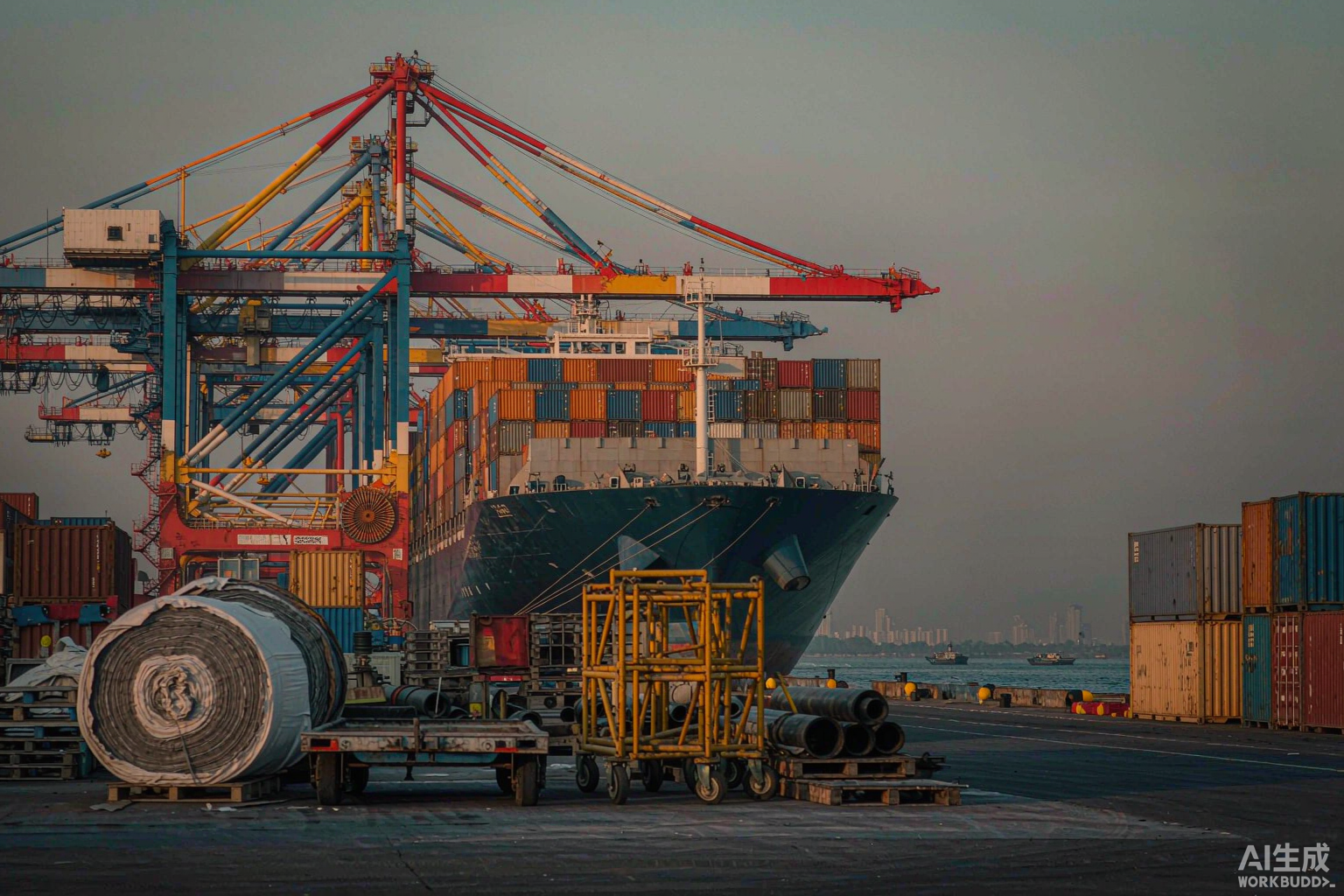
The spread between Shanghai-Los Angeles and Shanghai-Rotterdam has widened to a record $4,436 while about 12% of global container capacity sits in port congestion, just as the Suez return meets the 2027 annual contract season. This article breaks down routing, rates, congestion and policy, and gives fabric exporters eight practical moves.
October 2026 marks a genuine transition point for global container shipping. On one side, Asia–Europe rates have now fallen for twelve consecutive weeks as Suez transits accelerate. On the other, trans-Pacific rates are still sitting at historic highs while global port congestion has climbed to a four-year peak. The clearest signal came on 1 October: Drewry’s World Container Index (WCI) put Shanghai–Los Angeles at USD 7,835 per 40ft against just USD 3,399 per 40ft for Shanghai–Rotterdam — a gap of USD 4,436, or roughly a 130% premium, the widest spread ever recorded between the two mainline corridors. At the same time, shippers have already started preparing for the 2027 annual ocean-freight contract season. For Chinese exporters of roller blind and blackout fabric, sheer curtain fabric, sofa and upholstery fabric, carpets, jacquard, high-shrinkage yarn fabrics, coated fabrics and woven fabrics, this combination of a record rate divergence and an approaching contract season means next year’s landed-cost structure has to be rebuilt from scratch. This article strings together the four threads — routing, rates, congestion and policy — using the latest data available in early October, and ends with a practical playbook for fabric exporters heading into 2027.
1. The market snapshot for this week
Put the key indices side by side and the divergence becomes obvious. According to Drewry and the Shanghai Shipping Exchange: the WCI composite stood at USD 4,434 per 40ft on 1 October, down 1% week on week; Shanghai–New York at USD 10,428 per 40ft (+1%); Shanghai–Genoa at USD 3,702 per 40ft (−3%); and Shanghai–Rotterdam at USD 3,399 per 40ft (−2%), its twelfth straight weekly decline. The Freightos Baltic Index (FBX) for week 40 showed Asia–US West Coast at USD 8,319 per FEU and Asia–North Europe at USD 3,260 per FEU, both flat on the week. The Shanghai Containerized Freight Index (SCFI) closed at 3,662.30 on 2 October (−0.66%), while the China Containerized Freight Index (CCFI) reached 1,923.93 (+0.3%). Xeneta’s 1 October reading is more granular: Far East–US West Coast spot at USD 8,346 per FEU (+1.4% week on week) and Far East–US East Coast at USD 11,523 per FEU (+0.7%), still 344% and 335% above the 28 February baseline. In one sentence: Europe is falling, the trans-Pacific is oscillating at a high level, and the spread between the two is itself a cost variable that now needs to be managed as a line item.
2. Why the rate divergence has opened up so widely
One end of the divergence is Europe. The Suez return is the core driver: Maritime Strategies International estimates that about 35% of Asia–Europe sailings are already using the Red Sea–Suez route again, while Linerlytica calculates that more than 140 containerships representing over 2 million TEU have switched back from the Cape of Good Hope since May 2026. In one week in early October, 30 vessels above 4,000 TEU transited Suez — the busiest week since 2024. Shorter routings release effective capacity directly (an Asia–Europe loop run via the Cape needs three to four extra ships), pushing rates down; Xeneta data shows Far East–North Europe down 34% from its July peak and Far East–Mediterranean down 43%. The other end of the divergence is the trans-Pacific. Although Xeneta’s chief analyst Peter Sand has called the 2026 trans-Pacific peak (typhoon season winding down, Asian congestion easing, Golden Week cutting Chinese exports), US-bound rates remain several times higher than a year ago and neither side wants to blink first. That is how a record USD 4,436 gap appears — and it is not just a number. It means the same Chinese fabric, moving to Los Angeles versus Rotterdam, carries a logistics cost that differs by more than double.
3. Port congestion at a four-year high: 12% of global capacity absorbed
Many expected rates to collapse, but port congestion is offsetting the capacity released by the Suez return. A C.H. Robinson report notes that roughly 12% of global container ship capacity is currently tied up by port congestion, the highest level in four years. Asian ports account for close to two-thirds of global congestion, with schedule reliability at Shanghai and Ningbo tracking as low as 12%–17%. Industry-wide schedule reliability has fallen for a second consecutive month to its lowest since September 2022. Supply is also tight: about 30 new ships were delivered over the past month with none scrapped, and five new vessels above 16,500 TEU joined the North Europe trade in October. To clear post-holiday backlogs, carriers plan to withdraw roughly 13% of capacity through blank sailings in November, with eight void sailings already scheduled for North Europe in October. This “nominal decline, practical difficulty in booking space” pattern is exactly where fabric exporters most often lose money.
4. The full Suez return: routing is being re-sequenced
October is the landmark month. On 4 October the 24,200 TEU “OOCL Spain” completed COSCO’s first westbound Suez transit in more than two years on the AEU1 service. On 17 October the 8,110 TEU “ONE Continuity” departed Laem Chabang to launch the Premier Alliance’s FE1 service, with its first westbound Suez transit set for 9 November. Hapag-Lloyd’s SE1 service will send the “Umm Qarn” through Suez from Tanjung Pelepas on 27 October, while CMA CGM’s OCR and Gemini’s NE4 and AE5 loops are also returning. All three major alliances plus MSC have now restored Red Sea transits to varying degrees, and an industry consensus has formed. One caveat remains: Suez Canal container throughput is still about 60% below 2023 levels, and security is the principal brake — the EU’s Aspides mission has acknowledged that available warships are insufficient to cover all escort requests. In other words, the return is a trend, but it is far from a full recovery.
5. The policy variable: the truce runs to January 2027, but port fees remain unresolved
For fabric exporters moving cargo to the US, the most important October signal is not the freight rate but the port fee. The US has levied Section 301 port service fees on Chinese-operated and Chinese-built vessels since 17 April 2025, and China has applied reciprocal “special port fees” to US-linked vessels since 10 October 2025; both were mutually suspended from 10 November 2025 for one year. On 23 September 2026, US Treasury Secretary Scott Bessent said the “Busan Agreement” would be extended to 10 January 2027, and on 28 September China’s Ministry of Commerce confirmed an extension of the Kuala Lumpur economic and trade arrangements, including the mutual suspension of port fees, to 10 January 2027. However, as of 5 October 2026 the USTR’s formal Federal Register notice still says the suspension expires at 11:59 p.m. Eastern on 9 November 2026, and no extension notice had been published. There is still a gap between a verbal statement and the written rule — and if the fees return, a 10,000 TEU vessel could face millions of dollars in US port costs, which will ultimately be passed through into freight. US-bound buyers should keep a dedicated port-fee clause and budget in their contracts.
6. The 2027 annual contract season: rhythm and judgment
The industry convention is that trans-Pacific mainline contracts are negotiated mainly in March–April and take effect in May, while Asia–Europe contracts are more dispersed, with most main agreements negotiated at year-end and executed in early the following year. In other words, the core 2027 negotiation window is from late 2026 through the first half of 2027. BIMCO expects 2027 container capacity growth to exceed demand growth; if the Suez return broadens further, the supply-demand balance will loosen more, which in theory favors buyers at the bargaining table. But with spot rates still oscillating at high levels, “how low to lock” is very hard to judge. A more robust approach is not to lock a full year of fixed pricing at the market peak, but to first agree on Q1 2027 space guarantees and a pricing mechanism, blending long-term and short-term contracts with fixed and index-linked pricing.
7. Eight practical moves for fabric exporters
- Cost the East Coast–West Coast spread separately. Using Xeneta’s figure of roughly USD 2,400 per container, pull out your East Coast volume and calculate how much you pay for the East Coast premium. That single line becomes your opening number at the 2027 negotiation.
- Do not sign a 12-month fixed-price US East Coast contract before the end of October. If you must commit, sign a 90-day short-term contract, or add index-linked terms with a clear adjustment cycle and triggers.
- Rebuild your 2027 freight budget. Use sensitivities of USD 4,500–5,500 for the West Coast and USD 6,000–7,000 for the East Coast (Xeneta’s three-month outlook), rather than the pre-crisis anchors of 1,880 and 2,650.
- Set a spot-rate trigger. For example, start signing the 2027 long-term contract in the week West Coast spot falls below 7,000 (about 16% below the current level) for two consecutive weeks; below 6,000, lock the bulk and keep 20% open.
- Model shiftable volumes for “East Coast to West Coast plus inland”. Lay out the switching schedule for booking, drayage, rail or truck and destination warehouse by week, as a fallback for both price pressure and space protection.
- Ask forwarders to quote base freight and surcharges on two separate lines. The average low-sulphur fuel oil price across 20 major ports reached about USD 901.5 per tonne in mid-September (versus about 543.5 in late February), and bunker adjustment (BAF) and emergency bunker (EBS) surcharges are rising. Comparing only the base ocean rate always costs you at the destination port.
- Watch peak-season surcharges on emerging-market lanes. Maersk has applied a peak-season surcharge from 15 October on Far East to South Africa and Mauritius (USD 250 per 20ft, USD 500 per 40ft), with regional carriers usually following within weeks — Middle East and Africa buyers should price this into their landed cost now.
- Write the “Suez or Cape” basis into your quotations. For the same destination, the two routings differ by 10–14 days in transit and carry different war-risk and surcharge treatments. Your quotation must state the routing basis to avoid disputes on arrival.
8. Landing the strategy on fabric
For bulky, mid-value-per-container categories such as roller blind and blackout fabric, sheer curtain fabric, sofa and upholstery fabric, carpets, jacquard and high-shrinkage yarn fabric, coated fabric and woven fabric, freight represents a sensitive share of cost, so contract strategy matters even more. Three practical priorities: split your annual volume by trade lane and negotiate the US and Europe separately; route time-sensitive project cargo (hotel and office shading refurbishment) via the returned North Europe Suez services to claw back the 10–14 days; and use RCEP and existing free-trade arrangements to optimize destination tariffs so savings in freight are not eaten by duties. As a source factory for roller blind shading fabric and window covering fabric, Shaoxing Wanbo can support overseas buyers with LCL/FCL combinations, environmental and flame-retardant certification packages, and coordinated container loading and lead times — a one-stop export solution that helps you find a more stable landed cost between the rate divergence and the contract season. Prices and routing conditions change daily; this article is meant to help you understand the structure, not to replace same-day quotations.