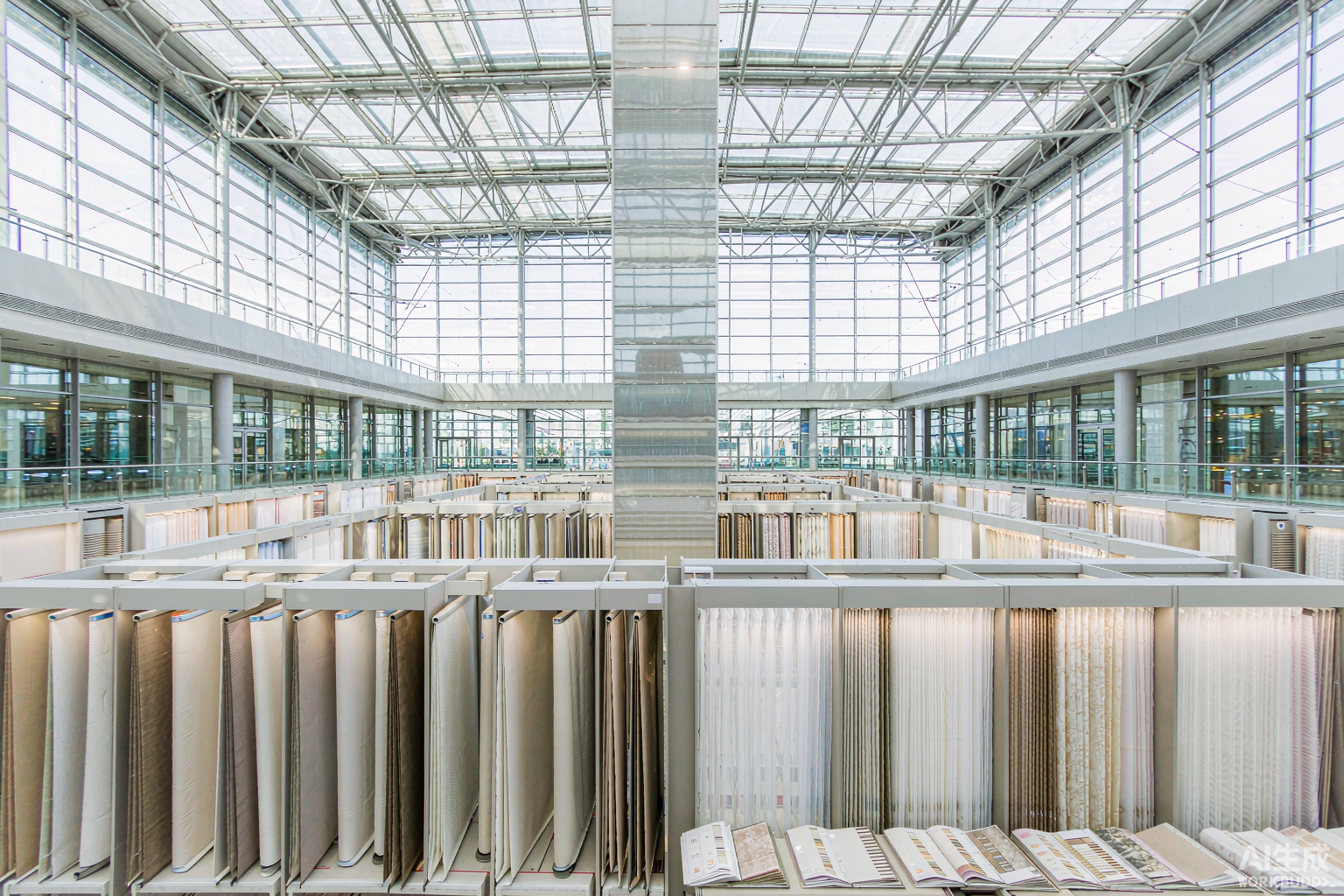
Phase 3 of the 140th Canton Fair (Oct 31 – Nov 4) gathers textile fabrics, home textiles, carpets and tapestries under one roof. This guide gives overseas fabric buyers a pre-fair checklist, a five-day booth screening playbook and the hot-selling fabric list, plus the latest ocean freight picture as carriers partially return to the Suez Canal — rates softening while European port congestion risk builds — so fair orders can turn smoothly into Q4 shipments.
Two major events are shaping China's export calendar right now: the 140th Canton Fair enters its third phase in Guangzhou from October 31 to November 4, 2026, with dedicated zones for textile raw materials and fabrics, home textiles, and carpets and tapestries — and, at the same time, the Suez Canal recorded its busiest week for containership transits since 2024 in the last week of September, as carriers bring Asia–Europe services back after more than two years of Cape of Good Hope diversions. For overseas buyers sourcing curtain, roller shade, sofa and carpet fabrics, this is a rare window in which sourcing, sampling and Q4 freight planning can all be advanced in the same few weeks. This guide covers how to work the fair efficiently, which fabric categories are selling hottest, and what the latest freight news means for the orders you will place there.
1. The 140th Canton Fair, Phase 3: why fabric buyers should fly in
Founded in 1957, the China Import and Export Fair — universally known as the Canton Fair — is China's longest-running and largest comprehensive trade exhibition, often called “China's No.1 Trade Fair.” The 140th edition runs October 15 to November 4, 2026 in three phases across roughly 1.55 million square meters of exhibition space, with more than 32,000 exhibiting companies including around 2,800 brand exhibitors. The previous session (the 139th) drew 314,000 overseas buyers from 220 countries and regions in person — a scale no other fabric sourcing event matches.
For home textile buyers, the key dates are the third phase (October 31 – November 4), themed “Better Life,” where three zones matter most: textile raw materials and fabrics, home textiles, and carpets and tapestries. This is precisely the territory of curtain and roller shade fabric, sheers, sofa fabric and rugs. Fabric is a touch-and-drape product: the hand feel, the fall of a sheer, the evenness of a blackout coating — these can only be judged in person.
Several new buyer-facing services at this session are worth noting:
- First-ever overseas buyer membership program, offering points and exclusive benefits to repeat visitors — worth activating on the official website if you source from China regularly.
- AI assistant “ASKME” for online exhibitor matching and instant messaging. Before the fair, use it to pre-match booths with keywords such as roller shade fabric, blackout coating, jacquard, sheer curtain, chenille; on site, it turns into a navigation shortcut.
- Expanded remote badge stations: new buyers can collect their buyer badge free of charge at airports, railway stations, ports, designated hotels and the Hong Kong office — no queues at the venue.
- Real-time indoor navigation across all 54 exhibition sections. Pre-marking target booths on the website or app saves hours of walking.
2. Four preparation steps: pre-registration, visa and your buying list
The fair's process is straightforward, but every step needs lead time:
- Pre-registration (mandatory): all overseas buyers must pre-register in the buyer service system (buyer.cantonfair.org.cn) or the official Canton Fair app, selecting Phase 3 (October 31 – November 4) as your attendance period.
- Invitation letter and visa: generate the invitation online — it is a key document for your Chinese visa application. Business travelers on tight schedules can also check the port visa channels at Guangzhou Baiyun Airport, Pazhou passenger port (for travelers from Hong Kong and Macao) and Nansha Port.
- Buyer badge: free of charge and the only valid entry credential; activate the e-credential before arriving at the complex.
- Build a precise buying list: specify fabric weight (GSM), width, composition, blackout performance, UV parameters, flame-retardant standards and certificates (OEKO-TEX, GRS, EN 13501, NFPA 701 where relevant), target volumes and acceptable MOQ ceilings. The sharper your list, the faster booth conversations move and the closer quotes are to true landed cost.
3. Five days on the floor: turning 32,000 exhibitors into 10 shortlisted suppliers
1.55 million square meters will overwhelm any buyer without a plan. Based on repeated buyer debriefs, a high-yield rhythm looks like this:
- Days 1–2: scan the fabric zones broadly. Do not deep-dive yet. Log booth numbers, product styles and first impressions; photograph the booth number plate and fabric tags; consolidate into a spreadsheet each evening.
- Days 3–4: revisit with the “four questions” method. For each shortlisted booth, ask four things — monthly capacity and standard lead time, minimum order quantity (MOQ), whether certification and third-party test reports are complete, and export references in your market (Middle East, Europe, Australia, North America). Vendors who cannot give specific numbers drop down the list.
- Sampling on site has rules: take free swatches for hand-feel screening; full-width or roll samples are usually couriered after the fair — agree the dispatch date and courier account at the booth so it does not drift for weeks.
- Day 5 and the 48 hours after: grade your suppliers. Classify contacts as A (test order now), B (await samples) and C (backup only); within two weeks of the fair, push A-grade contacts into test orders or a video factory audit while the fair's momentum is still alive.
- Add a factory visit: a booth conversation is never as convincing as a real production line. Guangzhou to Shaoxing Keqiao (China's largest fabric cluster) is about 6 hours by high-speed rail; most mills there welcome pre-booked visits during fair weeks.
4. Hot-selling fabric categories for 2026–2027: what to touch first
Judging from this year's inquiry mix from overseas customers, these categories deserve the most of your floor time:
- Fully blackout roller shade fabric (coated / foam-backed): demand from the Middle East, Australia and North American hotel projects keeps rising. The difference between white-yarn coating and black-yarn foam processes directly changes blackout rate and thermal performance — check opacity data and coating adhesion on the spot.
- High-shrink yarn fabrics: valued for elasticity and wrap performance in cushions, sofa wrapping and roller shade bottom rails; growing fast in European and American home retail channels over the past two years.
- Jacquard fabrics: large-jacquard and yarn-dyed jacquard are the main premium upgrade for European and American buyers; three-dimensional textures such as cracked-ice (ice-crack) patterns are appearing more and more on roller shades and sofa fabrics.
- Sheer and chenille yarns: light-softening, non-see-through sheers remain a living-room and model-apartment essential; single-direction vision sheers and Shangri-La blind structures are trending upward.
- Sofa fabrics and carpets: hotel and build-to-rent project orders have stabilized; stain resistance, abrasion (Martindale) and flame retardancy are the three questions every buyer should ask first.
- Woven blackout cloth: chosen for durability and engineering stability in public buildings, schools and hospitals; check weight and tear strength.
5. Ocean freight update: the Suez return is under way — rates down, congestion risk up
If 2024–2025 was the era of “around the Cape of Good Hope,” September–October 2026 is the era of “the Suez return, in progress.” The following combines public data from Drewry, Xeneta, Linerlytica and Sea-Intelligence as of late September and early October:
- Transit counts at a post-crisis high: per Linerlytica, more than 140 containerships with over 2 million TEU of capacity have returned to the Suez route since May; the last week of September was the busiest week for containership transits through the canal since 2024, with 30 vessels above 4,000 TEU passing in a single week.
- Major carriers restoring both directions: on October 4, COSCO and OOCL operated their first westbound Suez voyage in more than two years with the 24,188-TEU OOCL SPAIN on the AEU1/LL1 service, after shifting ten eastbound sailings back to the canal since mid-September. The Gemini Cooperation (Maersk and Hapag-Lloyd) announced on September 14 four more services returning through the canal, while maintaining around 92% schedule reliability — the best among the alliances.
- The return is partial and reversible: northern Red Sea transits remain roughly 36% below pre-crisis norms (though about 30% above the same period of 2025); Evergreen, ONE, HMM and Yang Ming still route most strings around the Cape; war-risk insurers continue to flag the area as high-risk. Industry language is “normalized risk,” not “resolved risk.”
- Rates: high but softening: Drewry's World Container Index stood at USD 4,468 per 40-ft container on September 24 (still about 154% above year-ago levels); on Xeneta's data, Asia–North Europe spot fell 29% from early July to about USD 1,590 per FEU and Asia–Mediterranean fell 38% to about USD 2,650; carriers are attempting a restoration to USD 4,000–4,200 in late October, while forwarder market pricing to North European base ports currently sits around USD 2,900–3,500 per 40-ft.
- Congestion risk is building: Sea-Intelligence put August global schedule reliability at 49.9% — the weakest since September 2022 — with late vessels averaging 6.81 days of delay, absorbing roughly 5% of global deep-sea capacity. Analysts warn that Suez-returning vessels will arrive in Europe at the same time as ships still completing Cape routings; arrivals could rise 10–39% during the transition, producing 2–3 weeks of congestion and, 8–9 weeks later, a possible equipment shortage in Asia.
- Surcharges and carbon costs stack up: carriers filed a fresh round of October surcharges on South Africa, East Africa and Gulf services; EU ETS Phase 2 adds roughly USD 40–80 per TEU on Europe-bound cargo. Build these into landed-cost calculations.
6. Q4 shipping windows: getting your fair orders onto vessels safely
- Europe: Q4 spot forecasts point to USD 2,100–2,800 per FEU — softer than Q3, but with a rate-restoration attempt expected late October. Lock space for orders signed at the fair by early November, and build a 7–10 day buffer into delivery schedules for destination congestion.
- Middle East and Africa: October surcharges and war-risk premiums remain active; book Gulf-bound cargo 2–3 weeks ahead and confirm in writing who bears surcharges under your FOB/CIF terms.
- North America: Q4 spot forecasts of USD 1,600–2,200 per FEU to the US West Coast and USD 2,400–3,000 to the East Coast via Panama signal a buyer's market — no need for panic bookings.
- Loading efficiency: blackout and sheer fabrics are light but bulky; prefer 40HQ containers, confirm roll outer diameters and pallet plans with your supplier, and plan the weight distribution when mixing fabrics, made-up blinds and components in one container.
- Terms reminder: freight rates and routing conditions change daily. The figures above describe market structure, not a quotable rate; always confirm current schedules with your forwarder before booking.
7. Wanbo during the fair: booth meetings and the Keqiao factory tour
As a source mill rooted in Keqiao, Shaoxing — the heart of China's fabric cluster — Wanbo manufactures roller shade fabrics, fully blackout coated fabrics, sheer curtains, jacquard, high-shrink yarn fabrics, woven blackout cloth, sofa fabrics and carpets, with OEM/ODM customization, color-card development and project supply. During Phase 3 of the 140th Canton Fair we keep two channels open:
- Meet us in Guangzhou: pre-book a slot and we will bring hot-selling color cards and sample books for your market to the fair for on-the-spot selection and indicative pricing.
- Visit the Keqiao mill after the fair: extend your trip to Shaoxing to inspect greige inventory, coating lines and final QC/packing — one itinerary that covers both fabric selection and factory audit.
Whether you are qualifying new suppliers at the fair or prefer to deal directly with a source mill, Wanbo provides one-stop export service from sampling, counter-sampling and bulk production to FOB/CIF/DDP quotations and booking assistance. Fair-season slots fill quickly — contact us early to reserve your meeting time.