The global carpets and rugs market is projected at USD 125.07 billion in 2026, growing at a 4.53% CAGR. DOMOTEX Hannover is now biennial with its next edition in January 2028, moving the 2027 sourcing battleground to Shanghai and Bangkok. This article unpacks six constructions, seven fiber families and five hospitality acceptance specs, with container and contract advice under the October 2026 Asia-Europe freight picture.
Beyond curtain and roller blind fabrics, carpet and rugs remain the most underrated category in soft interior furnishing. They are standard engineering materials for hotel lobbies, guest-room corridors and office fit-outs, and at the same time seasonal consumer goods in European and American households. According to the September 2026 report by 360iResearch, the global carpets and rugs market was estimated at USD 119.96 billion in 2025, is projected to reach USD 125.07 billion in 2026, and will grow at a CAGR of 4.53% to USD 163.65 billion by 2032. And while the category keeps expanding, the industry's flagship trade fair has just made a move every buyer should notice: DOMOTEX Hannover has switched to a biennial cycle. The fair rhythm has changed, and with it the sourcing windows, the supplier itinerary and the stock-planning calendar. This article puts the category landscape, the new fair calendar, the contract-critical performance specs and the latest October 2026 ocean freight situation on a single map - so you know how and where to buy carpet and rugs in 2027.
1. The New Fair Landscape: DOMOTEX Hannover Goes Biennial, the Asian Fairs Fill the Gap
According to organizer Deutsche Messe, DOMOTEX 2026 (19-22 January 2026, Hannover) debuted its new positioning as the "Home of Flooring & Interior Finishing": more than 500 exhibitors from over 50 countries, around 170 new exhibitors joining through the expanded wall, paint, wallpaper and sun-shading segments, a Retailers Park organized with MEGA Group and DECOR-UNION that was fully booked, plus an Architects Space, an Innovation Area and a Green Collection sustainability zone. The bigger news is the rhythm: the Hannover flagship fair is now held every two years, and its next edition runs 17-20 January 2028.
The practical consequence for your sourcing calendar: there is no DOMOTEX Hannover in 2027. The gap is filled by the Asian fairs and the sun-shading family. DOMOTEX asia/CHINAFLOOR in Shanghai (the largest international flooring fair in the Asia-Pacific, 27-29 May 2026) serves Asia-Pacific and Middle East buyers; the first co-located DOMOTEX South East Asia, R+T South East Asia and Future Build Asia land at BITEC Bangkok on 11-13 November 2026, putting flooring, shading and construction under one roof; and the first stop for shading-fabric buyers in 2027 remains R+T Stuttgart on 15-19 February. In other words, 2027 is the year of Asian sourcing, and the industry reconverges in Hannover in January 2028. Buyers used to pairing "Heimtextil in January with DOMOTEX in January" should rewrite that itinerary now.
2. Category Anatomy: Six Constructions, Seven Fiber Families
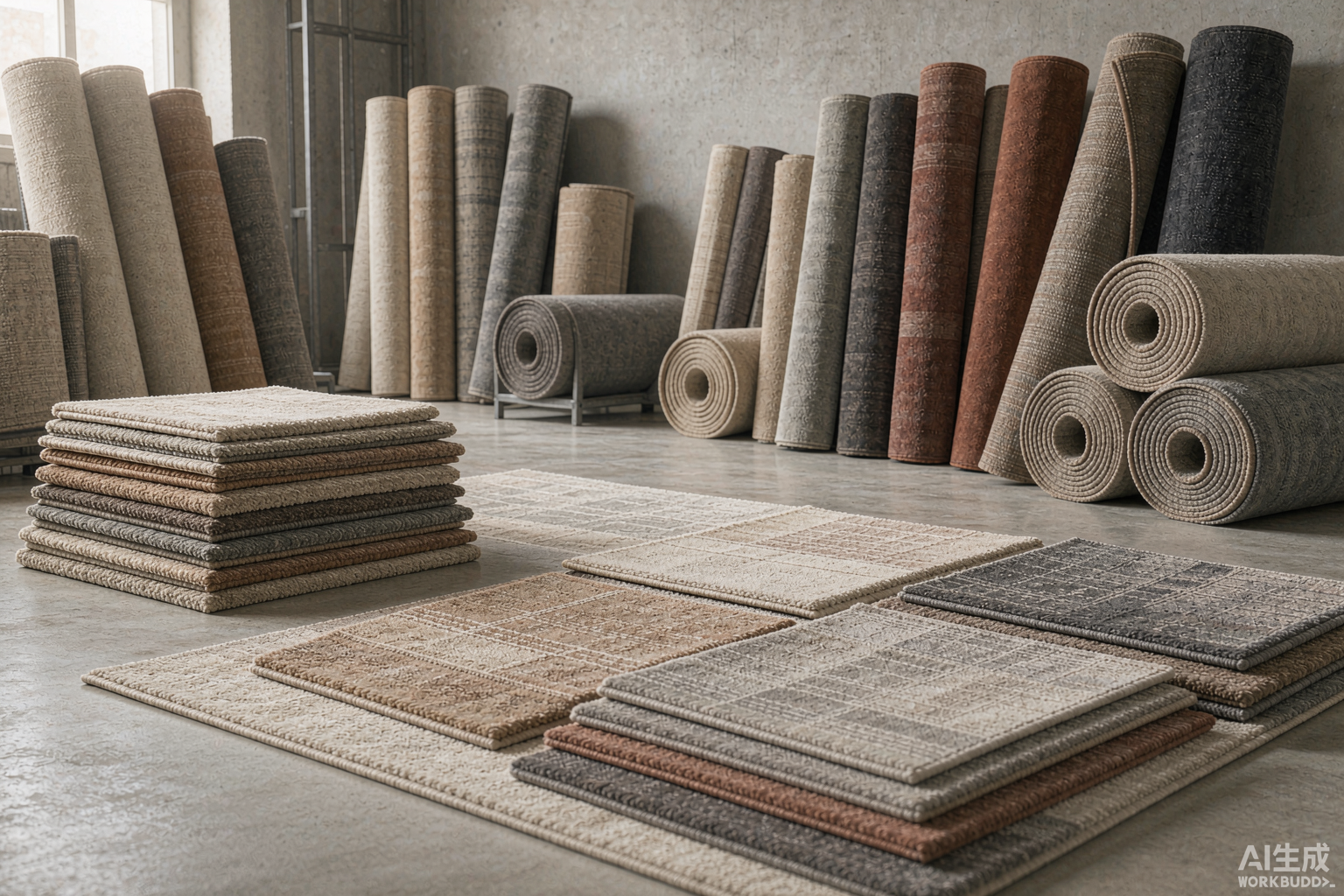
Carpets and rugs are not a single product line. Start by separating the constructions. First, tufted carpet - the industry workhorse, holding roughly 67.6% of the global market in 2025 per Mordor Intelligence, with high capacity, competitive cost and the broadest presence in residential and mid-range commercial projects. Second, woven carpet - Wilton and Axminster structures, prized for pattern precision and dimensional stability, the backbone of premium hotels and ballrooms; woven formats account for around half of the global market in some industry calibers. Third, needle-punched felt - the cost-efficient choice for exhibitions and short-cycle office installations. Fourth, carpet tiles - modular, locally replaceable and shipped flat, the default for offices and education spaces. Fifth, broadloom - the standard solution for hotel guest corridors. Sixth, area rugs, bath rugs and outdoor rugs - the volume drivers of e-commerce and retail.
Fiber selection layers on top. Polypropylene (PP) is inexpensive and stain-tolerant with modest resilience, suited to high-traffic public zones. Nylon (PA) delivers the best abrasion and resilience and remains the first choice for commercial contracts. Polyester (PET) offers strong color fastness and takes recycled rPET readily, making it a fixture on European and American sustainable procurement lists. Wool and wool blends serve premium hospitality and design-led projects, while jute, sisal and cotton carry the natural-look and value retail lines. On the supply side, China's manufacturing base is substantial: industry statistics put China at roughly 38% of global carpet capacity (about 1.22 billion square meters), reinforced by upstream polyester and PP filament yarn and latex-backing supply chains - the practical advantages being lead time and modification flexibility.
3. Hospitality and Contract Buying: Five Performance Specs to Write Into the Contract
Commercial acceptance logic differs completely from retail, and the following five items deserve a place in the purchase contract itself. One, fire classification: EN 13501-1 Cfl-s1 or better in Europe, and ASTM E648 Class 1 radiant panel performance in North America - a hard gate at handover. Two, acoustic performance: one of carpet's core selling points, tracked via NRC (noise reduction coefficient) and impact-sound improvement - critical in open-plan offices and guest-room corridors. Three, wear and usage classification: follow EN 1307 commercial use classes (such as Class 23/33/34) matched to foot traffic per zone. Four, indoor air and chemical compliance: low VOC and Green Label type certifications plus REACH SVHC screening are the passport to European public tenders. Five, antistatic and soil/stain protection, indispensable for hotel rooms and technical areas. Just as with curtain fabrics, color fastness and batch-to-batch consistency remain the invisible risk in multi-month projects - a follow-up batch drifting from the first approval is one of the most common causes of claims in hotel renovation programs. On sustainability, recycled fiber share, recyclable backing and readiness for a digital product passport (DPP) are moving from bonus points to screening criteria for European buyers.
4. The October 2026 Ocean Freight and Port Situation: Carpet's Freight and Container Math
Carpet is classic measurement-sensitive cargo - freight and stowage efficiency decide the landed cost. As of 1 October 2026, Drewry's World Container Index composite stood at USD 4,434 per 40ft container, down 1% week on week; Shanghai-Rotterdam was at USD 3,399 and Shanghai-Genoa at USD 3,702, with Asia-Europe spot rates falling for twelve consecutive weeks. Transpacific held firmer: Shanghai-New York at USD 10,428 (+1%) and Shanghai-Los Angeles at USD 7,835. The direct driver of the slide is the phased return to the Suez Canal: Drewry data show containership transits through Suez in week 39 up 68% year on year, with canal backhaul utilization rising from about 30% in September to a projected 40% in October. Hapag-Lloyd has announced a staged resumption of its Asia-Mediterranean services via Suez between October and December; Premier Alliance's FE1 Asia-North Europe loop returns with the first vessel ONE Continuity (about 8,100 TEU) expected through the canal on 9 November and in Rotterdam on 19 November, with three more vessels following in November-December; Maersk has restored roughly one-third of its normal Suez transit volume. Each service moving from the Cape of Good Hope back to the canal shortens round voyages and releases effective capacity, keeping downward pressure on Asia-Europe rates - a clear price window for buyers with carpet restocking plans in the first half of 2027.
The risk side needs equal attention. Transits through the Strait of Hormuz remain heavily constrained after more than two hundred days of disruption, with commercial vessels per day far below pre-crisis norms and Maersk applying a USD 1,000-per-container restriction fee for that area. Red Sea war-risk premia are still running at 0.3%-1% of vessel value, with some high-risk voyages quoted higher, and the situation along the Yemeni coast was still fluctuating in early October as control of coastal areas changed hands repeatedly - the insurance market remains cautious about a full normalization of Red Sea transits. Meanwhile the Panama Canal has announced more daily slots and a deeper draft, and congestion at major Asian ports - driven by record cargo volumes, typhoon backlogs and Golden Week blank sailings - is expected by industry observers to persist into 2027. Translated into carpet buying, three actions follow. First, index freight clauses to a public benchmark (WCI or FBX) with an agreed adjustment trigger. Second, prefer carpet tiles and flat-pack formats over wide-good broadloom rolls where the specification allows - loading efficiency on the same volume can materially improve, and the effective utilization of a 40HQ directly rewrites the ocean cost per square meter. Third, consolidate carpet rolls with roller blind fabric, sheer curtain and sofa fabric in mixed soft-furnishing containers to share freight and cut waiting time across suppliers.
5. Eight Sourcing and Buying Recommendations for Overseas Buyers
Combining the new 2027 fair calendar with the current logistics picture, we recommend the following checklist for carpet and rug procurement:
- Rebuild the 2027 sourcing calendar. Reallocate the January Hannover itinerary to DOMOTEX asia in Shanghai, DOMOTEX South East Asia in Bangkok (November) and R+T Stuttgart (15-19 February 2027), then reconverge in Hannover on 17-20 January 2028 - book hotels and flights early.
- Fix the construction by scenario before negotiating price. Woven or high-class tufted broadloom for hotel corridors, carpet tiles for offices, area rugs for retail and e-commerce; write the usage class (e.g. Class 33/34) into the inquiry so value tufted product cannot pass itself off as contract grade.
- Put fiber and recycled content into the specification sheet. List PP/PA/PET/wool ratios, recycled rPET share and backing type item by item, and confirm REACH and low-VOC requirements for European projects at the same time.
- Verify the five contract specs one by one. Fire classification, acoustic data, wear classification, antistatic and soil protection - ask for original third-party test reports, not photocopies.
- Run small batches and bulk in parallel. Manage patterned area rugs on a "first small drop plus reorder on winners" rhythm, and lock container lead times with batch color-difference tolerances for contract programs.
- Use the current rate window to lock contract prices. Twelve straight weeks of falling Asia-Europe rates plus Suez-released capacity make a favorable setting for index-linked contracts covering the first half of 2027, ahead of carriers' second-half FAK increase attempts.
- Design the container plan before ordering. Flat-stack carpet tiles, pre-set lengths for broadloom rolls, calculate loading efficiency first, and consolidate with curtain and blind fabrics to raise utilization.
- Treat DPP readiness and recyclability as the 2027 entry ticket. Request composition traceability and end-of-life documentation now; thresholds in European public and commercial tenders are rising fast.
6. Wanbo's One-Stop Soft-Furnishing Fabric Program
Shaoxing Wanbo is rooted in the Keqiao fabric industrial belt and has long served the Middle East, Europe, Australia and Southeast Asia with roller blind fabrics, curtain and sheer materials, sofa upholstery fabrics and home textile fabrics, and can coordinate integrated supply of carpet and rug programs through partner mills: blackout coated roller blind fabric, sheers, jacquard and woven fabrics can be consolidated with carpets and rugs in mixed containers, letting one container carry the complete soft-furnishing requirement of a project. Wanbo supports small-batch sampling, bulk production follow-up, third-party inspection and trilingual (Chinese-English-Arabic) merchandising service - helping overseas buyers turn the 2027 fair and freight windows into orders faster. Contact us for sample books and the latest quotations. Note that prices and shipping conditions change daily; the figures in this article are for structural understanding and do not replace a same-day quotation.