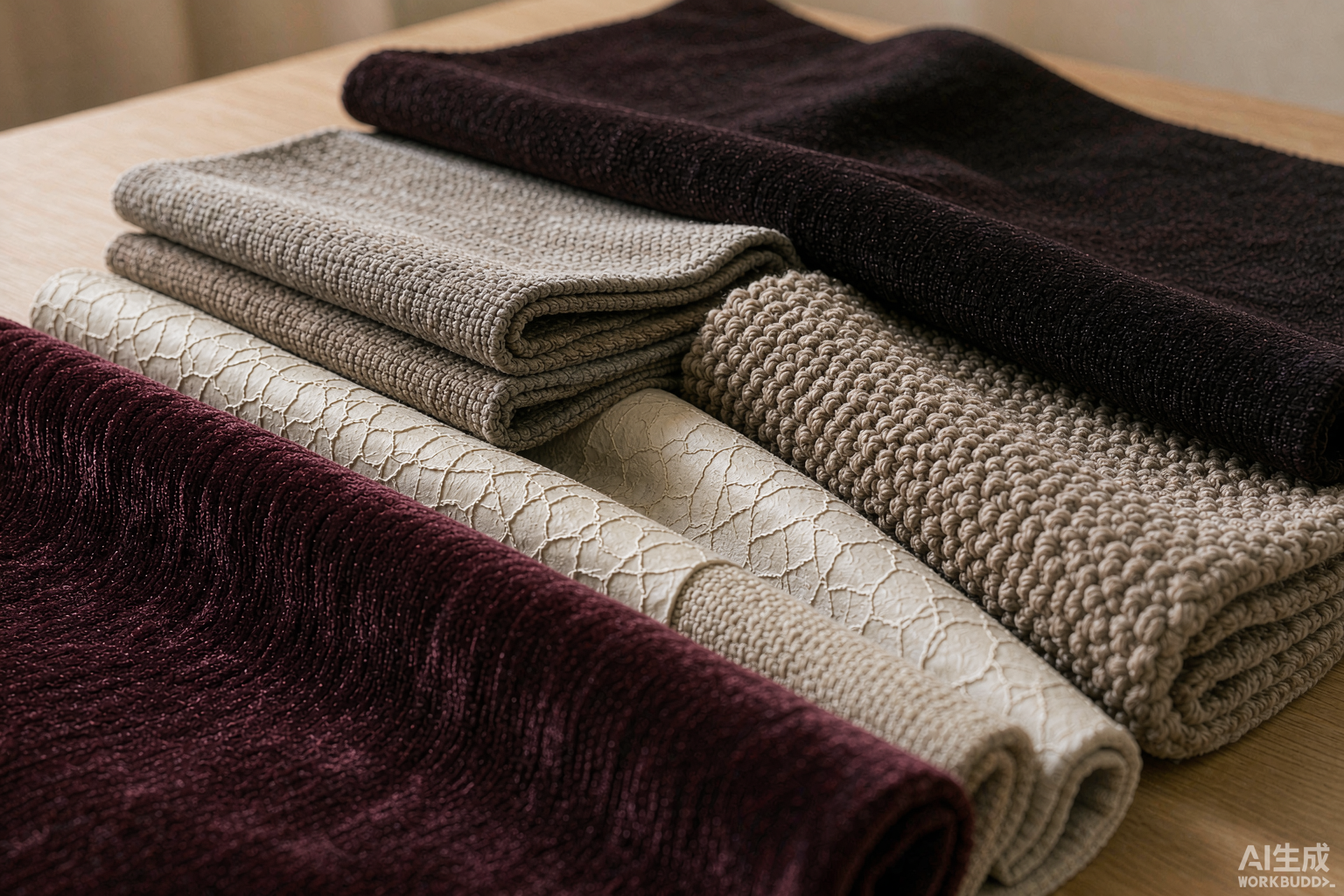
Texture is the No.1 AW 26/27 trend: short-dense-pile chenille, ice-crack emboss, modern jacquard and high-shrinkage weaves. Plus the Sept 2026 US-China 30-for-30 tariff list restoring MFN rates on 20+ home-textile lines - trends, testing thresholds and ordering strategy.
Autumn/Winter 2026–27 is delivering a quiet texture revolution across home textiles: from the Heimtextil Trends 26/27 forecast to upholstery-buyer feedback in Europe and North America, one signal keeps repeating — the market is moving away from flat, uniform surfaces toward dimensional, tactile, craft-feeling weaves. Chenille is making a strong return, velvet has shifted into deep jewel tones, jacquards are turning architectural, and “natural look plus performance” has become the double gate for sampling. For Chinese exporters there is now a bigger catalyst: on 27–28 September 2026, China and the United States simultaneously announced a “USD 30 billion for USD 30 billion” reciprocal tariff-reduction list, and more than 20 home-textile lines — curtains, bedding, table linen, pillows and cushions among them — are included on the US side. Texture upgrade plus tariff dividend equals a window for overseas buyers to restock and refresh assortments. This article unpacks the trends, the testing thresholds and the buying actions.
1. The AW 26/27 Texture Story: Three Directions
According to European upholstery-trend houses and industry media (the Mobus Fabrics A/W trend pack, Home Textiles Today and others), this season's texture wave moves along three axes. “Warmth reimagined”: rounded sofas, curved accent chairs and oversized cushions create cocooning spaces, lifting demand for soft fabrics with subtle lustre gradients. “Future craft”: slub yarns, irregular woven effects and matte-shine interplay turn handmade texture into a modern, architectural aesthetic. “Chromatic revival”: velvet moves into oxblood, mulberry, petrol teal and olive-green jewel territory. Industry observers broadly agree that chenille is one of the most important furniture fabrics of the season, that slub texture and heavy-weave constructions are strengthening, and that while bouclé remains popular its dominance is fading in favour of a wider variety of surfaces. On colour, warm grey, moss green, deep wine, warm sand and misty blue form the core palette, with two-tone yarns and melange effects gaining momentum.
2. The Fabric Family Map: Turning Trends into SKUs
- Chenille. Short, dense pile with a matte sheen defines the season. Sofa-fabric abrasion requirements have risen from the traditional 15,000 Martindale cycles to above 30,000; on the curtain side, drape and a blackout rate above 90% are the selling points, achieved through added weight and double-layer construction. Quality chenille yarn costs 15–25% more than ordinary yarn, so vet mills on pile height (1.5–3 mm) and shedding control (compact spinning plus light brushing and air-washing).
- Ice-crack (crackle) and embossed texture fabrics. Finishing creates an ice-crack relief on the surface; combined with matte coating it delivers both “texture” and “easy care”, a differentiator for roller blinds and contract curtains. Key tests: embossing durability (texture retention after repeated roll cycling) and coating adhesion.
- Jacquard and high-shrinkage yarns. This season's jacquards favour small geometrics with tonal layering rather than large florals; high-shrinkage fibres create bubble and relief effects — coordinate them with shrinkage specifications carefully, or finished dimensions will drift.
- Coated and woven fabrics. Coated blackout remains the functional baseline; matte low-sheen coatings fit the season's aesthetic best. Base cloths are predominantly fine-count wovens — write weight, blackout rate and hand-feel into the specification together.
3. The Hard Numbers: How European and American Buyers Test
Testing of textured fabrics is converging on a standard: upholstery at Martindale ≥30,000 cycles, pilling ≥ grade 4, colour fastness ≥ grade 4; curtains judged on weight (chenille curtains ≥280–320 g/m²), drape coefficient and wrinkle recovery; pile fabrics supplied with measured pile height, pile weight and fibre composition; and a 3–5% shrinkage allowance written into the contract. On compliance, recycled content (GRS), PFC-free water repellency and low-VOC dyes are becoming trend-level thresholds in Western channels, with OEKO-TEX Standard 100 as the retail baseline — putting those three certificates into your quotation measurably changes enquiry conversion.
4. The News Hook: The US “30-for-30” Tariff Dividend for Home Textiles
This is the most consequential home-textile export story of the past three months. According to announcements by China's Ministry of Commerce and the White House on 27–28 September 2026, the two countries agreed a reciprocal tariff-reduction framework of roughly USD 30 billion each, under the Trade Council mechanism. The US list covers 77 HTSUS codes, of which more than 20 are home-textile lines — blankets, bedding, table linen, kitchen and bathroom textiles, curtains, wall hangings, home decorations, sleeping bags, pillows and cushions — concentrated in Chapter 63 “Other made-up textile articles”. Over 90% of listed products will have the previously imposed additional tariffs removed and return to most-favoured-nation rates. Industry analysis notes that home-textile tariffs to the US had been running at roughly 7.3–19% (versus 34–45% for apparel), so the direct cost relief for curtain, bedding and decorative-fabric exports is substantial. Three cautions: first, apparel (Chapters 61/62) and cotton products are not included — the benefit covers only the listed codes. Second, the arrangement is at the announcement stage; the tariff-suspension measures are extended to 10 January 2027, and implementation depends on both sides' domestic legal procedures — have your customs broker verify code by code. Third, per China's General Administration of Customs, textile and apparel exports reached USD 203.31 billion in the first eight months of 2026, up 3.1% year on year, with August apparel exports up 12.3%; US wholesale and retail inventories remain low. Restocking demand plus tariff expectations create a genuine window to push curtain, blackout and decorative fabrics.
5. An Action List for Overseas Buyers
- Rebuild your selection matrix on two axes — texture and performance: fix abrasion and fastness grades first, then choose texture among fabrics already above the pass line.
- Shortlist weighted double-layer chenille curtains (90% blackout) and short-dense-pile sofa fabrics for spring 2027, and use the tariff window to lock price and volume early.
- For ice-crack/embossed fabrics, request roll-cycling durability and coating-adhesion reports before cutting, to avoid post-launch failures.
- Require GRS, OEKO-TEX and PFC-free evidence from suppliers, and check whether your US HTSUS codes fall inside the reduction list.
- On freight: Q4 Asia–Europe spot rates are easing as Suez transits resume, but schedule reliability remains low and transpacific rates stay elevated — book peak-season orders three to four weeks ahead. Rates and conditions change daily; use this as structural context, not as a substitute for a live quotation.
6. From Sampling to Mass Production: Making the Trend Survive the Supply Chain
Sampling textured fabrics is an order of magnitude harder than sampling plains: small changes in pile height, pile direction, twist, loom tension and finishing temperature all alter the surface effect, so “sample from a picture” is almost guaranteed to fail. The reliable workflow has four steps. Step one: 30–50 cm construction swatches to fix the texture direction. Step two: one-to-two-metre dyed lengths matched to your Pantone references, checked under dual light sources for metamerism. Step three: a 100–300-metre pilot run put through the full cutting, sewing and roll-cycling process, with feedback from the plant that will actually make the finished goods. Step four: a locked process card — yarn count, density, weight, pile height, setting temperature, finish recipe — with agreed tolerances, before mass production starts. Sealed physical samples at every step are the only hard currency that settles “goods not as approved” disputes.
Three high-frequency buying mistakes deserve a flag. First, equating heavy weight with high quality: weight drives drape and opacity, while abrasion and pilling are decided by yarn and construction. Second, inspecting only the centre of the width and ignoring the outer 10 centimetres — edge fade on embossed and coated fabrics is a classic bulk-return cause. Third, ignoring pile direction: chenille and velvet must be cut consistently in one direction, or a single sofa will show two-tone shading. None of these details appears on a quotation sheet, yet they decide your end-customer complaint rate.
On the commercial side, the tariff window rewards preparation. Map your current curtain, bedding and decorative-fabric SKUs against the published HTSUS codes now, while the list is still at the announcement stage: for codes that qualify, model the landed-cost delta against the 7.3–19% tariff range the industry has been carrying, and decide how much flows into margin versus price competitiveness. For codes that do not qualify — apparel in Chapters 61/62, cotton products, most synthetic-fibre and grey-fabric lines — nothing changes, so do not reposition your assortment on speculation. Timing matters as well: the suspension framework runs to 10 January 2027 and implementation awaits both governments' legal procedures, so the practical play is to place spring 2027 orders with tariff-adjusted pricing clauses — for example, a stated price revision if and when the reduction takes effect for your HS code. Add the restocking signal — US textile and apparel imports from China up 3.1% for the first eight months of 2026, August apparel exports up 12.3%, low wholesale inventory-to-sales ratios — and the case for locking spring volume early becomes straightforward.
Freight timing completes the plan. Q4 2026 Asia–Europe spot rates are easing as more carriers return to Suez routing, but schedule reliability remains near multi-year lows and North European ports still carry a congestion premium; transpacific rates stay elevated under blank-sailing discipline into the post-Golden-Week lull. Book three to four weeks ahead for peak-season programmes, keep a Cape-routed backup option for time-critical curtain lines, and fix free-time, demurrage and detention responsibility in the sales contract rather than leaving it to the destination agent. Rates and conditions change daily; treat this as structural context, not a substitute for a live quotation.
7. Wanbo: Turning Trends into Orderable Products
Wanbo, a source factory in Keqiao, Shaoxing, has long supplied overseas wholesalers, furniture manufacturers and finished-blind makers with a full fabric range: sofa upholstery, carpet backing and rug fabrics, sheers, roller-blind and curtain fabrics, ice-crack textured weaves, jacquards, high-shrinkage constructions, coated blackout and fine wovens. We support OEM customisation of patterns, weights and functional finishes, backed by sampling, third-party testing, and LCL or FCL shipment. The opportunity in the texture revolution lies not in chasing hype but in translating trend language into stable mass-production specifications — exactly what a source factory is for. Contact us for the AW 26/27 texture sample book, digital colour cards and current quotations, or arrange a video or on-site factory audit.