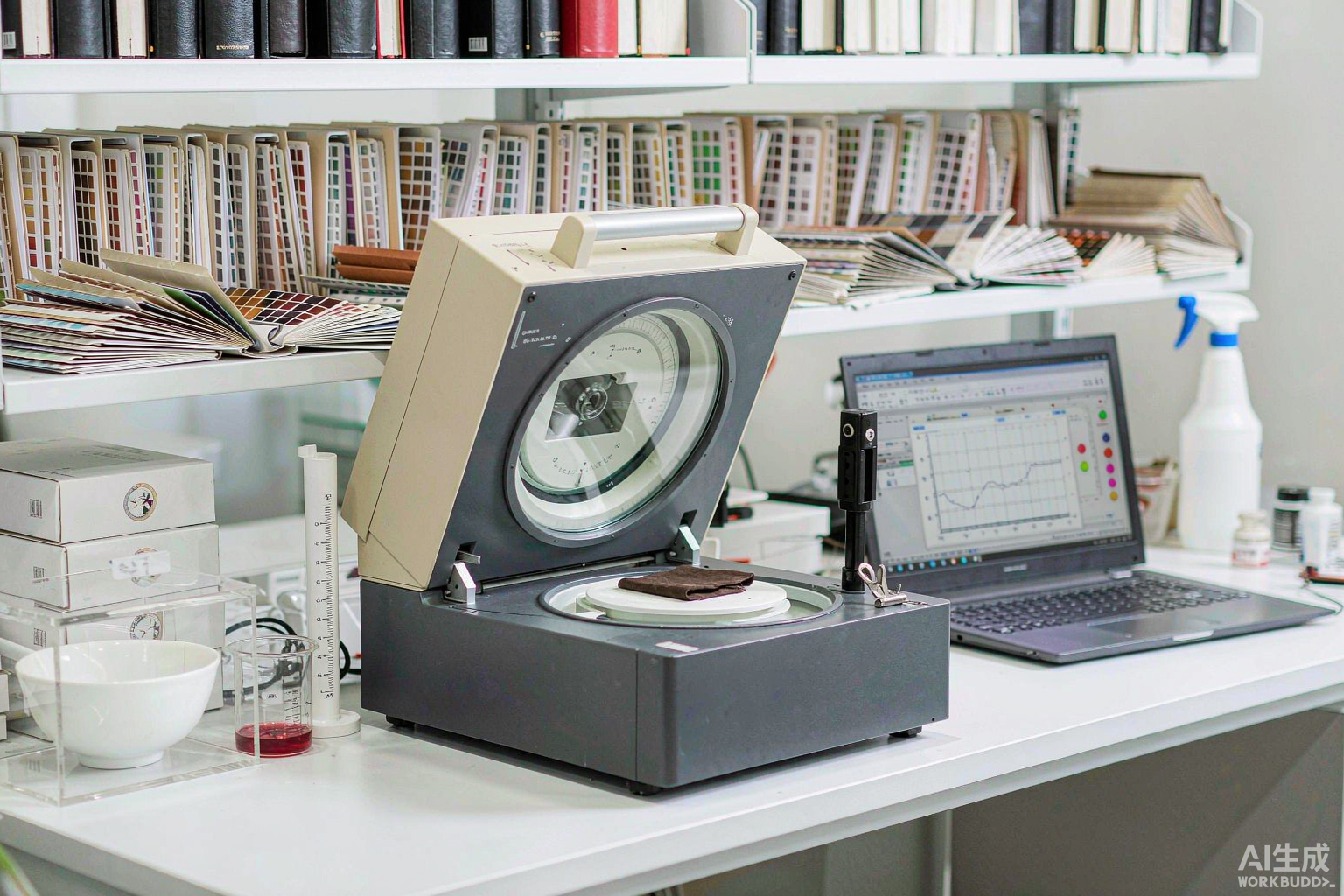
Ocean rates are falling but the time cost of shipping samples has not dropped a day. Spectrophotometers, digital shade approval and barcode/RFID sample libraries cut sampling rounds from 2-4 to 1-2 - with an eight-point supplier evaluation checklist for overseas buyers and a 90-day supplier roadmap.
In the entire fabric procurement chain, the slowest and most dispute-prone stage is not production - it is sampling and color approval. Overseas buyers know the routine: wait a week for international courier each time a sample ships, judge color differences by eye under whatever light source happens to be in the room, spend two or three weeks on a single lab-dip round trip, and go through two to four repeat sampling rounds before bulk color is finally approved. And in the current window of steadily falling ocean rates - Drewry's World Container Index (WCI) composite stood at $4,434 per 40ft container on 1 October, down 1%, with Asia-Europe spot rates declining for a twelfth consecutive week - freight is getting cheaper, but the time cost of shipping samples has not fallen by a single day. That is exactly where digital color card and sample management technology earns its keep: leading solutions claim lab dips can be approved right the first time up to 95% of the time, with time-to-market accelerated by 75%.
1. Why the Traditional Sampling Chain Is Slow
From the customer's confirmed color to bulk dyeing, the traditional route for a roller blind fabric runs roughly like this: the buyer provides a color standard or physical swatch - the dye house strikes a lab dip - international courier ships it (3-7 days) - the buyer judges it visually under assorted light sources - feedback goes back - a new lab dip is struck - and it ships again. The weakest link in this loop is the subjectivity of color judgment. The same fabric can present three different appearances under D65 daylight, TL84 European commercial light and CWF American cool-white fluorescent. Colorimetrists call this metamerism: two fabrics that look identical in the office can look like different colors in sunlight. Without quantified data, buyer and supplier can only argue back and forth - and every extra sample shipment burns real money in courier fees and days on the calendar.
2. The Digital Trio: Turning Color into Data
Tool one: the spectrophotometer. Benchtop and portable instruments from X-Rite, Datacolor, Konica Minolta and HunterLab are standard equipment in dye houses worldwide. They measure the fabric's reflectance spectrum and output a quantified color difference, Delta E - turning "does it look right" into "by how much is it off". For fabrics containing optical brightening agents (OBA), models with UV control (such as the benchtop Ci7800 and CM-36dG, or the portable CM-26dG) can exclude or calibrate the UV component, preventing whitener-driven reading drift between instruments. For flat goods like roller blind fabric, imaging instruments with apertures as small as 2mm can also handle small color chips and multicolor jacquard samples.
Tool two: digital color standards and remote shade approval. Digital color platforms such as X-Rite's Textile Color Hub let brands and dye houses exchange spectral data, tolerances and illuminant settings directly, evaluating lab dips without any physical sample traveling between them. The vendor's published figures: up to 95% of lab dips right on the first attempt, 75% faster time to market, zero physical samples shipped, and a significantly reduced carbon footprint. Digital color cards can be linked into PLM systems as digital standards, support industry-standard exchange formats such as .qtx and .adx, and pair with 3D virtual-material tools (such as PANTORA) to render fabric appearance.
Tool three: barcode- and RFID-managed sample libraries. Every color chip and archived roll gets a unique ID: one scan reveals the batch, dye-lot number, weight, composition, process parameters and customer it belongs to. The value shows up in three scenarios immediately - when a customer reorders, the historical batch recipe can be recalled precisely, eliminating "repeat-order shade drift"; in quality tracing, the problem dye lot or yarn batch can be located in minutes; and on the sales side, electronic catalogs let buyers view samples online with zoomed fabric texture detail, cutting pointless physical sample shipments.
3. What This Means for Overseas Buyers
Drop the trio into a procurement workflow and the payoff shows up in four numbers: sampling rounds fall from 2-4 to 1-2; each avoided courier round saves 3-7 days and tens to hundreds of dollars in freight; shade disputes shift from "my word against yours" to "the contract's agreed Delta E tolerance and measurement conditions decide"; and repeat-order consistency is underwritten by an archived-sample database rather than a salesperson's memory. In other words, a supplier who manages digital color well simply delivers with more certainty - and in peak seasons with tight vessel space and lead-time-sensitive markets, that certainty is worth real money.
4. An Eight-Point Supplier Evaluation Checklist for Overseas Buyers
When assessing a fabric supplier's digital sampling capability - especially roller blind, curtain, sofa upholstery and carpet fabric mills - work through the following list item by item:
- Does the lab run both a benchtop and a portable spectrophotometer, with regular inter-instrument agreement calibration, so the Delta E data you receive speaks the same language as the factory's laboratory?
- Is shade judging done in a standard light booth across multiple illuminants (at minimum D65, TL84, CWF and A), and can the supplier produce metamerism assessment records? A sample that passes under a single light source will reliably trigger reorder disputes.
- Does the supplier support digital color standards and spectral data exchange (.qtx, .adx and similar formats), and can digital standards replace some physical sample shipments to compress the approval cycle?
- Is the sample library barcode- or RFID-traceable, capable of retrieving any batch's dye-lot number, recipe and archived sample within minutes? This is the physical guarantee of repeat-order consistency.
- Are electronic catalogs and high-resolution video sampling offered, including fabric texture, drape and light-transmission demonstrations, to reduce shipment frequency in small-lot, multi-batch scenarios?
- Is there a written sampling lead-time commitment (for example lab dips in 5-7 working days, strike-offs in 7-10 working days), with defined compensation or expedite mechanisms for delays?
- Is a shade tolerance written into the contract - an agreed Delta E ceiling (a specific value under, say, the CMC 2:1 convention), the instrument model and the test conditions - so color acceptance rests on data rather than on dueling opinions?
- How is bulk-to-approval consistency closed-loop: is there a first-batch verification with archived counter samples, a bulk-versus-approval comparison procedure, and numbered archiving of retention samples?
5. Boundaries and Practical Reminders
Digital color approval is not a universal key. Two boundaries deserve respect. First, color can be digitized, but feel cannot - a fabric's hand, drape, pile direction and coating sheen still require physical confirmation, and the counter-sample stage before bulk production must not be skipped. Second, digital systems carry an implementation threshold for small and mid-sized dye houses: instrument calibration, staff training and data management all demand investment, so beyond the checklist, buyers should weigh a supplier's execution record and willingness to keep investing. The pragmatic pattern is a dual track: use digital shade approval to speed up routine lab dips and revisions, while keeping physical counter samples at the critical gates of first orders and reorders.
6. Three Buyer Types, Three Value Scenarios
The payoff of digital sampling differs by buyer type. Wholesalers and brands care most about repeat-order consistency: once a season's key color is fixed, every replenishment batch over the following months must match seamlessly - a barcode-indexed retention library with a historical recipe database lets them put an equals sign between batch five and batch one. E-commerce sellers care most about test-and-learn speed: small lots, frequent changeovers and rapid listings are the rhythm of that business, and electronic catalogs plus digital shade approval compress the "select color - sample - list" cycle from monthly to weekly, so testing two extra versions of a color family no longer feels like burning courier fees. Project and contract buyers care most about acceptance evidence: for bulk batches delivered across several months, a contract-stipulated Delta E tolerance and measurement conditions become the arbitration standard, with retention samples available for re-testing at any time - more reliable than any verbal promise, and a detail that quietly strengthens tender documents.
7. A 90-Day Implementation Roadmap on the Supplier Side
For fabric mills that want to close this capability gap, the rollout can be staged in three steps over roughly 90 days:
- Days 1-30: unify the measurement language. Install a benchtop spectrophotometer and a standard light booth, calibrate inter-instrument agreement, and write down an internal Delta E tolerance standard with defined measurement conditions - so that "approved" has a written definition for the first time.
- Days 31-60: turn samples into assets. Roll out barcode/RFID archiving of retention samples, and enter historical batch recipes, dye-lot numbers and customer color codes into a database, so recalling a reorder moves from flipping paper records to scanning a code.
- Days 61-90: go live on digital collaboration. Publish the electronic catalog, open .qtx/.adx digital color standard exchange, run digital shade approval in trial with two or three core customers, and pull the sampling-round data against the pre-project baseline.
Now lay this timeline against the Q4 2026 shipping rhythm: the industry's standard advice is to book vessels three to four weeks ahead to lock space. If color approval still takes three or four weeks, buyers are forced to either squeeze their stocking window or pile up inventory early and tie up cash. But once sampling and shade approval shrink to roughly a week, the "book the vessel first, fix the color later" sequence becomes viable - the color decision moves to the last responsible moment, and digitalization converts directly into inventory flexibility and working-capital relief.
Closing: Turn Sampling Time into a Competitive Chip
With freight rates falling and vessel space loosening as the base-case expectation from Q4 2026 into 2027, the lead-time competition is shifting from the sea to the shore: whoever compresses sampling and approval by more than 50% controls the replenishment rhythm. Digital color cards, spectrophotometry and barcode-based sample libraries are the key infrastructure that turns "waiting for samples" into "reading data". Wanbo is rooted in Shaoxing Keqiao, one of China's largest textile trading hubs, with a product line covering roller blind fabric, curtain fabric, sheer, sofa upholstery fabric and carpet fabric, and long experience serving overseas buyers on sampling, shade approval and small-batch customization - including electronic catalog viewing, quantified color-difference management and retention-sample traceability. If your procurement calendar is still being stretched by courier round trips, send us your color standards and tolerance requirements and test the difference with one round of digital sampling.
Note: freight figures above quote Drewry's World Container Index (WCI) reading of 1 October 2026; sampling-efficiency figures are from X-Rite's published solution claims. Rates and market conditions change daily - this article explains structure and selection logic and does not replace same-day quotations or physical test results.