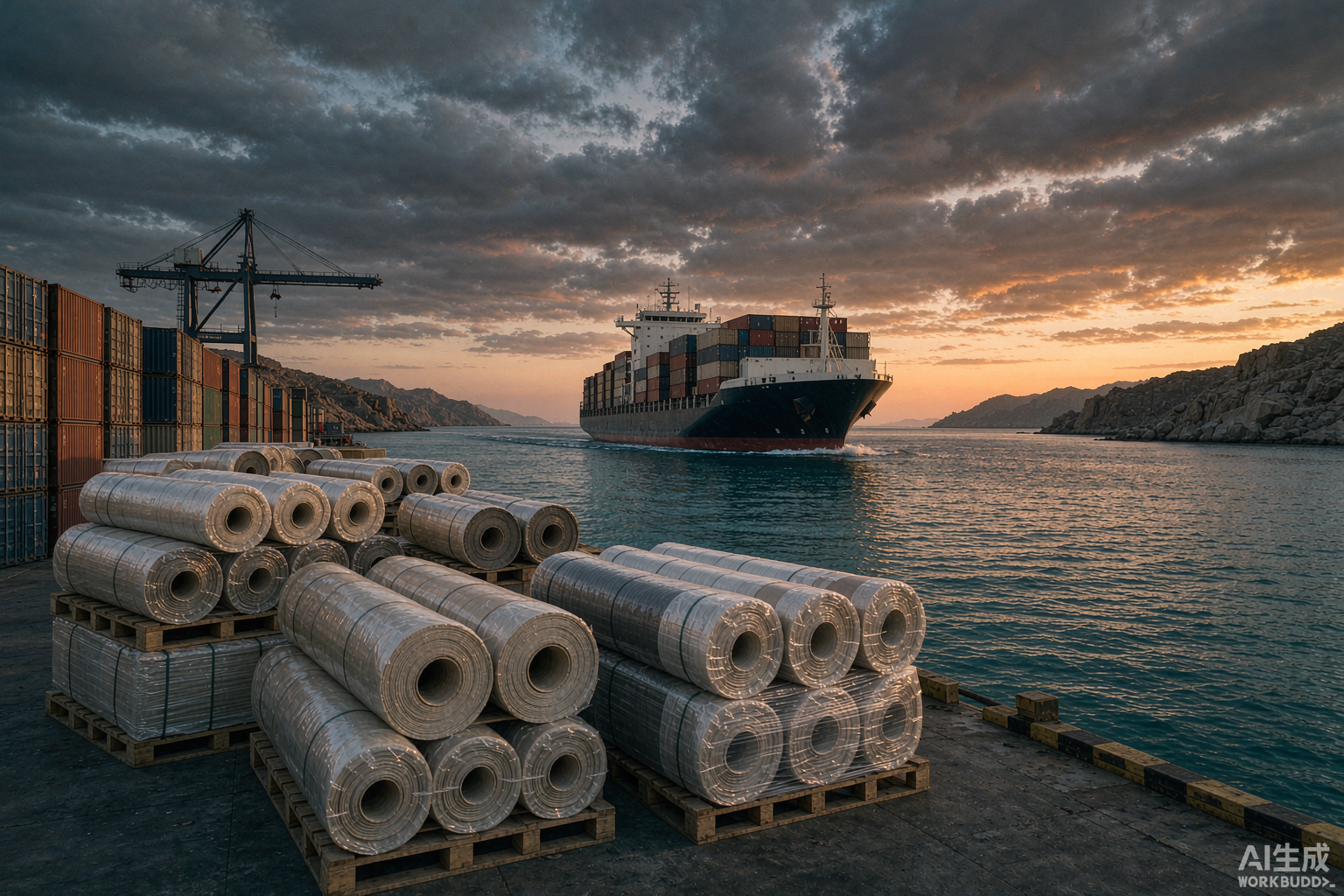
Roughly 80 attacks verified in the Strait of Hormuz in 2026; Maersk and CMA CGM add four-figure surcharges, while the IMO Net-Zero Framework heads to a December vote. Eight practical moves for fabric exporters rebuilding their Q4 freight math.
The ocean freight market entering the fourth quarter of 2026 is being reshaped by two storylines at once. The first is the deteriorating security situation around the Strait of Hormuz, which has pushed Middle East surcharges to record levels. The second is the reopening of the adoption window for the International Maritime Organization's Net-Zero Framework, which could put the first-ever global price on shipping greenhouse gas emissions. For roller shade, curtain, sheer and upholstery fabric exporters — and for the overseas importers who buy from them — that means every Q4 shipment needs its freight math rebuilt from scratch: base rates are falling, surcharges are rising, and carbon costs are moving from theory toward invoice.
1. Hormuz: the second "war-risk chokepoint" after the Red Sea
After the Red Sea crisis, the industry's attention shifted in 2026 to the Strait of Hormuz. According to notifications referenced by the International Maritime Organization, roughly 80 attacks against commercial vessels have been verified in the strait and its surrounding waters since the Middle East escalation began on 28 February. Between 8 and 12 September alone, five vessels were damaged in incidents in the strait and in waters near Oman, the United Arab Emirates and Iraq. On 29 September, the UK Maritime Trade Operations (UKMTO) reported that a very large tanker was struck by an unidentified projectile roughly 31 kilometres east of Khasab in Omani waters, starting a fire that the crew extinguished before continuing the voyage. Rhetoric in the region has hardened in parallel, and the tension is now written directly into carrier tariffs and booking systems.
For fabric traders the impact is concrete. Maersk has suspended reefer bookings to and from Iraq, Kuwait, Qatar, Bahrain, Saudi Arabia, Jordan and most of the UAE. Cargo accepted for local consignees in Jeddah carries an emergency freight cost of USD 3,800 on top of the normal rate. Landbridge routings through Salalah, Khor Fakkan, Fujairah and Aqaba are substituting for a growing list of Upper Gulf ports that can no longer be booked direct. Importers of window-covering fabrics into the Gulf should assume that transit reliability, not price, is now the binding constraint on this lane.
2. The surcharge stack: reading the risk price on your invoice
Between late September and mid-October 2026, carriers filed a dense wave of new charges. In its operational update of 17 September, Maersk introduced an emergency surcharge for cargo to or from ports in Iraq, Kuwait, Saudi Arabia, Bahrain, Qatar, the UAE (excluding Salalah) and neighbouring markets: USD 1,800 per 20ft dry container, USD 3,000 per 40ft, and USD 3,800 for reefer, special equipment and dangerous goods. An additional USD 1,000 per container applies to vessels transiting the Strait of Hormuz, explicitly to cover higher war-risk insurance premiums and crew risk compensation. CMA CGM raised its Emergency Fuel Surcharge with effect from 1 October 2026: USD 265 per TEU for dry head-haul cargo and USD 320 per TEU for reefer on mainline trades, with return and intra-regional moves at USD 75 and USD 90 respectively — an increase of more than USD 100 per TEU over the previous level, effectively a fuel-side pass-through of the Hormuz risk premium.
Africa lanes are also repricing. Maersk's peak season surcharge from Far East Asia to South Africa and Mauritius, effective 15 October 2026, is USD 250 per 20ft and USD 500 per 40ft. CMA CGM filed USD 600 per TEU from North and Central China to Dar es Salaam and USD 800 per TEU to Mombasa (USD 550 and USD 800 from South China), also effective 15 October. At the destination end, congestion is compounding the cost: Durban's average port call time has stayed above seven days for three consecutive weeks, Richards Bay is worse at more than nine days, and Cape Town waiting time rose 69 percent to over two days. South African industry bodies report more than 96 vessels at anchorage, with direct sunken costs near R98 million per day. The practical lesson for exporters: promise delivery dates based on anchorage waiting and customs dwell, not the theoretical port-to-port itinerary.
3. Base rates keep falling: the counter-current of the Suez return
The striking counter-current is that benchmark spot rates continue to fall. The Drewry World Container Index stood at USD 4,434 per 40ft container on 1 October 2026, down 1 percent week on week. Shanghai–Rotterdam slipped 2 percent to USD 3,399 and Shanghai–Genoa 3 percent to USD 3,702 — the twelfth consecutive weekly decline on Asia–Europe. Transpacific rates, by contrast, remain firm: Shanghai–New York rose 1 percent to USD 10,428 while Shanghai–Los Angeles held at USD 7,835.
A key driver of the Asia–Europe decline is the steady return of services to the Suez Canal: week 39 transits were roughly 68 percent higher than the same week last year, adding effective capacity and pressing on spot rates. Carriers are simultaneously managing capacity through blank sailings — Drewry counted 58 announced blank sailings out of 712 scheduled East–West departures for the coming weeks, an 8 percent cancellation rate, with about two-thirds concentrated on the eastbound transpacific. For roller shade and solar screen fabric — a bulky, volume-rated cargo family — the softening Asia–Europe base is a genuine window to lock FAK contract rates for Q4 and early Q1. But never quote from the composite index: within the same headline number, Rotterdam and New York differ by nearly USD 7,000 per box. Every quotation must be rebuilt lane by lane, by equipment type and verified gross mass, with October's new fuel and congestion surcharges layered on top.
4. The IMO Net-Zero Framework: the second shoe of global carbon pricing
More structural than any surcharge is carbon pricing. The IMO Net-Zero Framework was approved in principle at MEPC 83 in April 2025 and rests on two pillars: a global Greenhouse Gas Fuel Intensity (GFI) standard requiring the well-to-wake GHG intensity of marine fuels to decline in phases, and a pricing-and-reward mechanism that penalises non-compliance while paying for zero- and near-zero-emission fuels. It applies to seagoing ships of 5,000 gross tonnage and above and, once adopted, will be incorporated into Annex VI of MARPOL.
Under the current draft, a ship that meets the looser "base target" but misses the stricter "direct target" must buy remedial units at USD 100 per tonne of CO2-equivalent; ships below even the base target pay USD 380 per tonne. Ships can also buy surplus units from over-compliant vessels. The extraordinary session of the Marine Environment Protection Committee adjourned for twelve months in October 2025 on a 57–49 vote, delaying adoption. At MEPC 84, held in London from 27 April to 1 May 2026, analysis by University College London's shipping research group found that a majority of member states had returned to backing the framework broadly as approved in 2025. The vote is expected to return at the end of 2026 — currently indicated for December, after the late-November intersessional working group — though the United States, Saudi Arabia, the UAE, Russia, Panama and Liberia remain openly opposed, and a two-thirds majority is far from guaranteed.
Unlike the regional EU Emissions Trading System and the FuelEU Maritime regulation, an adopted IMO framework would be global, raising fuel costs on every deep-sea leg rather than only on Europe-touching services. The direction of travel is not in doubt even if the timing is: China's maritime safety administration issued guidance in April 2026 targeting at least a 15 percent cut in the carbon intensity of international voyages by 2030 versus 2025, and green methanol bunkering is scaling up at Ningbo-Zhoushan, Shanghai and Guangzhou. Fabric exporters negotiating annual freight contracts should therefore assume a carbon line item in 2027 pricing, whatever happens at the December vote.
5. Q4 action list: write the risk into the quotation
- Rebuild the surcharge stack. Split every quote into base freight, fuel/EFS, war-risk and strait-transit charges, destination congestion and peak-season surcharges. Any single change should trigger a re-quote — never bury a blended all-in rate in the contract.
- Confirm insurance by actual routing. Most insurers issued Notices of Cancellation in March 2026 for designated high-risk areas in the Middle East and Red Sea. FOB buyers must verify that war-risk cover matches the route actually sailed — especially the Persian Gulf, Gulf of Oman, Hormuz, and Saudi Red Sea ports such as Jeddah, Yanbu and King Abdullah Port.
- Get the routing in writing, per direction. The same service string can now sail Suez one way and the Cape of Good Hope the other, with a seven-to-fourteen-day difference. Delivery commitments should follow the booking confirmation, not the timetable.
- Add a congestion factor to lead times. For Durban, Mombasa, Lagos and Chattogram, plan from measured anchorage waiting and customs dwell rather than nominal transit, and complete pre-clearance and duty readiness before berthing.
- Lock Asia–Europe FAK rates now. Twelve weeks of falling base rates plus returning Suez capacity make this the window to fix Q4/Q1 FAK pricing. On the transpacific, the opposite applies: watch for post-Golden-Week rate restoration announcements and space competition.
- Reserve a carbon clause in contracts. Whatever the December outcome, EU ETS and FuelEU surcharges are already real. Define with carriers and buyers how carbon-related surcharges are shared and what triggers them.
- Quote parallel routings. Give Gulf and Red Sea consignees three options — direct, landbridge transhipment and part-airfreight. For South and East Africa, bake the 15 October PSS into the comparison before booking.
- Use packaging and stowage as your hedge. Improving container utilisation and trimming VGM weight are the only cost levers fully controlled by the shipper — and they matter most in a volatile freight market.
6. From index to quotation: how freight volatility travels into fabric orders
Freight volatility reaches an order through a visible transmission chain: the carrier publishes a rate restoration or surcharge notice, the freight forwarder re-quotes on the new basis, and only then does the change reach the price confirmation between buyer and seller. That chain usually carries a one-to-two-week lag, and whoever understands the rules first gains the pricing advantage. In practice, overseas importers and suppliers should agree on a "freight confirmation mechanism" in advance: for example, use the lane-specific Drewry index for the booking week as the reference, settle surcharges against carrier advisories at actual cost, and share any movement beyond an agreed threshold in a contractual ratio. This keeps one party from absorbing all the risk — and abandoning the order — and it removes the ground for verbal disputes. On CIF or CFR fabric contracts, sellers should also spread the expected October–December surcharge level into their prices proactively: it is far safer to quote slightly higher and rebate later than to chase the buyer for an supplement mid-shipment and burn trust.
One more detail is often missed: currency linkage. Ocean surcharges are denominated in US dollars, while many Middle East and African buyers settle in local currency — so the freight- volatility period often coincides with an exchange-rate volatility period, and the two together erode already thin fabric margins. A simple currency-linkage clause in the contract, or a forward cover taken at the time of pricing, locks the cost. In the current market, your real competitor in Q4 is not another mill; it is uncertainty itself.
7. Conclusion: put uncertainty into the contract, not into luck
The defining feature of the Q4 2026 freight market is that indices weaken while risk strengthens. Falling base rates give fabric exporters a real chance to lock in cost, while Hormuz security risk and the approaching IMO carbon framework demand triple-checking surcharges, insurance and routing on every shipment. Rates and the security situation change daily; the figures in this article are a public snapshot from early October 2026 (Drewry WCI, carrier customer advisories, UKMTO and IMO reporting) and are intended to explain market structure, not to replace same-day quotations.
Shaoxing Wanbo has specialised in roller blind, curtain, sheer and upholstery fabrics for more than fifteen years and is familiar with the sailing rhythms and documentation requirements of the main Middle East, European, African, Australian and Latin American trade lanes. We work alongside overseas importers to plan replenishment cycles, choose loading ports, optimise container stowage and provide one-stop support from sample approval to shipment tracking under complex freight conditions. Contact Wanbo for the latest fabric catalogue and Q4 shipping advice.