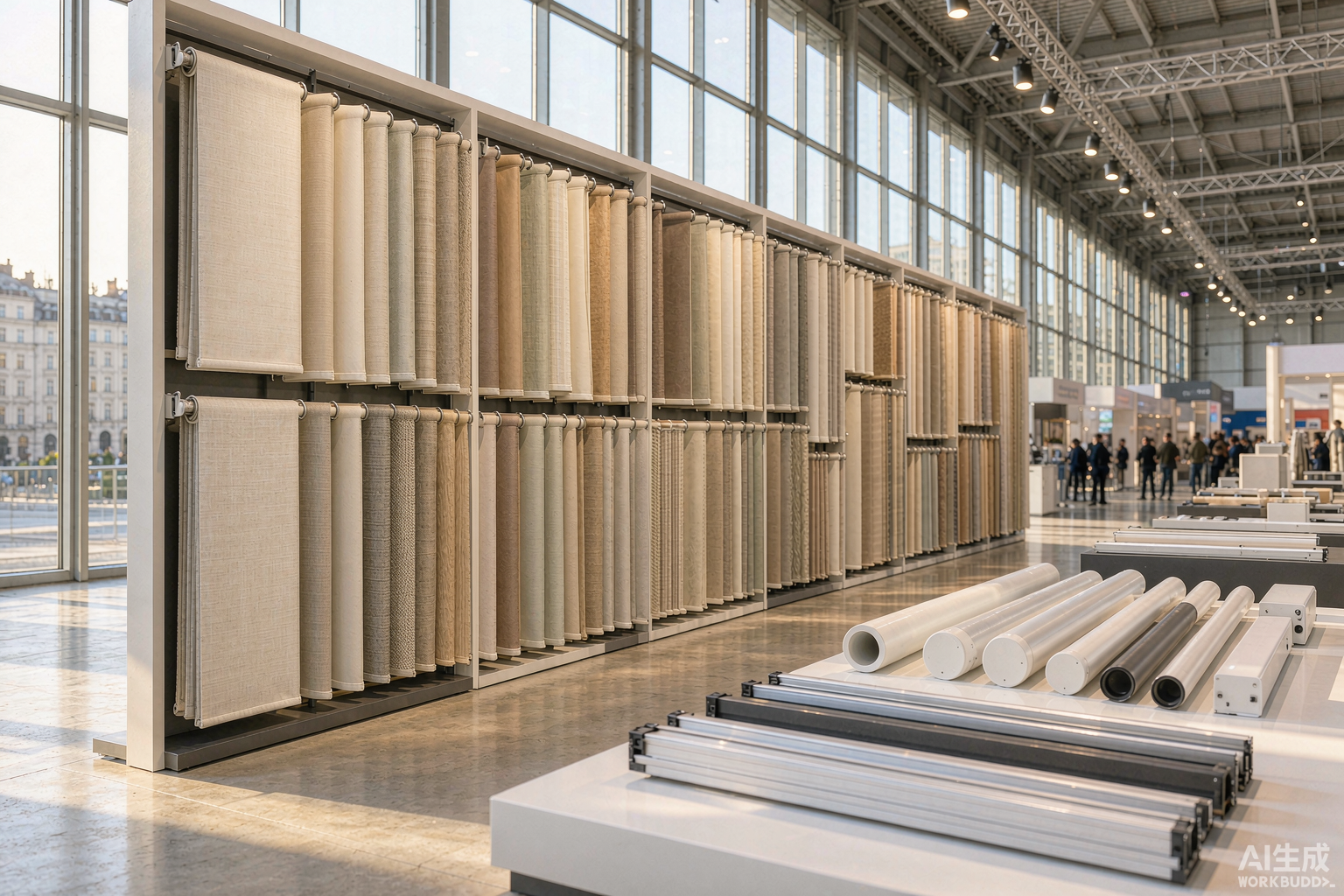
The world's largest shading fair turns 60: ten fully booked halls and a new outdoor hall. Three visitor routes for fabric buyers, on-spot sample tests, an eight-week prep checklist, post-fair conversion tactics, and the freight booking window as Suez transits resume.
From 15 to 19 February 2027, the world's largest and most influential trade fair for roller shutters, doors/gates and sun shading systems — R+T Stuttgart — celebrates its 60th anniversary at Messe Stuttgart, Germany. For overseas importers, wholesalers, fabric distributors and finished blind manufacturers, this is the one event where the entire shading value chain — outdoor and interior sun protection systems, roller-blind fabrics, tubular motors, drive and control technology, aluminium profiles, side rails, end caps, clutches and technical textiles — is gathered under ten fully booked halls. According to the organiser Landesmesse Stuttgart, every hall of the fairground is once again fully occupied for 2027, and the fast-growing outdoor shading segment has been expanded into the new Mahle Hall (Hall 4). That single scheduling decision is the clearest signal of where demand is heading: outdoor shading is the growth engine of the industry.
Why R+T Is the World's Leading Shading Fair
The figures from the last edition explain the fair's status. R+T 2024, held from 19 to 23 February 2024, welcomed 1,017 exhibiting companies from 43 countries and 61,155 trade visitors from 146 countries across approximately 120,000 square metres of exhibition space. Founded in 1965 and staged every three years, R+T is widely recognised as the global flagship event for roller shutters, doors/gates and solar shading systems. On the eve of the last edition, the R+T Innovation Award honoured 29 products from 25 companies, spanning drives, fabrics, complete systems and smart-home controls. In practical terms: the technology roadmap of the shading industry for the next three years is drawn during these five days in Stuttgart.
For 2027, organiser previews and industry press point to several themes worth planning around. First, the building envelope has become central to Europe's energy transition — external shading is now treated as an energy-saving building component, not a decorative accessory, and the accompanying conference programme reflects that shift. Second, motorisation and smart-home integration continue to move from premium to mainstream, with drive manufacturers showing solar-powered motors, weather sensors and compatibility with Matter, Zigbee and KNX ecosystems. Third, outdoor living — zip screens, vertical drops, pergolas, awnings and weather-resistant fabrics — occupies a dedicated hall for the first time, mirroring demand data that shows the global outdoor sunshade system market growing from roughly USD 11.6 billion in 2025 toward more than USD 20 billion by 2034 at about 6.2% CAGR (Dataintelo), and the awning market alone reaching USD 12.3 billion by 2034 (Fortune Business Insights).
R+T versus Heimtextil and Intertextile: Complementary, Not Competing
A common question from fabric buyers: “I already attend Heimtextil in Frankfurt and Intertextile in Shanghai — do I still need R+T?” The three fairs answer different questions. Heimtextil and Intertextile are soft-textile fairs: print and colour trends, fibre innovation, finishing and home-textile assortments. R+T is a systems fair: fabric is one engineered component inside a finished blind, awning or shutter, presented alongside drives, hardware, insect screens, machines and building automation. The official product spectrum covers roller shutters and accessories, exterior venetian and gathering blinds, awnings, internal sun shading, insect protection, drive and control systems, technical textiles, outdoor shading, gates and doors.
For a wholesaler moving from buying rolls of fabric to sourcing complete shading programmes, R+T is the only place where fabric, tubes, end caps, bead chains, side rails, motors and control protocols can all be seen, compared and negotiated in one trip. For contract and project buyers, it is equally valuable: architects, facade planners and electrical wholesalers all attend, and the fair's side events regularly address fire classification (EN 13501), shading performance (EN 14501) and energy-efficiency incentives in key European markets.
Three Visitor Routes for Fabric-Focused Buyers
- The fabric and technical-textiles route. Focus on interior roller-blind fabrics (sunscreen/openness fabrics, translucents, dim-outs and coated blackout fabrics), exterior fabrics (high-weatherability solution-dyed acrylic and PVC-coated glass-fibre mesh) and sheer curtain fabrics. Compare at least three suppliers per category on weight (g/m²), usable width, openness factor, coating weight and certification — OEKO-TEX Standard 100, GRS for recycled content, EN 13501 fire classification — and collect A4 swatches labelled with batch numbers on the spot.
- The drives and controls route. Tubular motors, battery and solar drives, app and voice control, weather sensors, and Matter/Zigbee/KNX compatibility. If you sell finished blinds, fabric-to-motor system compatibility is now part of the fabric specification: tube diameters, fabric roll diameters and torque limits must match the drive portfolio you intend to pair with.
- The hardware and components route. Tubes, end caps, idlers and clutches, bead chains, bottom bars, side rails and zip-guide systems. Hardware is where hidden cost and quality risk concentrate, especially for mixed-container buyers assembling programmes from multiple sources.
Turning Fair Samples into Repeatable Orders
A fair sample is only valuable if it is comparable. Bring a self-made sample-evaluation sheet and log, for every candidate fabric: weight in g/m², usable width, warp/weft density, openness or blackout percentage, coating type and weight, light-fastness class, fire standard and target market, MOQ, lead time and FOB reference price. European buyers should also verify REACH compliance and how each supplier handles the EU ESPR digital product passport agenda — these topics are regularly covered in R+T's forums.
Three 60-second on-spot tests remain extremely effective. Hold the fabric against the light to check structural uniformity and skew. Scrape a coated surface with a fingernail to detect powdering or whitening. Fold the fabric and press a crease with a thumbnail, then release: sharp “dead creases” that do not recover are a warning sign, especially on coated blackout fabrics destined for roller blinds that are rolled and unrolled daily.
Pre-Fair Preparation: An Eight-Week Checklist
- Start the Schengen business-visa process early — mid-February is peak season for German fairs and appointment slots are tight.
- Buy tickets online in advance and pre-book one-to-one meetings with key exhibitors; leading system suppliers' calendars fill up weeks ahead.
- Prepare a standard RFQ template — weight, width, MOQ, certification, lead time, trade terms — so every supplier quotes on the same basis and offers become directly comparable.
- Define the gaps in your current range before you go: missing 3.0-metre seamless blackout? Missing wind-rated zip-screen fabric? Missing GRS-certified recycled sunscreen? Shop with a shopping list, not just curiosity.
- Plan post-fair customer visits in Germany, the Netherlands or Poland to amortise travel cost across the trip.
- If you plan to audit factories after the fair, book appointments in the Yangtze River Delta early — flying Frankfurt or Paris to Shanghai and transferring to Keqiao is the most common factory-audit routing for European buyers.
The 72 Hours After the Fair — and the Freight Window That Follows
Fairs are won or lost after closing day. Within 72 hours, send a uniform sample-and-quote request to every shortlisted supplier; transfer your floor notes into a weighted supplier scorecard (sampling capability, response speed, certification completeness, price ladder); and agree sampling fees, sampling lead times and confidentiality terms with anyone entering the sampling stage.
Freight deserves equal attention when you plan spring replenishment. The Asia–Europe trade is in a transitional window: most major carriers have resumed or announced a phased return to the Suez Canal on Asia–Europe services, with Premier Alliance's FE1 and several other services switching from mid-October 2026, while some carriers remain on the Cape of Good Hope routing. Mediterranean spot rates have fallen back to mid-May levels, but North European rates still carry a congestion premium of roughly USD 400 per FEU. According to Freightos and Zencargo market updates from early October 2026, global schedule reliability has fallen for a second consecutive month to its lowest level since September 2022, Asian ports account for almost two-thirds of global congestion, Shanghai's on-time performance is tracking in the low double digits, and carriers recommend booking three to four weeks in advance. November capacity will also be trimmed by post-Golden-Week blank sailings. Rates and conditions change daily — use this as structural context, not as a substitute for a live quotation, and fix free-time and demurrage responsibility in the contract.
6. Budgeting the Trip — and Pairing the Sister Fairs
A five-day Stuttgart itinerary typically includes: long-haul flights (peak-season connections via Frankfurt or Munich followed by the high-speed rail link), accommodation around Stuttgart (hotel rates rise sharply during fair week; booking six or more weeks ahead, or commuting from a nearby town, saves real money), admission and forum fees, sample shipping and any post-fair customer visits. For most buyers, however, the biggest hidden cost is not travel — it is “walking away with nothing signed”: incomplete floor notes, RFQs quoted on inconsistent bases, and samples without batch information all destroy the price comparison you planned to run three months later. Allocate 20–30 minutes per booth, write the key parameters and verbal commitments on the back of the business card while standing there, and consolidate everything into your evaluation sheet the same evening.
If your calendar allows, link the sister fairs into one sourcing chain across the first half of 2027: January's Heimtextil in Frankfurt for soft-textile and fabric trends; 15–19 February at R+T Stuttgart for shading systems, hardware and drives; 10–12 March at Intertextile Shanghai Home Textiles Spring Edition (NECC) to revisit the Chinese supply base and commission samples; and 25–27 August at the Intertextile Autumn Edition to review first-half order performance. Three trips covering “trends — systems — capacity” is the highest-productivity annual sourcing rhythm for overseas buyers; buyers in the Middle East and Latin America can slot regional fairs in Dubai or São Paulo into the gaps to shorten sample round-trips.
Floor etiquette matters too. European exhibitors value appointments and data: opening with weight, width, certification and FOB — four parameters — earns more respect than small talk. For first-time suppliers, ask for the minimum sampling quantity and sampling lead time, validate delivery with a 100–300-metre trial order, then scale to your hero SKUs. Avoid squeezing prices below a workable margin at the booth: a fair held every three years is the start of a long relationship, and a stable annual supply agreement with priority production slots in peak season is worth more than a one-off discount. Finally, split your team: fabric buyers, product developers and e-commerce staff should each enter the halls with their own KPIs, meet to compare notes every evening, and use the official R+T app for exhibitor search and appointment booking — importing a target-exhibitor list in advance saves at least a full day of aimless aisle-walking.
7. Why Now Is the Right Moment for European Buyers to Engage Chinese Shading-Fabric Supply
European demand is pulling in three directions at once: energy performance (external shading that measurably cuts solar heat gain), motorisation (smart-home protocol compatibility), and sustainability (recycled content, traceability and digital product passports). Chinese industrial clusters are well positioned on all three. The Shaoxing Keqiao and Shengzhou fabric clusters offer a complete gradient from open-weave sunscreens to triple-coated blackout fabrics with globally competitive cost and lead-time flexibility; the hardware and motor ecosystem across the Yangtze and Pearl River deltas compresses the finished-blind supply-chain radius to around 200 kilometres.
Wanbo, based in Keqiao, Shaoxing, is exactly that kind of one-stop source: roller-blind fabrics, sheer and curtain fabrics, sofa upholstery fabrics and matching hardware for finished-blind manufacturers, wholesalers and project contractors worldwide, with OEM customisation, small-trial-order flexibility, and sampling that matches the exact qualities shown at international fairs.
See you in Stuttgart, 15–19 February 2027. If you cannot attend in person, contact Wanbo for fair-matching fabric programmes, digital colour cards and sample courier service — watch the trends at the fair, place the orders at the factory: that dual-track sourcing strategy remains the safest way to buy.