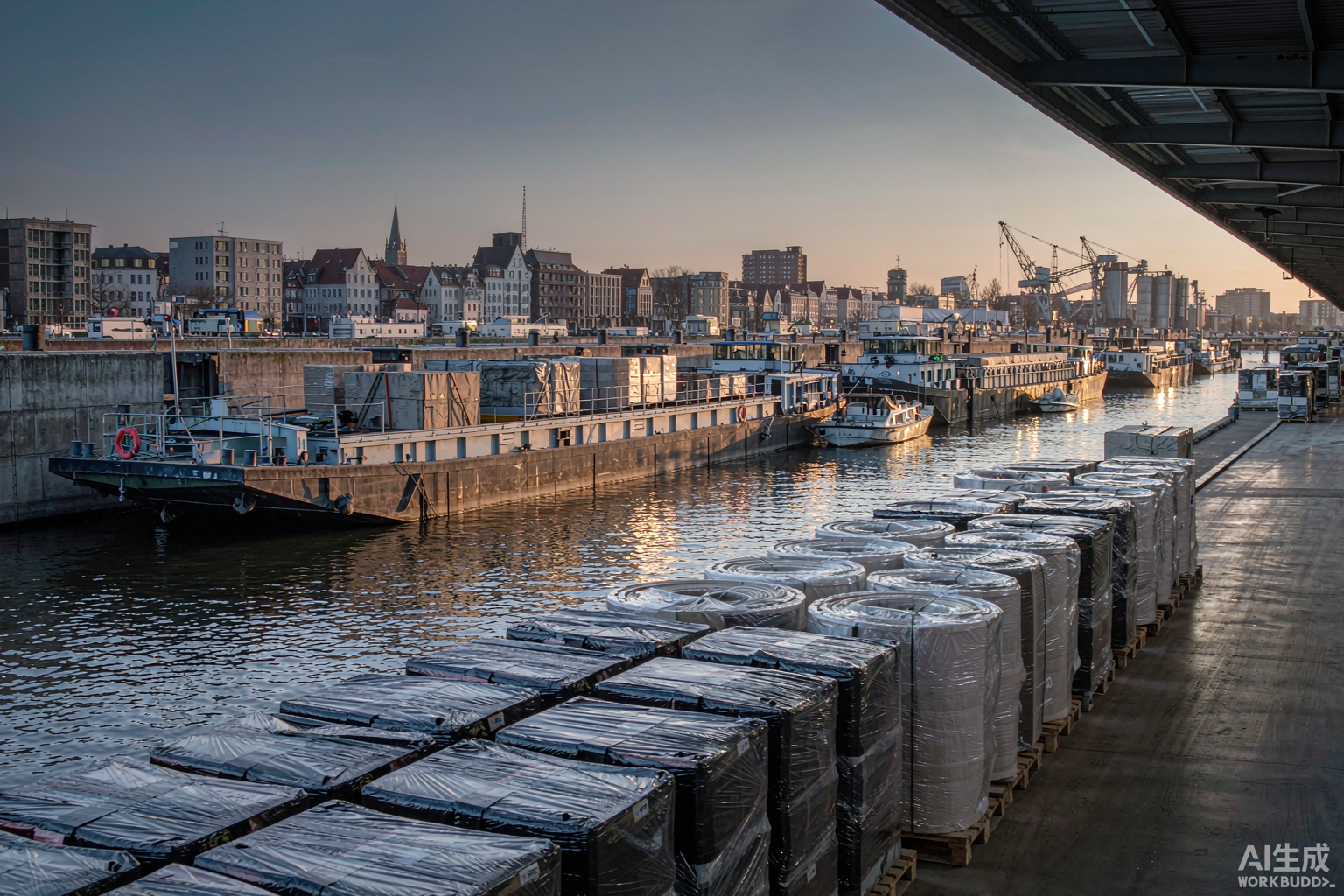
The Kaub gauge has fallen to a record low, Rhine barge traffic is broadly disrupted, and ARA-southwest Germany barge rates have hit ten times January levels. This article unpacks four impacts on North Europe fabric importers and eight countermeasures - from discharge-port changes and direct rail to free time and contract clauses.
When an inland fleet has to split a 4,600-tonne consignment across 14 barges to move it from Rotterdam to Nuremberg - a job three ships would normally do - the European inland waterway crisis has stopped being a risk warning and become live reality. According to Germany's Federal Waterways and Shipping Administration (WSV), the gauge at Kaub, the Rhine's shallowest pinch point, fell to 6 centimeters below its zero reference on October 1, an all-time low - just days after a previous record low of minus 2 centimeters was set on September 29. For importers shipping roller shade fabric, curtain cloth, voile and decorative textiles into Germany, Switzerland, Austria and eastern France, arrival at Rotterdam or Antwerp completes only half the delivery; the final leg from the seaport to the inland warehouse has become the hardest-to-predict and most cost-inflating segment of Q4 2026.
And this is no ordinary seasonal dip. Experts at the International Commission for the Protection of the Rhine (ICPR) note that the river has experienced four major low-water events since 2000 - 2003, 2018, 2022 and now 2026 - and this one is the most extreme yet. The EU's Copernicus climate service reported on October 2 that European rivers recorded their lowest average discharge in the summer of 2026 since records began in 1992, with record or near-record lows on the Rhine, Danube, Po, Loire, Rhone and Seine; Western Europe's average summer temperature of 21.7 degrees Celsius was 2.5 degrees above the 1991-2020 mean, the hottest summer on record.
1. How a water-level gauge decides the delivery date of a fabric order
Start with the key numbers. Barges typically need the Kaub reading at least 40 centimeters above the zero reference to carry even a quarter of their rated capacity, and normally wait for readings of plus 60-70 centimeters or more for full loads. Once the gauge fell below zero, most loaded barge traffic on the upper and middle Rhine effectively stopped: on October 1, according to Dutch shipping monitor Spotbarge, only two specialized chemical barges managed to transit the Kaub crossing all day.
Carrier Hapag-Lloyd has issued an ongoing low-water advisory with a surcharge framework for cargo moving on Rhine inland waterways: the surcharge applies to Rhine barge imports and exports until further notice, with rates determined by real-time readings at four official gauge stations - Kaub, Cologne, Duisburg-Ruhrort and Emmerich - and transport cannot be guaranteed once levels fall to or below 30 centimeters at Emmerich, 180 centimeters at Duisburg-Ruhrort, 105 centimeters at Cologne or 80 centimeters at Kaub.
The economic consequences show up directly in rates. On Spotbarge estimates, barge freight from the Amsterdam-Rotterdam-Antwerp (ARA) hub to Karlsruhe has climbed to roughly ten times its January level. Typical Rhine barges of 2,000-5,000 tonnes have been forced to cut loads by up to 75% when gauge readings fall below 75 centimeters. German inland operator MSG's case is the most vivid illustration: a 4,600-tonne shipment from Rotterdam to Nuremberg that normally needs three vessels was split across 14; at Luxembourg's Mertert port, the same 2,000-tonne cargo that one ship used to carry now takes eight to ten.
2. Ripple effects: railways fully booked, trucking short of capacity, fuel getting tight
Low water is never just a waterway problem - the real cost spreads through the alternatives. One inland logistics provider in the Rhine-Main region reports that between 60% and 70% of its import volumes from seaports are currently missing, its trains are fully booked for weeks, and because of shortages of train paths, wagons and locomotives, rail cannot replace lost waterborne capacity one-for-one; road transport is often the only remaining substitute, yet capacity is lacking for between 15% and 30% of the goods.
Germany's Federal Ministry of Transport (BMV) is continuing measures introduced earlier this year - additional rail freight capacity, truck driving-ban exemptions, alternative waterway routes, plus longer-term fixes such as removing bottlenecks on the Middle Rhine and supporting low-water-optimised vessels. But the structural gap cannot close quickly: energy analysts estimate that fully replacing Rhine river transportation for oil products alone would require roughly 3,000 extra road tankers per day. Swiss government data shows heating-oil costs hit their highest level since 2022 in September, up 8% month on month. For oversized and heavy cargo there is no fallback at all - without rail or road alternatives, the Rhine is the only channel.
Note, too, that the Rhine crisis is stacking on top of congestion that North European ports already carry. Global schedule reliability was just 49.9% in August (Sea-Intelligence), and North European hubs had previously been holding a congestion premium of roughly $400 per FEU. When a container is discharged on schedule but stalls on the inland leg, the clock on demurrage - and on detention once the box leaves the terminal - does not stop.
3. The contrast: what China's export gateway is doing
Zoom back to the origin side, and China's gateway ports are moving in the opposite direction - adding capacity. Ningbo Zhoushan Port handled more than 1.4 billion tonnes of cargo in 2025, ranking first globally for a 17th consecutive year; the upgraded Tiaozhoumen channel now pairs with Xiazhiman as a dual-channel system taking 200,000-tonne container ships around the clock; the Meishan automated terminal posted a 24-hour peak of 45,200 TEU, the port operates more than 40 container berths across 309 routes connecting more than 700 ports in over 200 countries and regions. For overseas buyers this means booking, gate-in and loading efficiency in China is improving, and the uncertainty is migrating to destination ports and inland legs - which is exactly where quotation and lead-time management should now focus.
4. Four concrete impacts on fabric buyers
First, inland lead times lose meaning. For full containers bound for Rhine-side inland points such as Duisburg, Mannheim, Stuttgart or Basel, the uncertainty window on barge connections has stretched from 2-3 days to more than a week; LCL cargo routed through inland hubs faces the same elongation.
Second, inland surcharges erode margin. Low-water surcharges are billed dynamically against gauge readings, and substitution onto rail and road multiplies the base cost: the total inland cost of a 40-ft container from an ARA port to southwest Germany can run to double its normal level.
Third, container detention risk is amplified. When barges stop, boxes sit in terminals or inland yards and the free-time clock keeps running; rail-wagon scarcity in the Rhine-Main region further extends the empty-return cycle.
Fourth, the Q4 replenishment window is compressing. Pre-Christmas replenishment for European retail and workwear-project business, plus spring 2027 range launches, all depend on Q4 delivery. The demand side will not wait for the logistics side: per The Business Research Company's September 2026 report, the global home textile market will grow from $151.24 billion in 2026 to $183.42 billion in 2030, a 4.9% CAGR, with Western Europe one of the core regions.
5. Which product categories and flows are hit hardest
Mapped against real fabric trade flows, the impact of low water is uneven - three business types need priority protection. First, B2B project orders: curtain and shading contracts for offices, hotels and public buildings typically carry liquidated-damage clauses, so a single week of inland delay can trigger penalties; for these orders, production and shipping plans should be scheduled backward from worst-case inland transit times. Second, private-label and DIY-channel replenishment: finished roller shades and voile lines supplied to large German DIY and home-improvement chains run on weekly replenishment cycles, and a week of empty shelf space is a real sales loss - suppliers should negotiate rolling volume commitments in advance. Third, cargo routed to inland points on the upper Rhine: destinations toward Basel and Strasbourg are hit most directly during Kaub low-water episodes, because the upper Rhine is the main supply artery for Switzerland and inland France - specialized barges prioritize fuel and chemicals first, and ordinary container barge slots and tonnage are squeezed earliest.
Just as important as port choice is reshaping inventory and contracts. European buyers have long run "zero stock plus fast replenishment", treating the inland leg as a reliable conveyor belt. A fourth consecutive extreme low-water event shows that this belt stalls every year or two. The more resilient model: hold in-European safety stock for best-selling solid colors and standard specifications, and reserve new patterns and custom specs for flexible air and fast-rail channels - absorb logistics volatility with inventory tiers instead of paying for it with demurrage and penalties.
6. Eight recommendations for European fabric importers
- Confirm the inland routing and its water sensitivity, shipment by shipment. For cargo destined above Kaub - Mannheim, Ludwigshafen, Basel, Strasbourg - agree barge feasibility and minimum load factors with forwarders before placing orders, and switch to direct rail where needed.
- Prefer rail-direct inland terminals. Duisburg, Munich, Nuremberg and Prague all have mature rail terminal options; capacity is tight but booking two to three weeks ahead still secures space - and rail is immune to water levels.
- Rethink the discharge port. For southwest Germany and Switzerland, evaluate discharging at Antwerp or Hamburg with rail/road direct legs; where appropriate, assess the southern corridor via Genoa/Livorno into Switzerland and southern Germany.
- Build low-water surcharges into pricing. When quoting end customers, include low-water surcharges and rail/road substitution differentials in the price terms, or state explicitly that inland charges float with current water levels - do not let a fixed door price absorb the difference.
- Negotiate extended free time. Before shipping, agree 14-21 days of combined demurrage/detention free time at destination, and for barge-connected cargo, confirm precisely when detention and demurrage start and what waivers apply.
- Hedge timing with split shipments. Move the main volume by rail or via northern ports, keep a small air-freight window for emergencies, and position safety stock in inland warehouses rather than at seaports for project customers.
- Put inland-delay clauses into contracts. In sales contracts and purchase terms, state that inland delays and costs caused by water levels, strikes or port congestion are shared against actual documentation.
- Build a water-level and port dashboard. Track WSV readings at Kaub, Cologne and Duisburg weekly, plus carrier low-water advisories and European rail capacity pricing - turn the gauge into part of the purchasing calendar.
WSV's short-term forecast shows only a slow recovery, and the drought fundamentals need sustained rainfall to reverse; ICPR experts warn that under global warming, such extreme low-water events will become more frequent and longer-lasting. For European fabric buyers, inland-logistics resilience is no longer an elective - it is a required course in the 2027 purchasing plan.
Rates and water levels change daily; this article explains the risk structure and does not replace current quotations or carrier advisories.
About Wanbo: Shaoxing Keqiao-based Wanbo Textiles specializes in manufacturing and export of roller shade fabric, curtain cloth, window voile, sofa upholstery, carpets and rugs, and jacquard, high-shrinkage yarn, coated and woven fabric categories, serving importers, wholesalers and finished-blinds factories in Germany, Switzerland, France, the UK and across Europe. We help European customers evaluate combined seaport, rail and road inland logistics, with flexible FCL/LCL options, multi-port export and split-delivery support, and continuous tracking of European inland waterway and port dynamics. For our latest fabric catalog and FOB/CIF quotations, contact the Wanbo team.