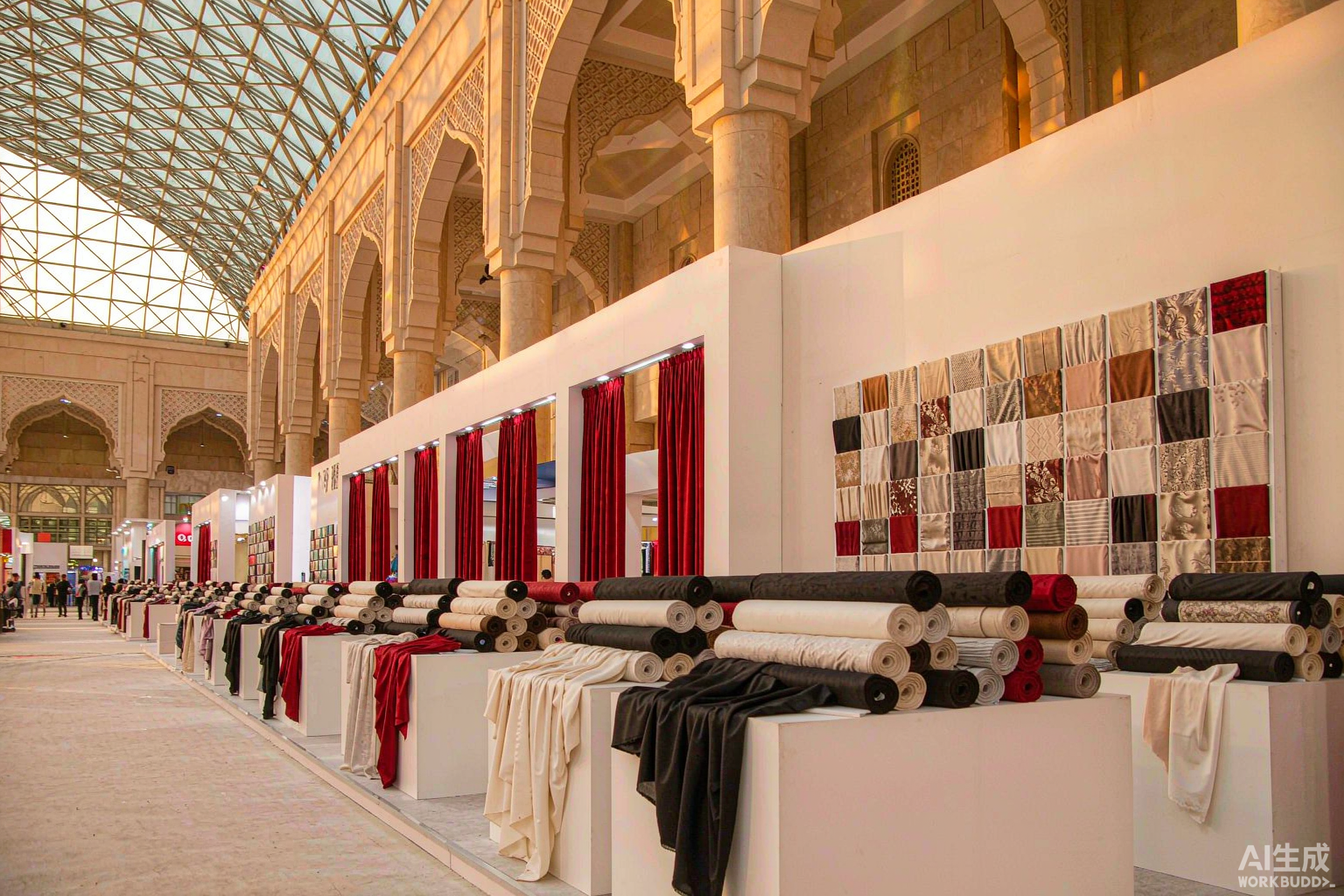
Ramadan 2027 (around 7 February) stacks with Chinese New Year, and Riyadh INTEX Saudi (Dec 20-22) becomes this year’s key procurement gateway. We break down hard Saudi market data, six product directions, the SABER certification timeline and logistics under Hormuz risk.
Overseas buyers trading with the Middle East know a rhythm well: six to eight weeks before Ramadan, the market suddenly crowds — everyone scrambling for vessel space, dyeing slots and exchange rates. But the 2026 calendar has torn up that schedule. Ramadan 2027 is expected to begin around 7 February, falling in the same week as Chinese New Year (6 February), and the Saudi market has gained a new procurement gateway this year: from 20 to 22 December, the second INTEX Saudi International Textile Exhibition will be held in Riyadh, forming a complete "Gulf sourcing corridor" together with the INTEX UAE show in Dubai on 15–17 December and the IATF Dubai textile fair on 16–18 November. For Chinese suppliers and overseas buyers sourcing roller-blind fabrics, blackout coated fabrics, sheers, jacquards, sofa upholstery and carpets, this means the "Ramadan peak season" actually starts in November this year. Whoever moves a month early claims the shelf space for Ramadan 2027.
1. The Market First: Three Hard Numbers on Saudi Window Coverings
Saudi Arabia is not an "average" market; its demand structure is dictated by geography and climate. IndexBox's Saudi Arabia Curtains Market Report (May 2026 edition) offers three key findings. First, 70–80% of Saudi curtain supply is imported, mainly from China, Turkey and the Indian subcontinent, with local production limited to small-scale custom sewing workshops. Second, blackout and thermal curtains are the fastest-growing sub-segment, expanding at 8–12% annually through 2035, driven by extreme summer temperatures, residential energy-efficiency subsidies and the Vision 2030 hotel renovation cycle. Third, the market is polarising: economy polyester curtains sell at SAR 30–60 per panel in hypermarkets, while premium custom blackout and designer drapery command SAR 150–400 per linear metre in showrooms — squeezing the mid-range out of both ends.
Zoom in further. IndexBox's dedicated blackout-curtain report states that Saudi blackout products rely on imports for 70–80% of volume, with China the dominant source of coated and laminated fabrics; triple-weave and noise-reducing multilayer constructions are gaining share rapidly in residential and hospitality channels, with consumers willing to pay a 40–80% premium over basic coated blackout for better durability and insulation. 6Wresearch values the Saudi curtains and window blinds market at USD 433 million in 2025, reaching USD 643 million by 2032 (CAGR 5.8%), with 2026 growth of 7.3% led by hospitality. Stats N Data's vertical-blinds estimate points the same way: roughly USD 104 million in Saudi Arabia in 2026, growing 7.5% annually.
The deepest logic is climate plus policy. Annual solar radiation exceeds 2,000 kWh/m² across most of the Kingdom, and summer temperatures routinely top 45°C — in this market, blackout and thermal performance is not decoration but necessity. Vision 2030 is industrialising that necessity: Saudi Arabia targets over 500,000 hotel keys by 2030 (IndexBox) and 150 million annual tourist visits, while Marriott and Al Qimmah Hospitality announced in January more than 2,700 additional rooms across Jeddah, Makkah and Madinah — one slice of the construction wave. Every hotel window eventually becomes a purchase order for shading fabric.
2. Three Fairs, One Corridor: Why December Is This Year's Most Important Window
The 2026 Gulf sourcing season is strung together by three fairs: IATF Dubai on 16–18 November (the region's largest and most professional textile fair, Dubai World Trade Centre, 30,000 m², 720 exhibitors, 37,000 visitors); the 20th INTEX UAE in Dubai on 15–17 December (same venue, 20,000+ trade buyers expected from the UAE, Iran, Pakistan, Saudi Arabia, Africa and the US); and the second INTEX Saudi in Riyadh on 20–22 December. For buyers, each stop plays a different role: IATF is for trends and new collections, Dubai INTEX for benchmarking and price negotiation, and Riyadh INTEX for direct access to Saudi wholesalers and project buyers — the first two let you "see goods" in the UAE, the third opens doors inside the Kingdom.
Why does the Riyadh stop matter? Because Saudi distribution differs fundamentally from the UAE: the Emirates are a re-export hub where cargo clears at Jebel Ali and flows onward, while Saudi orders must ultimately pass through the Kingdom's SABER clearance system and local distribution networks — separated by certification, agency and warehousing. Exhibiting locally in Riyadh shortens the distance to the end buyer by an entire country. The proven playbook for Chinese textile suppliers: negotiate generic SKUs and OEM orders at the Dubai stops, and project contracts plus annual frameworks in Riyadh — the two cities are a four-day hop within one visa circle.
3. Working Back 90 Days from Ramadan: Why the Timeline Moved a Month Earlier
Anchor on Ramadan 2027 beginning around 7 February and work backwards: retail stocking peaks six to eight weeks before Ramadan, meaning cargo must land by mid-December to early January; with a 35–45 day ocean transit from China to the Red Sea/Gulf plus Jeddah's current 10–12 day landside delay (Expeditors, 14 October), orders must be placed by mid-November and vessels must sail by mid-December. Add this year's Hormuz uncertainty — roughly 23 attacks in the first two weeks of October and war-risk premiums at 6–10% of hull value — and no Saudi importer dares stake everything on January sailings. That is the entire logic of "the season moved a month early": demand did not move earlier; risk premiums pushed the safety-stock threshold forward.
Supply is tightening too. Chinese New Year 2027 falls on 6 February, nearly the same week as Ramadan; Chinese factories will close for two to three weeks from late January, and dyeing schedules will be fully booked by mid-January. September's China textile and apparel exports hit USD 29.658 billion, up 21.5% year-on-year — a record for the period (General Administration of Customs, 14 October) — tilting both capacity and vessel space toward buyers who order early. Those who order in January will face a triple squeeze: dyeing queues, rebounding freight rates and the last pre-Ramadan sailing.
4. Product List: Six Directions for Saudi Arabia in 2027
- Full-blackout coated roller-blind fabric, 280–320 g/m² — dual demand from hotels and residences; blackout contributes the category's largest revenue share (IndexBox), and triple-weave and noise-reducing structures command 40–80% premiums. Lead with this.
- Fire-rated blackout curtain fabric (NFPA 701 / BS 5867 equivalent, mapped to SASO) — the hospitality access barrier, and the position where certified suppliers widen price gaps: compliance costs 5–10%, but project margins run 25–40% higher.
- Sheers and sunscreen fabrics (openness 3–5%) — installation peaks after Ramadan before summer; stable glare-control demand from glass-tower apartments and offices, corroborated by the Saudi vertical-blinds market at USD 104 million in 2026, +7.5% a year.
- Jacquard and chenille sofa fabrics (400 g/m² and above) — Ramadan hospitality culture and the majlis reception tradition stack up; heavyweight textures move fastest December to January, ideal for full-container direct shipments.
- Mosque and institutional curtains (large-size custom) — a stable category most suppliers ignore: 3-metre widths, high blackout and fire compliance in one product; few suppliers qualify, so competitive density is lowest.
- Motorized roller-blind compatible fabrics (38/45mm tube) — smart-home penetration is rising fast in the Kingdom; bundled motor-plus-fabric quotes close at significantly higher rates in project channels than fabric alone.
5. The SABER Ticket: What to Do Before Choosing Products
In Saudi deals, compliance comes first. SASO, the Saudi Standards, Metrology and Quality Organization, manages regulated products through the SABER online platform with two certificates: the Product Certificate of Conformity (PCoC, tied to the product, valid one year) and the Shipment Certificate of Conformity (SCoC, issued per consignment). Three rules every supplier and buyer must know. First, a SABER account can only be opened by a Saudi importer holding a valid Commercial Registration (CR) — Chinese factories cannot register themselves and can only support with technical files and test reports. Second, the SCoC number must appear on the Saudi customs declaration (Bayan), or the container is held at port. Third, selling the same product to different Saudi importers requires a separate PCoC for each — certificates cannot transfer between CR numbers. Common detention causes: SCoC obtained after the vessel sailed, PCoC expiring mid-transit, invoice HS codes mismatching the PCoC, labels missing Arabic text or importer details. Textile labels need Arabic or bilingual Arabic-English marking of product name, model, manufacturer, importer and origin. Allow time: products needing fresh test reports typically take 5–8 weeks from kickoff to PCoC — which makes now the last window to start the 2027 Saudi certification cycle.
6. Logistics: Pricing Hormuz Risk Into Your Quotes
The Saudi line's status as of mid-October: Jeddah is operational but congested with 10–12 days of landside delay after discharge; King Abdullah Port is likewise congested; Dammam flows comparatively smoothly. Kuehne+Nagel expects cargo flows to redistribute toward Jeddah, Aqaba and Salalah as Jeddah congestion eases, while Khor Fakkan and Fujairah congestion persists for weeks. Practical guidance: for the Red Sea side (Jeddah, Jizan), prefer carrier services already restored through Suez — BIMCO data shows weekly Suez container capacity at 753,000 TEU in early October, 51.5% of pre-crisis; for the east coast (Dammam), transship via Jebel Ali with feeder connection time budgeted; require insurers to confirm in writing the war-risk coverage and rate basis date for Red Sea and Persian Gulf legs on all CIF quotes; negotiate demurrage & detention free time above 14 days and state cost allocation in the contract if carriers divert via the Cape.
7. Ten Action Points
- Use Riyadh INTEX (20–22 December) as the milestone; work back the sampling, quoting and certification timetable — sampling complete by early November.
- Negotiate generic SKUs and OEM at the Dubai stops; pursue project contracts and annual frameworks in Riyadh, with separate scripts and sample sets.
- Write the Ramadan 2027 anchor (around 7 February) into the delivery terms of every quote, defining accountability for "arrival no later than 10 January".
- Start PCoC now: have the Saudi importer initiate on SABER while the factory prepares test reports and Arabic label artwork in parallel.
- Lead with triple-weave blackout and fire-rated blackout lines, using the 40–80% and 25–40% premium spaces to offset freight and compliance costs.
- Run large-format mosque and institutional orders as a separate track, stocking 3-metre-plus widths and fire reports — the least crowded blue ocean.
- Attach war-risk coverage confirmations to all CIF Saudi quotes; recommend dual-corridor forwarder plans (Suez direct + Jebel Ali transshipment) to FOB customers.
- Prefer full containers: with 10–12 days of landside delay at Jeddah, LCL detention risk is amplified — use 40ft high-cubes wherever possible.
- Watch Asia–Europe rates after ONE Continuity's first sailing on 9 November; lock 2027 Q1 space and contract rates before December.
- Build a weekly-refreshed per-container landed-cost model with freight, war risk, congestion surcharges and inland delay as dynamic variables, replacing the static annual budget.
Conclusion: Ramadan moved earlier, the fairs moved earlier, and risk premiums rose — the late-2026 Gulf sourcing season rewards those who positioned a quarter ahead. Wanbo, rooted in the source fabric supply chain of Keqiao, Shaoxing, China, has long supplied Saudi Arabia, the UAE and the wider Middle East with full-blackout coated roller-blind fabrics, sheers, jacquards, high-shrinkage yarn fabrics, coated and woven fabrics, sofa upholstery and carpets. We know the SABER certification path and the vessel-space rhythm of the Red Sea and Gulf corridors, and we support overseas buyers end to end — from selection and sampling, compliance documents to dual-corridor logistics plans. Book a fabric consultation during the Riyadh and Dubai fairs and claim your shelf space for the Ramadan 2027 season early.