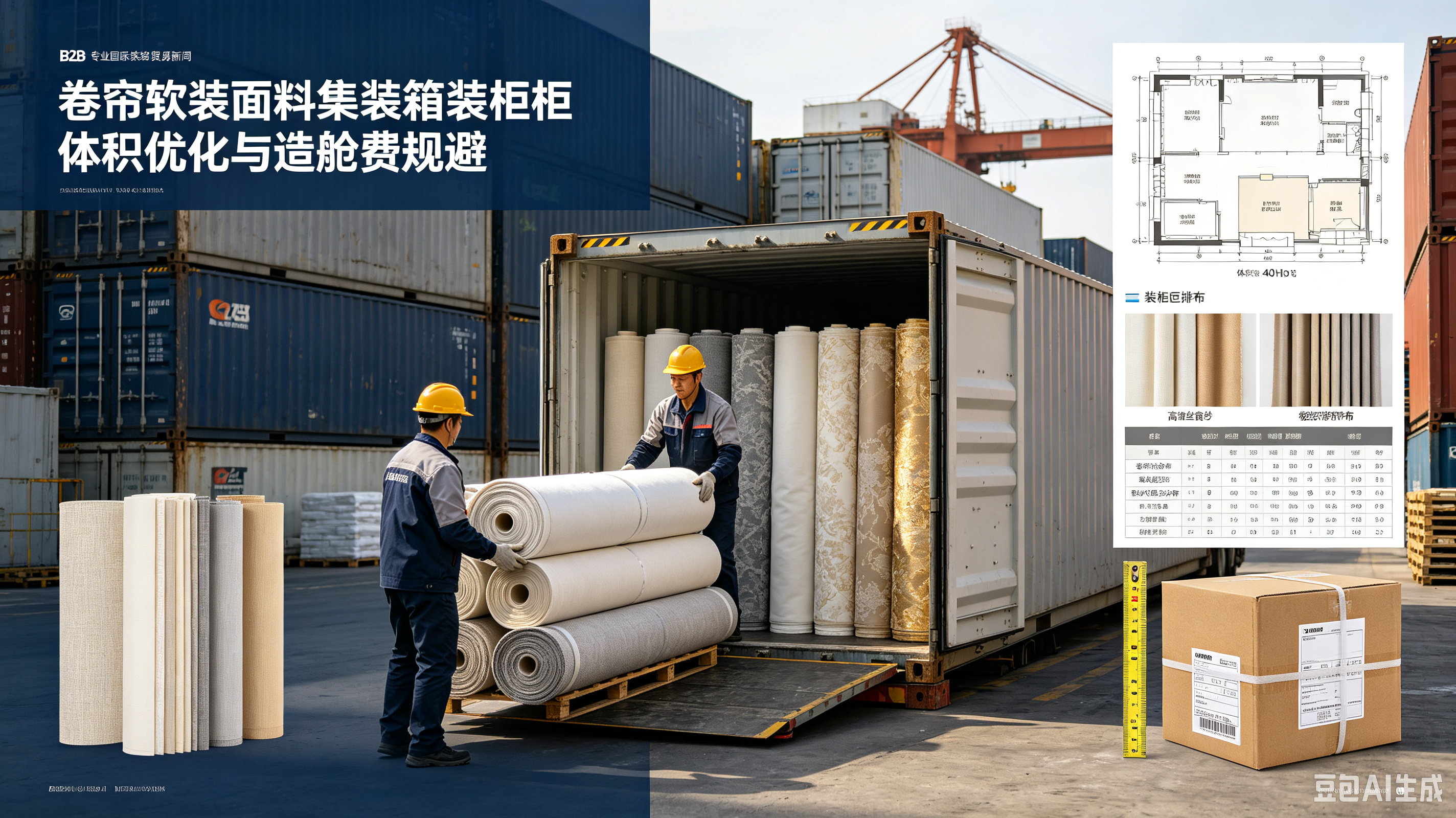
Rolled fabrics easily waste container space. Covers trade-fair sourcing, volume calculation, dead-freight prevention and hot selling fabrics.
In 2026, international ocean freight space prices keep fluctuating, and surcharges on Red Sea routes remain high. Rolled fabrics such as roller‑shade fabrics, upholstery fabrics and window screens fall into the category of light bulky cargo. The fabric roll diameter, protective corner packaging and stacking layout directly affect the cubic utilisation rate of shipping containers. Many overseas buyers only calculate fabric procurement costs when purchasing roller‑shade fabrics, ignoring wasted container space caused by improper roll stowage planning, which leads to high dead freight and raises the comprehensive import cost per metre of fabric. Some buyers inaccurately estimate cargo volume, booking container cubic capacity larger than the actual shipment volume and being charged Dead Freight by freight forwarders. In other cases, messy roll arrangement prevents full loading of 40HQ containers, pushing up per‑unit ocean freight sharply. Targeting overseas soft‑furnishing importers, this article explains volume calculation methods for rolled fabric container loading, key points to verify suppliers’ container‑planning capabilities during trade‑fair sourcing, risk‑avoidance plans for ocean freight space, recommends hot‑selling fabrics optimised for efficient container loading, and delivers a complete China fabric procurement & export solution for overseas buyers.
Container loading for rolled home‑textile fabrics differs greatly from regular carton cargo. Coated roller‑shade fabrics, high‑shrinkage‑yarn window screens and ice‑crack jacquard upholstery fabrics are cylindrical fabric rolls fitted with paper tube protectors at both ends. Unlike cartons, cylindrical rolls cannot be stacked tightly without gaps and tend to create substantial voids inside containers. Many buyers simply estimate volume based on fabric metres, disregarding paper tube diameter, outer stretch‑film thickness and space occupied by corner protectors, resulting in volume estimation deviations of 10%‑20%. Two common loss scenarios: first, booking space for a calculated cubic volume in advance, yet the actual shipment volume turns out smaller, and the forwarder charges dead freight. Second, underestimated volume means goods cannot all fit into the booked container, and leftover cargo requires extra LCL shipment, generating secondary logistics costs. Coupled with tight container space on Red Sea lanes, last‑minute space bookings incur extreme premiums, making engineering orders highly vulnerable to delays.
Overseas buyers in the second half of the year can assess suppliers’ container‑plan design capabilities via international trade fairs. November’s Frankfurt Heimtextil Home Textiles Fair gathers top global fabric manufacturers. Buyers may inspect packaging schemes for different fabric rolls on‑site and ask for factory simulation cases of container stacking layouts. October’s Canton Fair Textile Pavilion hosts original manufacturers from the Keqiao industrial cluster. Factories including Wanbo can provide cubic calculation tables for mixed fabric combinations on‑site and demonstrate mixed stowage layouts combining roller fabrics, upholstery fabrics and window screens. This helps evaluate whether suppliers excel at container optimisation and filter out manufacturers that only produce fabrics without container‑planning expertise.
Five key verification points to select suppliers with container‑optimisation capabilities at trade fairs. First, request suppliers to provide standard roll dimensions for the corresponding fabric, including inner paper tube diameter, outer roll diameter, corner protector thickness and cubic measurement per packed roll. Second, enquire whether the factory can adjust roll length to modify roll outer diameter, match container width and reduce void spaces. Third, verify mixed‑category stowage plans: when combining roller fabrics, window screens and upholstery fabrics in one shipment, whether alternating large and small rolls can boost container utilisation. Fourth, confirm volume estimation error tolerance. Reliable original factories can keep overall volume error within ±5% to lower dead‑freight risks. Fifth, review photos of previous full‑container shipments to confirm standardised packaging and protector specifications, and avoid irregular rolls that waste container space.
Practical workflow of rolled fabric procurement, container stowage planning and ocean export for overseas buyers. At pre‑order stage, suppliers issue detailed volume calculation lists. Based on fabric categories and ordered metres, simulate stacking inside 20GP/40HQ containers, compute theoretical loadable cubic capacity and reserve reasonable error margins as the basis for space booking instead of blind estimation. During order placement, negotiate adjustable roll lengths to optimise outer roll diameter and improve stacking density without impairing customers’ cutting usage. Standardise paper tubes, corner protectors and stretch film during packaging to avoid inconsistent roll sizes.
Ocean freight space risk control: book cubic capacity as close to actual shipment volume as possible with safe floating buffers. If order changes reduce shipment quantity, promptly notify freight forwarders to adjust booked space before cargo cutoff to avoid dead freight. Prioritise dual alternative ports Shanghai and Ningbo for logistics routes. Lock space in advance for Red Sea shipments to avoid sudden freight premiums. After container loading, factories take complete loading photos for filing to verify actual stowage. Compile full test and certificate‑of‑origin documents to ensure smooth customs clearance.
Recommended foreign‑trade hot‑selling fabrics optimised for high container utilisation:
- Standard blackout coated roller‑shade fabric. Wanbo flexibly adjusts roll lengths with regular outer roll diameters and minimal stacking gaps. Flame‑retardant versions fit global engineering projects and achieve high full‑container loading rates.
- Solid‑colour high‑shrinkage‑yarn window‑screen fabric. Lightweight with controllable roll diameters, ideal for mixing with roller fabrics to fill voids inside containers. Consistently popular for retail markets across Europe, America and Australia.
- Ice‑crack jacquard upholstery fabric. Produced in standard rolls with uniform dimensions. Mixed stowage together with roller fabrics improves container space utilisation, a top seller for soft furnishing retail.
- Solid‑colour plain woven curtain fabric. Stable weaving with optional roll specifications. First choice for bulk orders to the Middle East and Southeast Asia; simple volume calculation with small volume deviation.
- Outdoor UV‑resistant sun‑shade woven fabric. Tight, deformation‑resistant rolls that resist crushing and collapsing on long ocean voyages, suitable for full‑container exports for outdoor projects in the Middle East and South Africa.
As an original fabric export enterprise based in Keqiao, Wanbo’s product portfolio covers coated roller‑shade fabrics, high‑shrinkage‑yarn window screens, ice‑crack jacquard fabrics, upholstery fabrics and carpet base fabrics. Our factory has mature simulation and calculation capabilities for rolled‑fabric container loading. We optimise roll specifications and create container stacking layouts according to customers’ mixed orders, keeping volume error within reasonable ranges. Mixed‑category fabric consolidated shipments maximise container space utilisation, cut per‑unit ocean freight and mitigate dead‑freight risks. We also supply complete test and customs‑clearance documents, helping overseas buyers reduce unnecessary hidden ocean logistics expenses and deliver orders steadily.