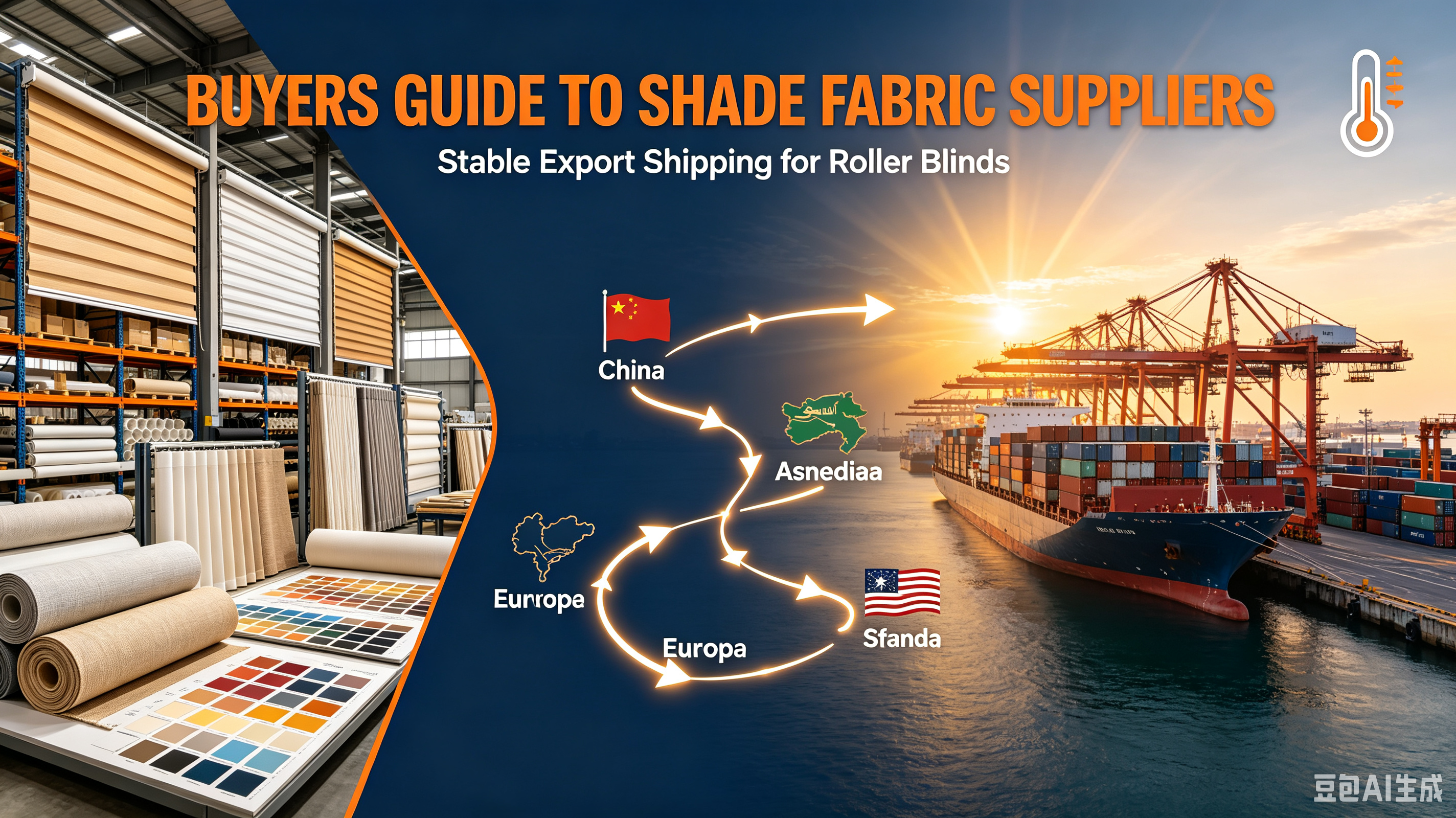
2026 high temperature drives blind orders. Learn how global buyers select reliable roller fabric suppliers and avoid shipping risks.
roller blind fabricwindow curtain exportchina fabric suppliershade fabric wholesaleshipping risk solution
Extreme high temperatures have swept many regions worldwide in 2026, with summer temperatures in the Middle East, Southern Europe and South Africa repeatedly hitting record highs. Demand for heat-insulating, UV-resistant roller blinds and functional window curtains has skyrocketed for commercial buildings, high-end residences and chain hotels. Statistics from the international soft furnishing industry show that global import orders for sunshade window coverings surged by 26.3% year-on-year in the first half of this year, among which purchasing demand for roller blinds and solar screen fabrics saw the sharpest growth.
Behind the booming market, overseas curtain wholesalers and engineering purchasers are generally trapped in two major dilemmas: on the one hand, the Red Sea shipping route remains volatile, pushing ocean freight and port detention fees continuously higher with endless delivery delays; on the other hand, the market is flooded with middlemen and small OEM factories, leaving numerous overseas buyers caught in pitfalls such as fabric color difference, substandard shading performance and insufficient production capacity for timely restocking.
To seize the business opportunities brought by the high-temperature-driven demand for sunshade products, buyers must not only resolve unstable ocean logistics issues but also source reliable suppliers with self-owned production capacity and comprehensive export supporting services. As a self-operated roller blind and curtain fabric exporter based in Keqiao, Shaoxing, Wanbo Import & Export Co., Ltd. has accumulated years of practical experience serving clients across the Middle East, Europe and Africa. Combined with the current ocean shipping market situation, we have compiled a dual practical guide covering supplier screening and logistics risk avoidance for overseas purchasers.
I. Skyrocketing Demand for Sunshade Products Driven by Heatwaves Creates Prime Purchasing Window for Overseas Buyers
Gulf Countries in the Middle East: Continuous advancement of Saudi Vision 2030 urban construction has triggered mass renovation of office buildings and resort hotels, generating robust rigid demand for full blackout heat-insulating roller blinds and outdoor sunshade fabrics. Local curtain shops have doubled their restocking frequency compared with last year. With summer temperatures exceeding 45°C locally, ordinary thin curtains fail to meet heat insulation needs, creating high premium margins for functional solar screen fabrics.
European Countries: New building energy-saving regulations have been rolled out across Europe, mandating heat-insulating sunshade window treatments for newly constructed buildings. Orders for sheer shades, honeycomb blinds and motorized adjustable roller blinds have surged, while importers attach greater importance to eco-friendly and sound-insulating fabric properties.
South Africa, Nigeria and other African regions: Large-scale expansion of outdoor resorts and commercial stores has made waterproof UV-resistant outdoor roller blinds a bestseller. Lacking local weaving mills, the region relies entirely on imports from China.
The explosive demand has directly led to order backlogs across the industry. Small and medium-sized traders without self-owned factories struggle to keep up with production schedules. Coupled with shipping delays on the Red Sea route, countless overseas buyers face a situation where they cannot receive goods despite having orders placed. Many purchasers opt for blindly low-priced orders, only to receive thin fabrics with poor sun protection that cannot be sold in local markets, resulting in massive inventory losses.
II. Four Major Existing Ocean Shipping Pain Points for Curtain Exports in Current Market, All Avoidable by Selecting the Right Supplier
Tight vessel space for direct Red Sea sailings with surcharges climbing steadily
Affected by geopolitical conflicts, direct shipping slots bound for the Middle East are extremely scarce. Shipping lines impose war surcharges and congestion surcharges, adding an extra cost of over USD 2,000 per container. If a supplier only offers a single ocean shipping channel, order fulfillment will grind to a halt once the route is suspended. Reputable exporters provide multiple flexible transport alternatives including China-Europe Railway Express and Mediterranean sea-rail intermodal transport to switch delivery routes seamlessly.
Frequent port inspections cause cargo detention due to incomplete documentation from small manufacturers
Ports across the Middle East and Europe have tightened textile inspection standards, requiring complete certificates including certificates of origin, fabric test reports, flame retardant and UV resistance certifications. Many small suppliers cannot furnish full sets of export customs clearance documents, leading to prolonged cargo detention at ports and hefty storage fees. Formal self-operated export enterprises can issue all required international certifications in one stop to accelerate customs clearance efficiency.
Uncontrollable lead times for orders concentrated in peak season due to OEM middlemen
Order volumes peak sharply in hot weather seasons. Middlemen without in-house weaving workshops need to source fabrics externally, extending production lead times to over 40 days. Source manufacturers with integrated weaving, dyeing and finished product processing workshops stock hundreds of sunshade fabric variants in inventory, enabling shipment arrangement as fast as the same day and drastically cutting waiting periods.
Opaque logistics information with no predictable arrival timelines
Many small-scale exporters cooperate with irregular freight forwarders and fail to provide real-time updates on port congestion and sailing schedule changes. Professional curtain exporters maintain dedicated foreign trade logistics teams that synchronize full cargo transit milestones, pre-empt risks of shipping fare hikes and port detention, and adjust delivery solutions promptly.
III. Five Core Standards for Overseas Purchasers to Screen Qualified Roller Blind Export Suppliers
1. Possess a complete self-owned industrial chain, reject pure OEM middlemen
Judgment criteria: Whether the enterprise operates internal weaving workshops and finished product processing plants with year-round spot inventory. Wanbo of Shaoxing owns a full-process production line covering full blackout roller blinds, sheer zebra blinds, honeycomb blinds and outdoor sunshade fabrics of all categories, eliminating the need for external fabric procurement to guarantee stable mass order delivery even in peak seasons. Customized fabrics with special thickness, sun-proof and waterproof functionalities are also available to adapt to climate demands of various countries. Pure middlemen carry no spot inventory and face severe stockouts in peak seasons, making them unsuitable for long-term cooperation.
2. Offer mature multi-channel export logistics solutions instead of relying solely on Red Sea ocean freight
Qualified export suppliers must provide diverse cross-border transport options: China-Central Asia Railway Express delivering straight to inland warehouses in the Middle East, Mediterranean sea-rail intermodal transport to Europe, direct ocean liner shipping to Africa, and urgent air freight for sample rush orders. Parallel multi-transport routes insulate orders from disruptions on single congested waterways, stabilize delivery schedules and cut additional ocean surcharge costs.
3. Furnish complete international test certifications for smooth customs clearance and local sales across all regions
Sunshade fabrics exported to overseas markets require full test certificates for UV resistance, flame retardancy, environmental protection and shading grades. All roller blind fabrics manufactured by Wanbo comply with universal testing standards for the Middle East and the EU, with complete documents dispatched together with cargo for hassle-free port clearance. Certifications also satisfy tendering qualification requirements for local engineering projects, supporting engineering purchasers undertaking large-scale hotel and office building projects.
4. Provide multilingual communication support with in-depth knowledge of popular styles for local global markets
Middle Eastern clients favor high heat-insulation full blackout solar screen fabrics, European buyers prefer lightweight sheer blinds, while the African market prioritizes waterproof outdoor roller blinds. Professional exporters understand regional market preferences thoroughly and employ English and Arabic-speaking sales staff to recommend perfectly matched products, avoiding unsalable inventory caused by mismatched purchasing styles with local market tastes.
5. Deliver one-stop supporting services to lower comprehensive procurement costs
Full-process supporting services span fabric sampling, color card delivery, full-container packaging, consolidated container loading to share logistics costs, after-sales return & exchange and free replacement for damaged goods. Source exporters can deliver curtain fabrics, finished roller blinds and installation accessories in a single shipment, eliminating the need for purchasers to source from multiple separate suppliers and saving communication and logistics expenses.
IV. Practical Regional Purchasing Advice to Capture Sunshade Market Dividends amid Global Heatwaves
Purchasers from Saudi Arabia, UAE and other Gulf nations: Prioritize spot heat-insulating solar screen roller blind fabrics and select exporters offering China-Europe Railway Express transport to bypass congested Red Sea routes, delivering lower costs and stable lead times for large-volume engineering orders;
European soft furnishing importers: Focus on eco-friendly sound-insulating honeycomb blinds and sheer zebra blinds, choosing Mediterranean sea-rail intermodal delivery to avoid exorbitant freight fees incurred via the Cape of Good Hope detour;
African outdoor project purchasers: Source waterproof UV-resistant outdoor roller blind fabrics and partner with exporters offering dedicated direct ocean shipping lines to Africa to reduce transit detention and cargo damage risks.
V. Conclusion
Global heatwaves in 2026 have unlocked long-term market dividends for sunshade roller blinds and functional curtains. Nevertheless, volatile Red Sea ocean shipping and uneven supplier quality pose challenges for overseas purchasers aiming for steady profits. Buyers should never merely compare unit fabric prices but comprehensively evaluate suppliers’ production capacity, logistics supporting resources, export qualifications and after-sales capabilities.
Pure low-price middlemen cannot withstand peak-season order backlogs and shipping risks. Long-term cooperation should only be established with local self-produced self-operated export manufacturers headquartered in Keqiao. Shaoxing Wanbo Import & Export Co., Ltd. boasts years of experience in roller blind and curtain fabric export, abundant spot inventory, full coverage of multi-modal transport logistics and complete international certifications. We serve wholesalers and engineering purchasers across the Middle East, Europe and Africa, accepting customized orders of all batch sizes while providing the latest ocean shipping market insights and optimal delivery schemes to help overseas clients steadily seize local sunshade market share. Feel free to contact our sales team anytime for samples, quotations and full-container purchasing inquiries.
Behind the booming market, overseas curtain wholesalers and engineering purchasers are generally trapped in two major dilemmas: on the one hand, the Red Sea shipping route remains volatile, pushing ocean freight and port detention fees continuously higher with endless delivery delays; on the other hand, the market is flooded with middlemen and small OEM factories, leaving numerous overseas buyers caught in pitfalls such as fabric color difference, substandard shading performance and insufficient production capacity for timely restocking.
To seize the business opportunities brought by the high-temperature-driven demand for sunshade products, buyers must not only resolve unstable ocean logistics issues but also source reliable suppliers with self-owned production capacity and comprehensive export supporting services. As a self-operated roller blind and curtain fabric exporter based in Keqiao, Shaoxing, Wanbo Import & Export Co., Ltd. has accumulated years of practical experience serving clients across the Middle East, Europe and Africa. Combined with the current ocean shipping market situation, we have compiled a dual practical guide covering supplier screening and logistics risk avoidance for overseas purchasers.
I. Skyrocketing Demand for Sunshade Products Driven by Heatwaves Creates Prime Purchasing Window for Overseas Buyers
Gulf Countries in the Middle East: Continuous advancement of Saudi Vision 2030 urban construction has triggered mass renovation of office buildings and resort hotels, generating robust rigid demand for full blackout heat-insulating roller blinds and outdoor sunshade fabrics. Local curtain shops have doubled their restocking frequency compared with last year. With summer temperatures exceeding 45°C locally, ordinary thin curtains fail to meet heat insulation needs, creating high premium margins for functional solar screen fabrics.
European Countries: New building energy-saving regulations have been rolled out across Europe, mandating heat-insulating sunshade window treatments for newly constructed buildings. Orders for sheer shades, honeycomb blinds and motorized adjustable roller blinds have surged, while importers attach greater importance to eco-friendly and sound-insulating fabric properties.
South Africa, Nigeria and other African regions: Large-scale expansion of outdoor resorts and commercial stores has made waterproof UV-resistant outdoor roller blinds a bestseller. Lacking local weaving mills, the region relies entirely on imports from China.
The explosive demand has directly led to order backlogs across the industry. Small and medium-sized traders without self-owned factories struggle to keep up with production schedules. Coupled with shipping delays on the Red Sea route, countless overseas buyers face a situation where they cannot receive goods despite having orders placed. Many purchasers opt for blindly low-priced orders, only to receive thin fabrics with poor sun protection that cannot be sold in local markets, resulting in massive inventory losses.
II. Four Major Existing Ocean Shipping Pain Points for Curtain Exports in Current Market, All Avoidable by Selecting the Right Supplier
Tight vessel space for direct Red Sea sailings with surcharges climbing steadily
Affected by geopolitical conflicts, direct shipping slots bound for the Middle East are extremely scarce. Shipping lines impose war surcharges and congestion surcharges, adding an extra cost of over USD 2,000 per container. If a supplier only offers a single ocean shipping channel, order fulfillment will grind to a halt once the route is suspended. Reputable exporters provide multiple flexible transport alternatives including China-Europe Railway Express and Mediterranean sea-rail intermodal transport to switch delivery routes seamlessly.
Frequent port inspections cause cargo detention due to incomplete documentation from small manufacturers
Ports across the Middle East and Europe have tightened textile inspection standards, requiring complete certificates including certificates of origin, fabric test reports, flame retardant and UV resistance certifications. Many small suppliers cannot furnish full sets of export customs clearance documents, leading to prolonged cargo detention at ports and hefty storage fees. Formal self-operated export enterprises can issue all required international certifications in one stop to accelerate customs clearance efficiency.
Uncontrollable lead times for orders concentrated in peak season due to OEM middlemen
Order volumes peak sharply in hot weather seasons. Middlemen without in-house weaving workshops need to source fabrics externally, extending production lead times to over 40 days. Source manufacturers with integrated weaving, dyeing and finished product processing workshops stock hundreds of sunshade fabric variants in inventory, enabling shipment arrangement as fast as the same day and drastically cutting waiting periods.
Opaque logistics information with no predictable arrival timelines
Many small-scale exporters cooperate with irregular freight forwarders and fail to provide real-time updates on port congestion and sailing schedule changes. Professional curtain exporters maintain dedicated foreign trade logistics teams that synchronize full cargo transit milestones, pre-empt risks of shipping fare hikes and port detention, and adjust delivery solutions promptly.
III. Five Core Standards for Overseas Purchasers to Screen Qualified Roller Blind Export Suppliers
1. Possess a complete self-owned industrial chain, reject pure OEM middlemen
Judgment criteria: Whether the enterprise operates internal weaving workshops and finished product processing plants with year-round spot inventory. Wanbo of Shaoxing owns a full-process production line covering full blackout roller blinds, sheer zebra blinds, honeycomb blinds and outdoor sunshade fabrics of all categories, eliminating the need for external fabric procurement to guarantee stable mass order delivery even in peak seasons. Customized fabrics with special thickness, sun-proof and waterproof functionalities are also available to adapt to climate demands of various countries. Pure middlemen carry no spot inventory and face severe stockouts in peak seasons, making them unsuitable for long-term cooperation.
2. Offer mature multi-channel export logistics solutions instead of relying solely on Red Sea ocean freight
Qualified export suppliers must provide diverse cross-border transport options: China-Central Asia Railway Express delivering straight to inland warehouses in the Middle East, Mediterranean sea-rail intermodal transport to Europe, direct ocean liner shipping to Africa, and urgent air freight for sample rush orders. Parallel multi-transport routes insulate orders from disruptions on single congested waterways, stabilize delivery schedules and cut additional ocean surcharge costs.
3. Furnish complete international test certifications for smooth customs clearance and local sales across all regions
Sunshade fabrics exported to overseas markets require full test certificates for UV resistance, flame retardancy, environmental protection and shading grades. All roller blind fabrics manufactured by Wanbo comply with universal testing standards for the Middle East and the EU, with complete documents dispatched together with cargo for hassle-free port clearance. Certifications also satisfy tendering qualification requirements for local engineering projects, supporting engineering purchasers undertaking large-scale hotel and office building projects.
4. Provide multilingual communication support with in-depth knowledge of popular styles for local global markets
Middle Eastern clients favor high heat-insulation full blackout solar screen fabrics, European buyers prefer lightweight sheer blinds, while the African market prioritizes waterproof outdoor roller blinds. Professional exporters understand regional market preferences thoroughly and employ English and Arabic-speaking sales staff to recommend perfectly matched products, avoiding unsalable inventory caused by mismatched purchasing styles with local market tastes.
5. Deliver one-stop supporting services to lower comprehensive procurement costs
Full-process supporting services span fabric sampling, color card delivery, full-container packaging, consolidated container loading to share logistics costs, after-sales return & exchange and free replacement for damaged goods. Source exporters can deliver curtain fabrics, finished roller blinds and installation accessories in a single shipment, eliminating the need for purchasers to source from multiple separate suppliers and saving communication and logistics expenses.
IV. Practical Regional Purchasing Advice to Capture Sunshade Market Dividends amid Global Heatwaves
Purchasers from Saudi Arabia, UAE and other Gulf nations: Prioritize spot heat-insulating solar screen roller blind fabrics and select exporters offering China-Europe Railway Express transport to bypass congested Red Sea routes, delivering lower costs and stable lead times for large-volume engineering orders;
European soft furnishing importers: Focus on eco-friendly sound-insulating honeycomb blinds and sheer zebra blinds, choosing Mediterranean sea-rail intermodal delivery to avoid exorbitant freight fees incurred via the Cape of Good Hope detour;
African outdoor project purchasers: Source waterproof UV-resistant outdoor roller blind fabrics and partner with exporters offering dedicated direct ocean shipping lines to Africa to reduce transit detention and cargo damage risks.
V. Conclusion
Global heatwaves in 2026 have unlocked long-term market dividends for sunshade roller blinds and functional curtains. Nevertheless, volatile Red Sea ocean shipping and uneven supplier quality pose challenges for overseas purchasers aiming for steady profits. Buyers should never merely compare unit fabric prices but comprehensively evaluate suppliers’ production capacity, logistics supporting resources, export qualifications and after-sales capabilities.
Pure low-price middlemen cannot withstand peak-season order backlogs and shipping risks. Long-term cooperation should only be established with local self-produced self-operated export manufacturers headquartered in Keqiao. Shaoxing Wanbo Import & Export Co., Ltd. boasts years of experience in roller blind and curtain fabric export, abundant spot inventory, full coverage of multi-modal transport logistics and complete international certifications. We serve wholesalers and engineering purchasers across the Middle East, Europe and Africa, accepting customized orders of all batch sizes while providing the latest ocean shipping market insights and optimal delivery schemes to help overseas clients steadily seize local sunshade market share. Feel free to contact our sales team anytime for samples, quotations and full-container purchasing inquiries.