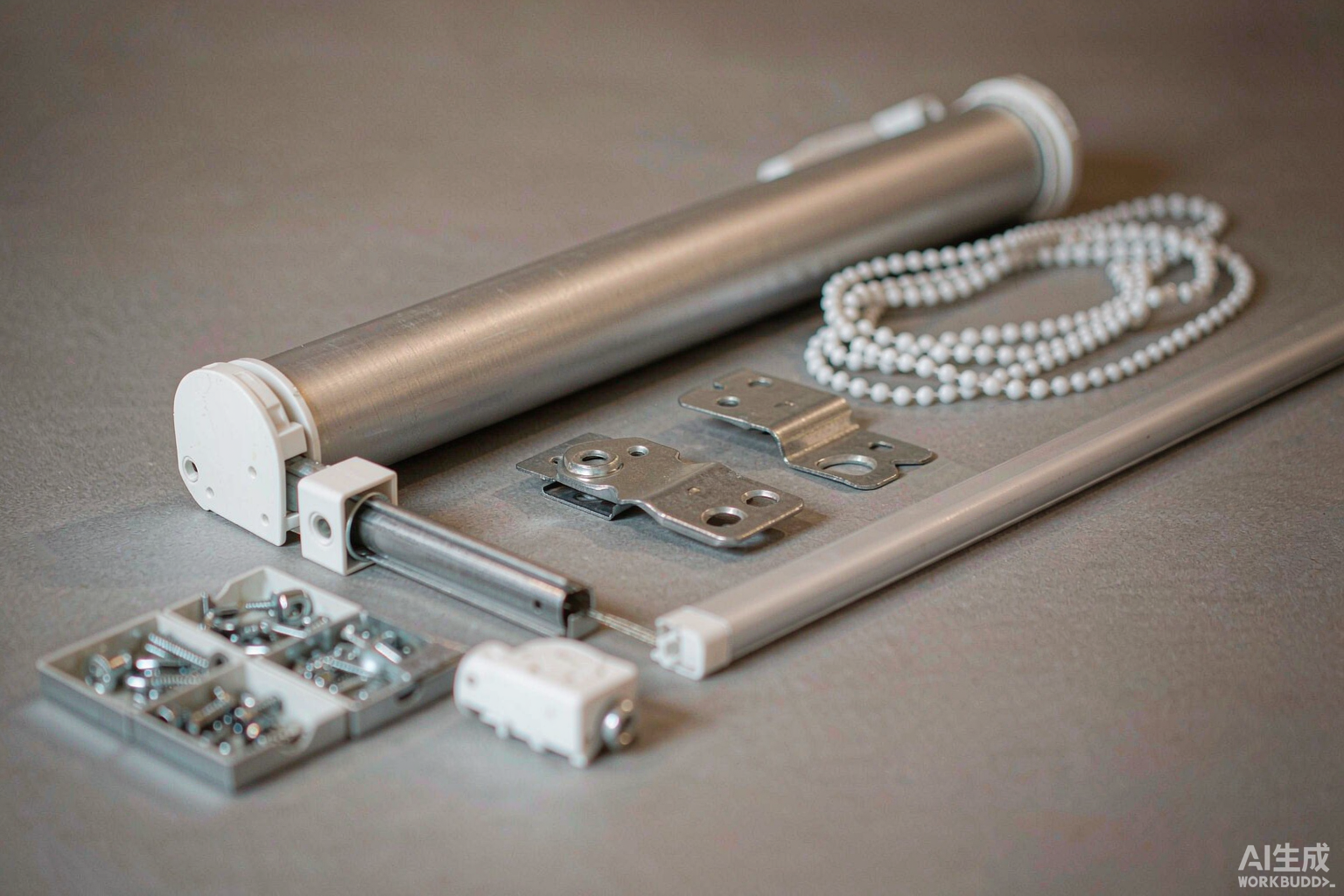
The global roller blind market still grows at roughly 5% a year, yet most end-user complaints are not about the fabric but about tubes, clutches, end caps and bead chains. This guide breaks down the hardware BOM, six fabric-to-hardware matching parameters and the compliance gates, plus a one-container sourcing plan.
Beyond the Fabric: The Invisible Half of a Roller Blind
Over the past two years we have talked with a lot of overseas buyers who arrive with the same story. They compared three rounds of fabric swatch rings, approved samples twice, shipped the goods, installed the blinds — and then the complaints came in. Not about the cloth. About blinds that would not fit, would not pull, would not hang straight, or simply fell down. When the systems were opened up, the culprit was almost always hardware: a tube wall too thin so the blind sagged in the middle; an end cap with loose tolerances that rattled; a clutch that did not match the tube diameter so the blind rebounded on its own; a bottom rail too light so the hem fluttered instead of hanging clean.
In the roller blind category, fabric represents roughly 50–65% of the bill of materials, and it determines what the end customer sees. Hardware represents roughly 20–30%, and it determines what the end customer experiences — and how often they call you back. For procurement teams, this is the invisible half of the product, and it is where the money quietly leaks out. This guide opens the hardware system up: what is in the bill of materials, how each part has to match the fabric, which traps buyers fall into, and how to ship fabric and hardware together from China without creating a second supply chain.
1. The Market Still Grows, but the Growth Has Moved to the System
Forecast houses disagree on scope, but they agree on direction. On the 360iResearch definition, the global roller blinds market was about USD 1.86 billion in 2025, roughly USD 1.96 billion in 2026, growing at a 5.33% CAGR to about USD 2.67 billion by 2032. Data Insights Reports uses a broader “fabric roller blind” scope of about USD 4.67 billion in 2025, reaching USD 7.6 billion by 2034 at a 5.5% CAGR, with Europe the largest value hub, blackout the dominant product type at roughly 37% of product revenue, commanding a 20–25% price premium over translucent alternatives. Fortune Business Insights puts the wider blinds-and-shades category at USD 7.13 billion in 2025, USD 7.51 billion in 2026, a 2.45% CAGR to USD 9.11 billion by 2034, with North America at 50.63% share.
Scope differences are less important than three consistent findings. First, replacement and renovation demand is more stable than new construction. Because roller blinds are retrofit-friendly, they benefit from ageing building stock in Europe and North America without any facade work. Second, motorised variants are the fastest-growing segment at roughly 15% CAGR, against about 10% for manual. Third, residential accounts for roughly 60% of demand, but the commercial segment is growing faster because building energy codes are pushing solar shading into specification. Commercial property owners using solar-rated fabrics can cut perimeter-office cooling loads by a meaningful margin, which converts shading directly into operating savings.
Those three findings point to one procurement conclusion: your customer is no longer buying a roll of fabric, they are buying a system that fits, pulls, connects and can be warrantied. Every metal and plastic part inside that system will be tested by the end user for five to ten years.
2. The Real Bill of Materials for a Roller Blind
First-time buyers often ask for a fabric price per metre and assume the job is done. A finished roller blind is closer to this:
- Tube. Typically 28mm, 32mm or 38mm in aluminium or PVC. Diameter and wall thickness set the bending resistance; wide windows and heavy fabrics must step up in diameter or wall gauge.
- Crown and clutch. One end is fixed (crown / idler), the other is the clutch driven by the bead chain. This pair decides whether the blind glides or slips, rebounds, or jams.
- Bead chain. Usually 4.5mm or 6mm ball chain. Colour has to sit with the fabric and the interior, and the chain system has to satisfy child-safety rules.
- Brackets and fixings. Ceiling mount, wall mount and recess mount each need a different bracket; expansion bolts, self-tapping screws and clips must match the wall substrate.
- Bottom rail. Decides whether the hem hangs clean and whether it swings under ventilation or a breeze. Options include plain aluminium, fabric-wrapped and weighted rails.
- End caps. Decorative and structural. In wholesale, MOQs of 1,000 sets and up are common; ex-works bulk pricing runs roughly USD 0.55–0.79 per set, while retail DIY repair kits sell for USD 8–10.
- Side channels and guides. Used in full-blackout and project work to stop light leaking around the edge.
- Motor and controls. Tubular motors, lithium or solar power, remotes and gateways. Since 2026 more projects require Matter, Zigbee or KNX compatibility, and that must be confirmed before the order is placed, not after.
3. Six Parameters That Tie Fabric to Hardware
Hardware is not a generic commodity you can swap freely. Lock these six parameters at quotation stage or your bulk run will fail:
1) Tube diameter × fabric weight × window width. This is the single most common failure. The heavier the fabric and the wider the window, the more bending section the tube needs. As a rule of thumb, beyond roughly 2.5 metres of width a 32mm tube usually stops being enough and 38mm, or a heavier-wall aluminium tube, becomes necessary.
2) Roll diameter. The wound fabric must fit the installation envelope — the cassette inner diameter or the channel spacing. Roll diameter is a function of fabric thickness multiplied by the number of wraps, and the number of wraps is a function of drop height. If a designer specifies a window opening and procurement quietly upgrades to a thicker fabric while keeping the old cassette, the blind jams halfway down.
3) Torque and clutch ratio. Manual blinds rely on the bead chain driving a clutch; if the reduction ratio does not match the tube diameter and fabric weight you get either a blind that will not pull or one that free-falls. Motorised blinds need the motor's rated torque in Nm matched against a tube-diameter compatibility table. Ask for that table and file it with the approved sample.
4) Width, height and fabric direction. Whether the blind is made to a fixed drop or a fixed width determines tube length and bracket spacing, and it also determines whether the fabric must be rail-roaded, which changes consumption and cost.
5) Colour consistency. Brackets, end caps, chains, bottom rails and channels come in white, grey, black, champagne and matt black. If one container carries pure white brackets, off-white end caps and grey-white chain, the end customer will see it immediately. Buyers running their own brand should write the colour reference into the contract annex.
6) Surface treatment and durability. Exterior and semi-exterior blinds (pergolas, patios, verandas) need weather-rated hardware. Coastal markets — the Gulf, coastal Australia, South-East Asia — need salt-spray testing, or white rust appears within a season.
4. Four Hidden Difficulties in Hardware Sourcing
One: the SKU tail is enormous. A roller blind component catalogue easily runs to a thousand SKUs, while a single purchase order may call for a few hundred pieces of each. For the factory, the mould changes, colour changes and packing changes carry a hidden cost far above material cost.
Two: MOQ thresholds are high. Established hardware plants typically ask 3,000–5,000 pieces for plated and zinc-alloy parts. Small buyers are pushed to traders and pay 15–30% more.
Three: short-shipment rate. This is the most under-estimated hidden cost. What an installer fears most is finding three brackets missing from a hundred sets; the air freight to replace them can cost fifty times their value. The only real fix is contractual: write a spare ratio into the agreement. The industry norm is 5–8% over-shipment on hardware and 3–5% on fabric.
Four: mixed lots and colour drift. Components from different suppliers rarely line up on tolerance or colour. This is precisely why sourcing fabric and hardware from one partner usually costs less in total than splitting the order to chase the lowest unit price on each line.
5. The Commercial Case for Bundling Fabric and Hardware
When fabric and hardware leave the same supplier and the same industrial park, the buyer captures three concrete gains.
Gain one: freight. Hardware is small but heavy, so its share of freight is disproportionately high. Shipping it in the same FCL, or in the same LCL consolidation as the fabric, typically cuts the landed cost of the hardware line by more than 20%.
Gain two: one inspection. A single pre-shipment inspection covers fabric and hardware, saving a full third-party inspection fee, commonly USD 300–600 per visit.
Gain three: one accountable party. If the blind does not fit, there is one counterparty to fix it, instead of a fabric mill blaming bracket tolerance and a bracket plant blaming excess fabric thickness.
In practice, order against a project ratio table. Fix the target market's product mix first — for example 60% standard manual blinds, 25% blackout blinds, 15% motorised — then derive hardware ratios and spare quantities from that mix and place one container-sized order. This satisfies supplier MOQs and spreads the fixed cost.
6. Compliance: Hardware Faces Harder Doors Than Fabric
1) Child safety. EN 13120 in the EU and ANSI/WCMA in North America set explicit requirements on accessible cord and bead-chain length; non-compliant products have been recalled in multiple markets. For any roller blind export, ask for the EN 13120 structural statement and for the safety devices — chain tensioners, breakaway connectors — to ship as standard rather than as options.
2) Heavy metals and chemistry. Plated parts and PVC parts are priority targets under REACH (the SVHC list), RoHS and US CPSIA lead limits. Specify trivalent chromium plating rather than hexavalent chromium for metal components.
3) Flammability. Hospitality and commercial projects often require the whole window system to satisfy BS 5867, NFP 92-503, NFPA 701 or EN 13501. A compliant fabric paired with a non-compliant PVC end cap can still fail the assembly.
4) Recyclability and sustainability. European circular-economy expectations now reach into hardware. Aluminium and mono-material plastics such as PP and PA are easier to recover than mixed-material assemblies, and easier to defend in a customer ESG questionnaire.
7. The China Export Route: Cluster Specialisation and Shipping Rhythm
China's roller blind chain is clearly specialised. Zhejiang, especially Shaoxing and Ningbo, concentrates on fabric and weaving. Guangdong, especially Foshan and Dongguan, concentrates on aluminium profiles and hardware machining. Jiangsu and Hebei add aluminium extrusion and surface treatment capacity. Consolidating all three stages under one supplier is exactly how an overseas buyer ends up with a complete system rather than a pile of parts.
On the shipping side, China's textile and apparel exports for the first eight months of 2026 reached USD 203.31 billion on a USD basis, up 3.1% year on year, with textiles alone at USD 98.03 billion, up 3.7% (China Customs data). The underlying export base remains solid, but freight rates and surcharges move sharply, so the contract must state the shipping window and who absorbs surcharges.
One more detail worth checking with a customs broker early: hardware and fabric sit in the same HS chapter but different tariff lines, so they must be declared separately. Some markets, including Brazil and Turkey, levy a higher duty on finished blinds than on “fabric plus components”. That is why a number of buyers export components and assemble locally — a decision best taken before the project starts, not at the port.
8. Eight Practical Moves for Buyers
- Request the tube-diameter / torque / fabric-weight compatibility table at sampling stage and make it part of the approved-sample file.
- Put roll diameter in the specification and ask for a figure calculated at maximum drop height rather than an estimate.
- Contract 5–8% over-shipment on hardware and 3–5% on fabric so you never air-freight a few missing brackets.
- Ask for a colour reference for hardware from the same production lot and lock it in the contract annex.
- For coastal and outdoor projects, require salt-spray test reports, ideally 96 hours or more.
- For any motorised project, confirm protocol support (Matter / Zigbee / KNX) and motor torque model at quotation stage.
- Ship child-safety devices with the goods and show them in the installation manual; never treat them as optional.
- Keep fabric and hardware on one purchase order in one container, covered by one inspection report.
Why More Buyers Hand the Whole System to Wanbo
Wanbo has worked the Shaoxing industrial belt for years, and we do more than fabric. Roller blind fabric in blackout, semi-blackout, screen and solar, jacquard and coated woven constructions; matching tubes, end caps, bead chains and clutches, brackets, bottom rails and side channels; and motorised assemblies with tubular motors and smart gateways — all on one purchase order, inspected and stuffed in the same park.
For an overseas buyer that means fewer suppliers, a shorter communication chain and a single accountable party for quality. For a brand owner it means an OEM/ODM partner that genuinely understands fabric, structure and compliance as one problem. If you are building the supply chain for your next roller blind programme, send us your window schedule, target market and quantity mix, and we will come back with a complete quotation covering fabric, hardware and shipping.