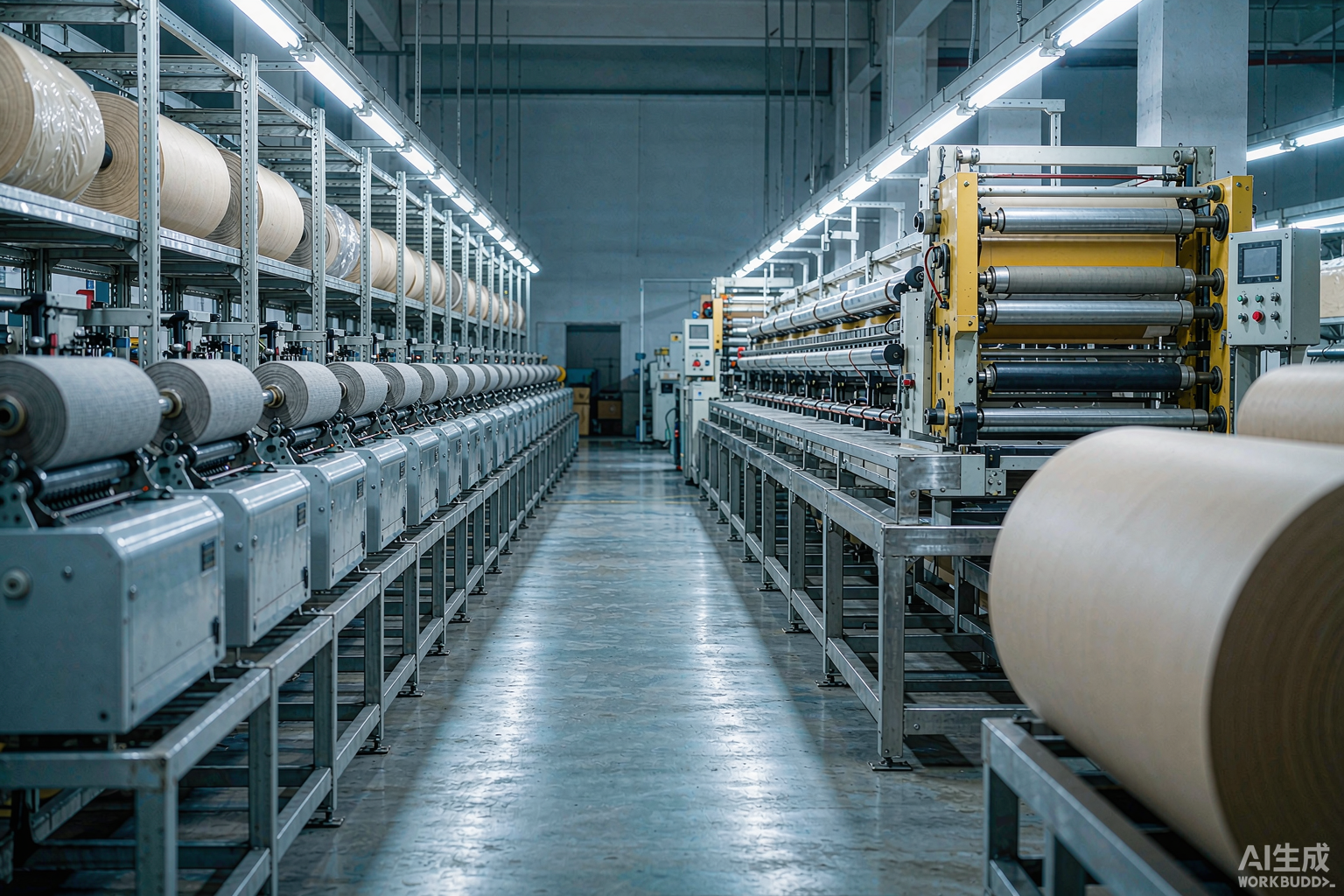
Delivery failures are rarely caused by production accidents — nine times out of ten, nobody verified the supplier’s real capacity before placing the order. This article breaks down the most inflated figure in the industry, explains how the bottleneck stage governs total capacity across weaving, dyeing, coating, setting and packing, and gives six practical verification checks. It then dissects lead time from order confirmation to container loading, lists four calendar risk windows, and sets out seven risk control tools plus a workable definition of on-time delivery.
In export trade, what damages a customer relationship most is rarely quality — it is lead time. Two weeks late and the distributor's shelves sit empty, a construction schedule slips, or a marketplace promotion window is missed outright. For project customers such as hotels and office buildings, a late delivery can push back the whole handover, and the penalty clause kicks in immediately. Yet the root cause of a delivery failure is almost never a production accident: nine times out of ten it is that nobody genuinely verified how much capacity the supplier actually had before the order was placed.
This article covers two things: how to verify the number that suppliers overstate most often — capacity — and how to turn lead time from a verbal promise into a managed process.
1. Why capacity is the most inflated number in the industry
Almost every supplier can quote a monthly capacity figure, but very few volunteer how that figure was derived. There are three common sources of padding:
- Theoretical machine speed rather than real speed. The metres-per-minute on a machine's nameplate is an ideal figure. Real output is discounted by changeovers, adjustments, warp breaks, roll changes, cleaning and waiting time.
- Full utilisation rather than actual utilisation. Running only when orders exist, power restrictions, labour shortages and a book already full before peak season all push genuine available capacity well below the nominal number.
- Own plant only, with subcontracting counted as in-house. When capacity runs short the work is outsourced, and both quality and timing simultaneously leave your control.
So the important question is not “what is your monthly capacity” but “how much capacity do you have in each of the five production stages, and which one is the bottleneck”.
2. Breaking capacity down: the five stages of roller blind fabric
Roller blind shading fabric passes through roughly five stages, and total capacity equals the slowest of them:
- Weaving — water-jet or rapier looms produce the base cloth. The number of machines, their speed, width and warp density determine base cloth capacity, and at many mills this is the true bottleneck.
- Dyeing or dope dyeing — dyeing depends on the number of dye vats and the cycle time per batch. Dope dyeing with masterbatch in the spinning stage skips dyeing altogether, giving far more stable colour but requiring a high minimum order quantity.
- Coating, foaming or lamination — the coating line is a capital-intensive stage. A mill has few of them, so this is often the second bottleneck. The white coating on blackout fabric is applied here.
- Stenter setting, embossing or finishing — this determines width stability and hand feel, and the number of stenter frames is limited.
- Inspection, roll splitting and packing — it looks simple, but with too few hands this is where backlogs build fastest.
Understanding these five stages has a practical benefit: when a supplier says “yes, we can”, you can follow up by asking which stage has the free slot. If the bottleneck stage is full, spare capacity anywhere else will not produce your goods.
3. How to verify capacity: six things you can actually do
- Ask for the machine list and nameplate speeds, not for a summary figure. Request model, quantity, working width and speed of the main machines, and check that this matches workshop photographs.
- Ask about shift pattern and utilisation. One shift, two or three? How many days a week? What is current utilisation? This directly sets available machine hours.
- Look at work-in-progress and semi-finished turnover. The volume of greige stock, part-processed rolls and rolls awaiting inspection — and how old they look — is more truthful than any report.
- Work backwards from energy or dyestuff consumption. This is the most objective single check: take the electricity or auxiliary chemical consumption per unit of output, multiply by monthly consumption, and you can derive an approximate production volume.
- Ask to see the production scheduling board or order book. Do not look at the total — look at what date the line is already booked up to. That is your real constraint.
- Ask about the subcontracting ratio and the share held by long-standing customers. A high outsourcing ratio means uncertain timing. A high share held by existing customers means your ability to be slotted in is limited.
4. The full anatomy of lead time
Many buyers understand “lead time” as production days only, but between order confirmation and container loading there are more stages than expected. A typical breakdown is below, though the actual figures vary with order size, colour reference and season:
- Contract and technical confirmation — colour reference, width and weight, sample approval: 3 to 7 days.
- Raw material preparation — fast if yarn is in stock; 7 to 20 days if it must be purchased or custom-spun, and longer still for special masterbatch colours.
- Scheduling queue — up to 15 to 30 days in peak season. This is the least controllable segment of all.
- Production — weaving, dyeing, coating and setting together, typically 10 to 25 days.
- Inspection and packing — 3 to 7 days.
- Inland transport and customs declaration — 3 to 7 days.
- Vessel loading — by sailing schedule, usually one or two departures per week.
Once these stages are laid out, the conclusion is clear: the segment that genuinely needs to be locked in advance is the scheduling queue — and that is precisely the segment buyers can least easily see.
5. Calendar risk in peak season
Shading fabric exports have several recurring capacity crunch periods that purchasing plans must avoid or pre-empt:
- Around Chinese New Year — a rush before the holiday and a one- to two-week ramp-up after it, so the practical impact often spans a full month. This is the single biggest variable of the year.
- Around Ramadan and Eid — orders for Middle Eastern markets ship in a concentrated window, while local customs and logistics efficiency fall over the same period.
- European summer holidays — European customers and forwarders slow down across July and August, and both confirmation and customs clearance take longer.
- The ocean freight peak before Christmas and Black Friday — tight space and rising rates, overlapping with the factory peak season.
- Immediately before and after major trade shows — staff are pulled from the lines to prepare the booth and follow up visitors, so production hands shrink at the same moment.
6. Seven tools for controlling lead time risk
- Book capacity 90 to 120 days ahead. For peak-season orders, the cost of booking early is far lower than the cost of arriving late.
- Sign a capacity reservation agreement. Set a monthly reserved quantity or machine-hour allocation, and state clearly what happens if it is breached.
- Ship in instalments. Split a large order into several batches so the first tranche can go on the shelf or into installation while the rest arrives on plan.
- Write explicit penalty and delay clauses. The purpose is not to claim damages but to make the supplier schedule your order earlier.
- Build a second supplier. Even a 20% share can protect delivery at the critical moment.
- Hold safety stock. For fast-moving standard colours, keeping two to three weeks of sales in the warehouse is more economical than chasing zero inventory.
- Require checkpoints at key milestones. Agree on four gates — raw material arrival, weaving complete, coating complete and packing complete — require photographic or written confirmation, and attend the factory in person for critical orders.
7. How to measure on-time delivery
If lead time is to be managed with data, the definition must come first: on-time delivery should compare the confirmed order delivery date with the actual container loading date, be counted by batch rather than by order, and allow a grace period of 3 to 5 days. Batches inside the grace period still count as on time but should be flagged separately, and two consecutive breaches beyond the grace period should trigger a capacity review. Only with a consistent definition does the number have management value.
8. A practical checklist for buyers
- Before ordering, ask for the current booked-up date of the bottleneck stage, not just the total lead time.
- Put the day counts for each of the five stages into a contract annex as the basis for delay assessment.
- Start peak-season orders three to four months ahead and state the liability for delay in the contract.
- Require milestone confirmations in writing or image form, and arrange factory audits or on-site follow-up for important orders.
- Keep two to three weeks of safety stock for standard colour references.
- Record every actual delivery date to build long-term supplier on-time performance data.
- Develop at least one alternative supplier to avoid single-point dependency.
In its shading fabric export business, Shaoxing Wanbo works with a multi-market, multi-batch order structure and can provide customers with scheduling window confirmation, milestone feedback and instalment delivery arrangements, turning lead time from a verbal promise into a trackable process. If your order spans a peak season, the earlier the scheduling conversation starts, the more room you have.