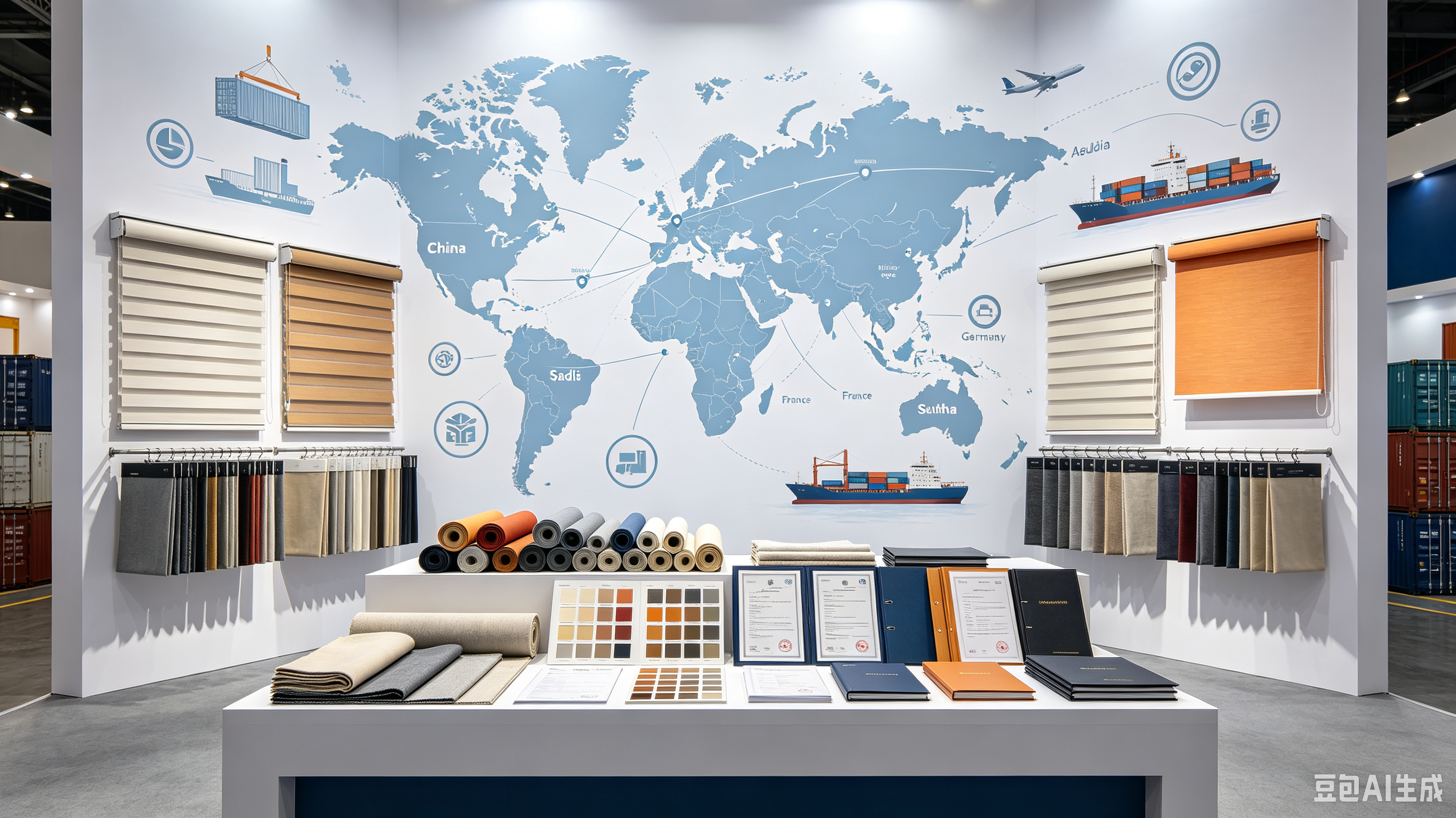
2026 international exhibitions show rising demand for roller shade fabrics. Global buyers are increasingly focusing on Chinese suppliers’ production capacity, certifications, stock availability and multi-modal shipping solutions.
roller shade fabric buyerchina curtain supplierwindow blind fabric exportshade fabric exhibition 2026international shipping solution
In 2026, the global market for roller blind and sunshade fabrics is entering a new growth cycle. Persistent heatwaves, building energy-saving renovations, expansion of outdoor spaces, upgrades of home furnishing window treatments, together with supply-demand matching opportunities brought by international exhibitions, continuously fuel the export growth of Chinese roller blind fabrics. Notably, buyers from the Middle East, Europe, Africa and other regions are shifting focus from simply "pursuing low-cost fabrics" to "seeking stable, compliant Chinese suppliers for long-term cooperation".
At recent large-scale international window covering and textile exhibitions, roller sunshade fabrics, blackout roller cloth, solar screen fabrics, outdoor awning fabrics and sheer horizontal blind fabrics have become highly inquired product categories. Nevertheless, many overseas buyers reported that although numerous suppliers attend exhibitions, it is not easy to screen genuine factories with independent production capacity, stable spot inventory, complete test certifications and diversified marine export solutions.
Starting from new trends in international procurement for 2026, this article combines popular exhibition fabrics, supplier screening standards, solutions for maritime risk mitigation and China export schemes, to deliver a practical purchasing guide of roller sunshade fabrics for overseas buyers.
I. Why Are Roller Sunshade Fabrics Attracting Continuous Attention from Overseas Buyers in 2026?
The rising demand for roller sunshade fabrics is driven jointly by climate, policies, construction sectors and retail markets rather than a single factor.
Firstly, sustained global high temperatures boost demands for building shading. Residential buildings, hotels, office towers, shops, restaurants and scenic outdoor areas all require curtain fabrics with thermal insulation, blackout and anti-UV functions. Thanks to convenient installation, simple maintenance and controllable costs, roller blinds become the preferred option in many overseas markets.
Secondly, building energy-saving policies push up demand for functional fabrics. Europe, the Middle East and other regions have raised stricter standards for building energy consumption. Sunshade fabrics are no longer merely decorative materials; they are critical products affecting indoor temperature, air conditioning energy consumption and living comfort.
Thirdly, international exhibitions accelerate supply chain restructuring. More overseas buyers hope to connect directly with Chinese factories at exhibitions to cut intermediate links, improve price transparency and guarantee stable supply. Therefore, suppliers equipped with R&D, production, testing and export logistics capabilities stand a better chance of securing long-term partnerships.
II. Hot Exhibition Fabrics: Which Roller Sunshade Fabrics Suit Overseas Markets?
Feedback from recent international exhibitions reveals obvious demand differences among customers from different regions. When selecting products, buyers should not only focus on "bestsellers", but also verify whether the fabrics comply with local climate, regulations and application scenarios.
1. High Heat Insulation Full Blackout Solar Fabric
This fabric gains remarkable attention in high-temperature Middle Eastern markets. Its core advantages lie in outstanding thermal insulation, blackout and anti-ultraviolet performance, ideal for hotels, office buildings, commercial complexes and residential projects. For markets enduring long-term temperatures above 40°C, buyers prioritize fabrics that can effectively lower indoor temperatures and reduce air conditioning loads.
Such fabrics generally require stable shading rate, thermal performance and flame retardant test reports. Especially for engineering orders, whether suppliers can provide complete certification documents directly affects project acceptance and customs clearance efficiency.
2. Eco-friendly Flame Retardant Blackout Roller Fabric
The European market imposes strict requirements on environmental protection and safety. Indicators such as flame resistance, low formaldehyde, sound insulation and thermal performance often serve as basic procurement prerequisites. Eco-friendly flame retardant blackout roller fabrics fit soft furnishing stores, hotel renovation, office refurbishment and apartment projects.
For European buyers, fabric color palette, hand feel, draping property and environmental compliance carry great importance. Compared with merely chasing low prices, European clients tend to choose suppliers with stable quality, minimal batch-to-batch discrepancy and complete certifications.
3. Waterproof Anti-UV Outdoor Sunshade Roller Fabric
Noticeable demand for outdoor sunshade fabrics emerges in Africa, Southeast Asia and parts of the Middle East. Scenarios including shops, restaurants, resorts, scenic spots and parking lot entrances require fabrics resistant to sunlight, rain, humidity and sandstorms.
When evaluating waterproof anti-UV outdoor roller fabrics, weather resistance, anti-aging capacity, color fastness and waterproof performance are key indicators. As outdoor projects demand high fabric durability, buyers should further confirm test reports and practical application cases after sampling at exhibitions.
4. Silent Thickened Blackout Base Fabric for Roller Blinds
The silent thickened blackout base fabric is a globally popular universal fabric. Suitable for home decoration, hotels, offices, apartments and electric roller blind systems, it enjoys high market acceptance. For small and medium wholesalers, this fabric features fast turnover and wide application scenarios, ideal for trial orders and restocking of regular hot items.
The key qualities of such fabrics include draping performance, stable shading effect, flat surface and controlled pulling noise. Hotel and apartment projects set higher standards for fabric texture and user experience.
III. Core Criteria for Overseas Buyers to Screen Chinese Suppliers at Exhibitions
Exhibition schedules are limited; buyers should not make decisions merely based on samples and quotations. Reliable suppliers ought to simultaneously possess capabilities covering product R&D, production control, quality inspection, export documentation and logistics coordination.
1. Independent Original Production Capacity
Premium suppliers should own weaving, coating, finishing and testing facilities instead of acting as pure trading resellers. If suppliers can provide factory photos, workshop videos, sample rooms, color card catalogues and quality control procedures, they own a more solid supply chain foundation.
2. Consistency Between Exhibition Samples and Mass Production Goods
Exhibition samples are elaborately displayed, yet the real capability test lies in whether bulk goods maintain identical color, GSM, shading rate, hand feel and packaging. Buyers should request samples of different batches, pre-production samples and test reports to avoid subsequent quality disputes.
3. Certifications Required for Target Markets
Requirements vary across countries and regions. Middle Eastern markets prioritize flame retardancy, thermal insulation and shading reports; European markets focus on environmental and flame retardant standards; African markets emphasize waterproofing, anti-UV property and durability. Complete certification documents facilitate customs clearance and support bidding for local engineering projects.
4. Stable Spot Stock & Flexible Order Acceptance
Without spot inventory for hot-selling fabrics, orders are prone to delays during peak seasons. Qualified suppliers should cater to both full-container engineering orders and small-batch trial orders, supporting progressive cooperation from sample confirmation, small trial shipments to repeated bulk orders for clients.
5. Capability to Offer Diversified Export Logistics Solutions
Fluctuations on the Red Sea route remind overseas buyers that relying on a single sea freight channel brings risks. Trustworthy suppliers can provide multiple options including ocean freight, railway transport, sea-rail intermodal transport and air freight, and offer reasonable suggestions according to destination, cargo volume and urgency.
IV. How Overseas Buyers Reduce Order Risks Amid Volatile Maritime Export Conditions
The current international trade environment is complex. Fluctuating ocean freight rates, sailing schedules, port congestion and transit risks may affect roller fabric exports. Buyers shall mitigate risks from four perspectives.
1. Adopt Combined Multi-Route Transportation
Do not rely entirely on one single shipping route. Sea freight can be adopted for regular restocking; railway or air freight for urgent orders; space reservation and shipment schedules can be planned in advance for long-term engineering orders.
2. Lock Inventory of Regular Hot-Selling Fabrics in Advance
High heat insulation full blackout fabrics, eco-friendly flame retardant fabrics, outdoor waterproof fabrics and thickened blackout base fabrics are regular categories with wide market recognition. Locking inventory in advance can lower risks of price hikes and delivery delays in peak seasons.
3. Confirm Export Documentation Ahead of Time
Documents including certificates of origin, test reports, packing lists, commercial invoices and manifests must be prepared beforehand. Incomplete paperwork may trigger customs clearance delays, rising port storage charges and even hinder cargo collection.
4. Establish Long-Term Partnerships with Suppliers
Long-term cooperative suppliers are more willing to reserve production capacity, prioritize space booking, stabilize quotations and provide after-sales support. Compared with frequently switching suppliers, selecting a comprehensive qualified Chinese factory helps reduce long-term procurement costs.
V. How China Export Solutions Help Overseas Buyers Stabilize Supply Chains
For overseas buyers, a China export solution means far more than "shipping goods out". It represents a complete supply chain service covering product selection, sampling, production, testing, space booking, customs clearance and after-sales service.
A stable export solution for roller sunshade fabrics should include:
- Recommend suitable fabrics based on target markets;
- Supply color cards, sample books and test reports;
- Support spot supply of regular hot-selling fabrics;
- Accept customization of special specifications;
- Provide multi-channel logistics: sea freight, railway transport, sea-rail intermodal transport;
- Prepare complete export documents;
- Track cargo transportation status;
- Handle after-sales issues such as color difference, damage and replenishment orders.
For Middle Eastern clients, priority should be given to thermal insulation, shading, flame retardancy and alternative railway transport solutions; For European clients, priority should be given to environmental standards, flame retardancy, small-batch mixed wholesale and sea-rail intermodal transport; For African clients, priority should be given to waterproofing, anti-UV performance, weather resistance and stability of long-distance ocean dedicated lines; For global small and medium wholesalers, priority should be given to universal hot-selling items, spot inventory and flexible trial order policies.
Conclusion
In 2026, the international demand for roller sunshade fabrics still enjoys growth potential, yet overseas buyers’ procurement logic is transforming. Price is no longer the sole consideration. Supply chain stability, product compliance, spot inventory, testing certifications and diversified logistics schemes are becoming core factors for selecting Chinese suppliers.
For Chinese suppliers, exhibitions serve not only as platforms to display samples, but also opportunities to prove factory capacity, product quality and export service capabilities. For overseas buyers, valuable cooperation never equals a single low-priced order, but long-term stable fabric supply and comprehensive export solutions.
After exhibitions, overseas buyers should focus on verifying suppliers’ production capacity, sample consistency, certification documents, spot inventory and logistics solutions before launching formal trial orders and long-term cooperation.