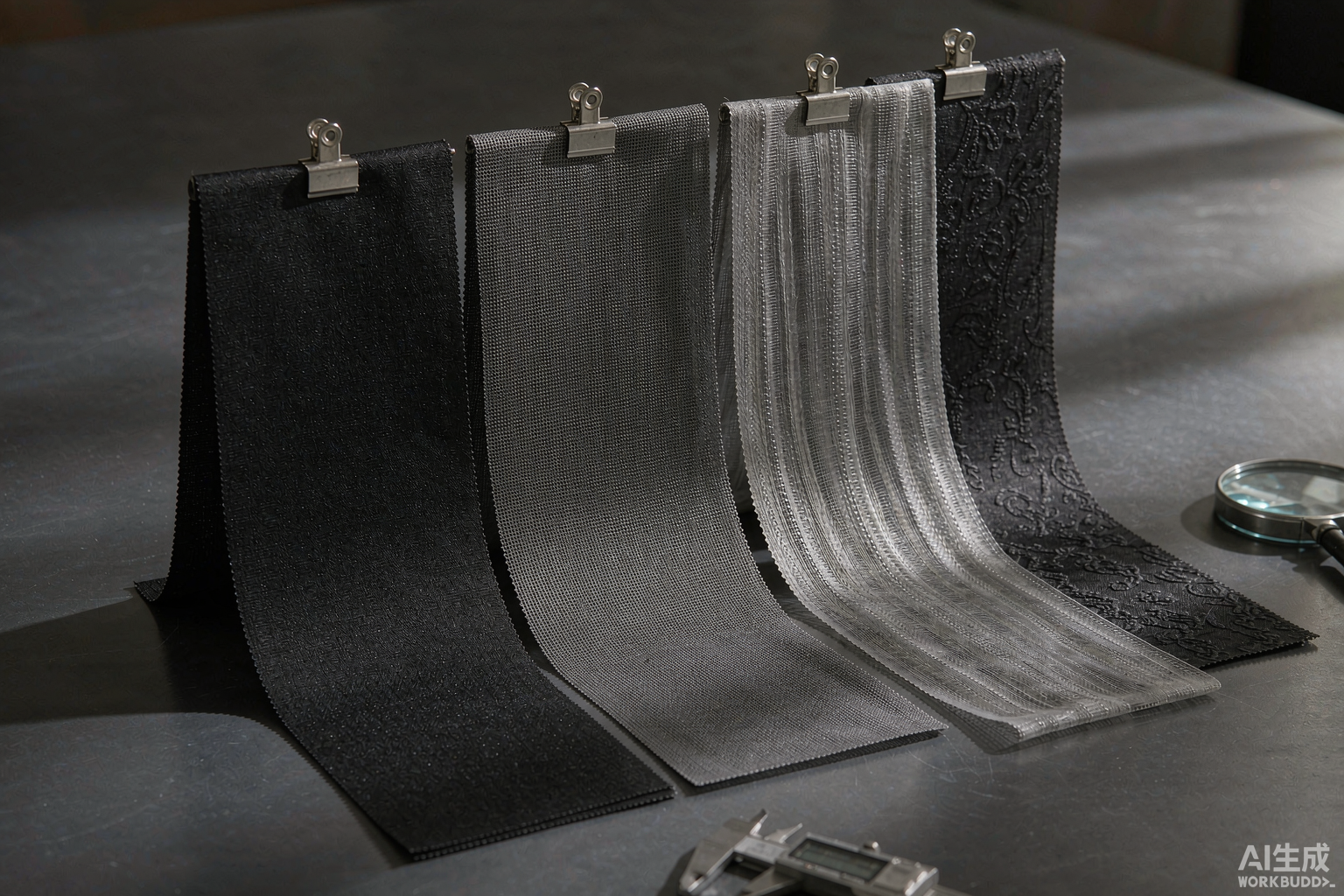
Blackout coatings live or die by pinholes and shade difference; sheers by transmittance and UV resistance; sofa fabric by Martindale and crackle uniformity; carpet by cold-proof backing; high-shrinkage by batch consistency. Seven categories, seven coordinate systems, plus eight mixed-container rules.
One Swatch Ring Cannot Cover a Whole-Category Order: an Engineering-Grade Comparison of Roller Shade Fabric, Sheer Voile, Sofa Fabric, Carpet, Jacquard, High-Shrinkage and Coated Fabrics
We keep meeting the same kind of buyer at fairs and in our factory: carrying a swatch ring that holds only roller shade fabrics, while purchasing an entire soft-furnishing project spanning curtains, upholstered furniture and rugs. The outcome is predictable — the roller shades are chosen well, but the sofa fabric fails Martindale, the carpet backing cracks, and the sheer curtains yellow within two months. The cause is not a bad supplier; it is that the seven categories each live in their own technical coordinate system, and applying one standard to all of them must fail. This article explains the core metrics, acceptance criteria and mixed-container shipping rules for roller shade fabric, sheer voile, sofa fabric, carpet, jacquard, high-shrinkage and coated fabrics in one pass — a comparison map that overseas buyers can carry straight to the inspection table.
1. Align the Language First: What Each Category Is and Where It Lives
These seven names are constantly confused, so let us draw the boundaries. Roller shade fabric is a single flat panel that winds onto a tube; its core metrics are light blocking and coating. Sheer voile is a light, translucent fabric that admits light but blocks the view; its core is transmittance and drape. Sofa fabric is upholstery; its core is abrasion resistance and pilling. Carpet is judged by weight, pile height and backing. Jacquard is a weaving structure — yarns floating up and down on the loom according to a pattern — and can appear in curtains, sofas or carpets alike. High-shrinkage yarn is an effect yarn that exploits differences in thermal shrinkage between fibers to create crinkled texture, used mostly in sofa and decorative fabrics. Coated fabric is a base cloth that has received a functional coating on the back or face (white glue, colored glue, PVC, acrylic, PU); most full-blackout roller shades rely on it. In one sentence: jacquard and high-shrinkage describe how it is woven, coating describes how it is finished, and roller shade, sheer, sofa and carpet describe where it is used — three dimensions that cross to form the complete selection vocabulary.
2. Roller Shade Fabric: Light Blocking, Openness Factor and Coating Process Are Three Lives
Roller shade fabric first divides into three families. Full blackout achieves 99%+ light blocking through coating, with mainstream weights of 220–320 g/m² — the workhorse of bedrooms, hotel guest rooms and cinemas. Dimout blocks 50–85%, common in meeting rooms and living rooms. Sunscreen fabric controls the openness factor through weave density (typically 1%, 3% or 5%); the smaller the openness, the stronger the light control and the narrower the view. Three failure points to check at acceptance: first, coating pinholes — hold the fabric against a light source and count star-point leaks; in engineering acceptance, more than three visible pinholes per meter is grounds for rejection. Second, coating odor and VOC — batches destined for the EU should ship with OEKO-TEX 100 or an equivalent REACH conformity declaration per lot. Third, shade difference — roller shades hang side by side on the same wall, so color difference within a roll and across rolls should sit at gray-scale grade 4 or better; below that the human eye sees it instantly.
3. Sheer Voile: Balancing Light, Privacy and Weathering
The acceptance logic of sheer fabric is entirely different from blackout: what it sells is not darkness but “daytime privacy.” Three core metrics: light transmittance (commonly 35–60%, with jacquard and contract voiles toward the top of the range); weight and drape (60–120 g/m² — below 60 the panel floats when hung, above 120 it stops feeling like a sheer); and UV resistance and lightfastness (for Australia and the Middle East always ask the UV-protection grade; in high-insolation regions select batches with lightfastness grade 5 or better, otherwise yellowing arrives within two months). Among the sub-types, jacquard voile offers rich texture for the premium-lifestyle channel; contract voile holds stable pricing for bulk hotel and apartment projects; warp-knit voile wins on value for volume; cotton-linen voile carries the natural hand that fits the organic trend. One reminder: extra-wide sheers (3.2–3.6 m) are a scarce resource for large-window projects — confirm the usable width before ordering, because seaming eats both aesthetics and margin.
4. Sofa Fabric: the Truth About Martindale, Pilling and Ice-Crack Texture
The first metric for sofa fabric is the Martindale abrasion count: from 20,000 cycles for home sofas, above 30,000 for hotel and contract use, and 50,000+ recommended for high-traffic commercial spaces. The second is the pilling grade (GB/T 4802 or ISO 12945; grade 4 is the passing line). The third is color fastness (grade 4+ to light, 3–4+ to wet and dry rubbing). The ice-crack texture that has swept high-end hospitality soft furnishings in recent years is, in essence, high-shrinkage yarn interwoven with regular yarn and then heat-treated — the shrinkage difference lifts the surface into a crackle motif. Its premium comes from the uniqueness of that texture, but inspection must add one more item: texture uniformity — when crackle density varies too much within one piece, an upholstered sofa looks like it was made from two different cloths. Finally, always reconcile the weight against the composition label: the blend ratio (polyester/linen, polyester/viscose) directly moves the triple balance of price, hand-feel and abrasion.
5. Carpet: Weight, Pile Height and Backing — Three Underestimated Things
Carpet is the category most often damaged by “photo-based purchasing.” Three hard metrics: weight (machine-woven decorative rugs commonly 500–1500 g/m²; under-weighted carpet collapses within three months); pile height (6–12 mm suits living rooms and hotel corridors); and backing (the flexibility and slip behavior of latex backing decides lifespan — cold-cracking backing is the most common invisible loss inside a sea container, because 40 days of winter trans-Pacific transit is cold enough to embrittle an inferior compound). For jacquard carpets, add pattern-registration accuracy: misaligned pattern repeats are infinitely magnified in large-area installations. For contract projects, require abrasion and anti-static reports — office and airport tenders usually write them directly into the technical specification.
6. Jacquard and High-Shrinkage: the Two Worlds of Structure and Effect Yarn
Jacquard splits by complexity into dobby jacquard (geometric tone-on-tone patterns) and full jacquard (photo-grade figurative motifs). Evaluate it on three points: pattern repeat (the size of the repeating unit, which decides how large areas read), weft density (which decides fineness of texture), and yarn combination (metallic or pearl fibers change the care requirements). High-shrinkage follows effect-yarn logic: two yarns with thermal shrinkage differing by 15–30% are interwoven, and after heat setting the higher-shrinkage yarn pushes the lower-shrinkage yarn into relief or crinkle. Its risk list is equally clear: in factories with unstable heat-setting temperature control, texture density drifts between batches of the same order. So the core assessment for high-shrinkage products is not the pattern but batch consistency — keep 2 meters of the approved trial sample and check every bulk lot against it, roll by roll.
7. Coated Fabric: the Process Ladder from White Glue to Functional Coating
Coating is the soul of full blackout — and the easiest place to cut corners. The ladder, low to high: white-glue coating (basic blackout, lowest cost, stiffer hand); colored-glue coating (the face color matches through, balancing blackout and appearance); PVC coating (strong durability and waterproofing but a complex environmental profile — EU buyers should check plasticizer compliance); acrylic/PU functional coatings (low VOC, soft hand, can carry flame-retardant or anti-bacterial function packages). The purchasing verification list: coating weight (which caps light blocking), bond strength between coating and base cloth (peel test), fold-whitening (if the coating whitens after 20 folds, the process is below standard), and burning behavior (contract markets ask for reports under EN 13501 or BS 5867). On price, this category rewards the old saying fully: a batch quoted 20% below comparable weight has almost always economized somewhere on coating weight or bond strength.
8. Seven Categories in One Container: the Mixed-Container Rules
- Load by weight tiers — carpets and heavy coated fabrics form the load-bearing bottom layer; sheer and jacquard fabrics ride on top, protected from dead creases over long transits.
- Rolled first, folded with limits — roller shade and coated fabrics go fully rolled; only crease-tolerant satins accept flat folding, and then with paper-tube padding every 20 pieces.
- Moisture discipline — load enough desiccant and wrap with moisture-barrier paper; coated fabric and carpet backing suffer adhesive damage from condensation, and 40-day voyages make this mandatory.
- One dye-lot sheet — list roll-by-roll dye numbers on the packing list so destination sorting never pairs lot A with order B.
- Samples travel first — keep two sealed samples of each category, one in the container and one at the factory; destination inspection then arbitrates against the seal at the lowest possible dispute cost.
- Certificates travel with the file — archive OEKO-TEX, REACH and flame-retardant reports by category in one PDF folder that accompanies the shipment; EU clearance and end-client acceptance then pass in one go.
- Cap mixed categories at five — beyond five, loading losses and documentation complexity outrun the freight saving of one container; split into two boxes.
- Give the factory a 3-day buffer — seven categories mean seven production sequences; agree “ship when complete” rather than “ship as ready” to avoid batch fragmentation.
Closing: the Winning Move in Whole-Category Sourcing Is One Factory, One Standard
Seven categories, seven coordinate systems. The hardest part for an overseas buyer is not understanding each system — it is finding a supplier whose single quality culture covers them all. Sourcing seven categories from seven vendors multiplies the cost of shade management, lead-time management and responsibility boundaries; a source factory that weaves, coats and finishes coated roller shades, sheers, jacquards, high-shrinkage textures, sofa fabrics and carpets under one roof solves color consistency and multi-category container completion by construction.
Wanbo has spent 15 years rooted in the Keqiao shading-fabric cluster, with complete weaving, coating and jacquard lines. Roller shade fabric, sheer voile, sofa fabric, carpet, jacquard, high-shrinkage and coated fabrics are supplied from one factory under one inspection standard, verifiable item by item against the metric system in this article, with multi-category mixed containers completed and shipped direct to major ports worldwide. If you are planning a cross-category soft-furnishing or contract project, send us the project list and we will return a technical parameter sheet per category that you can paste straight into the contract.