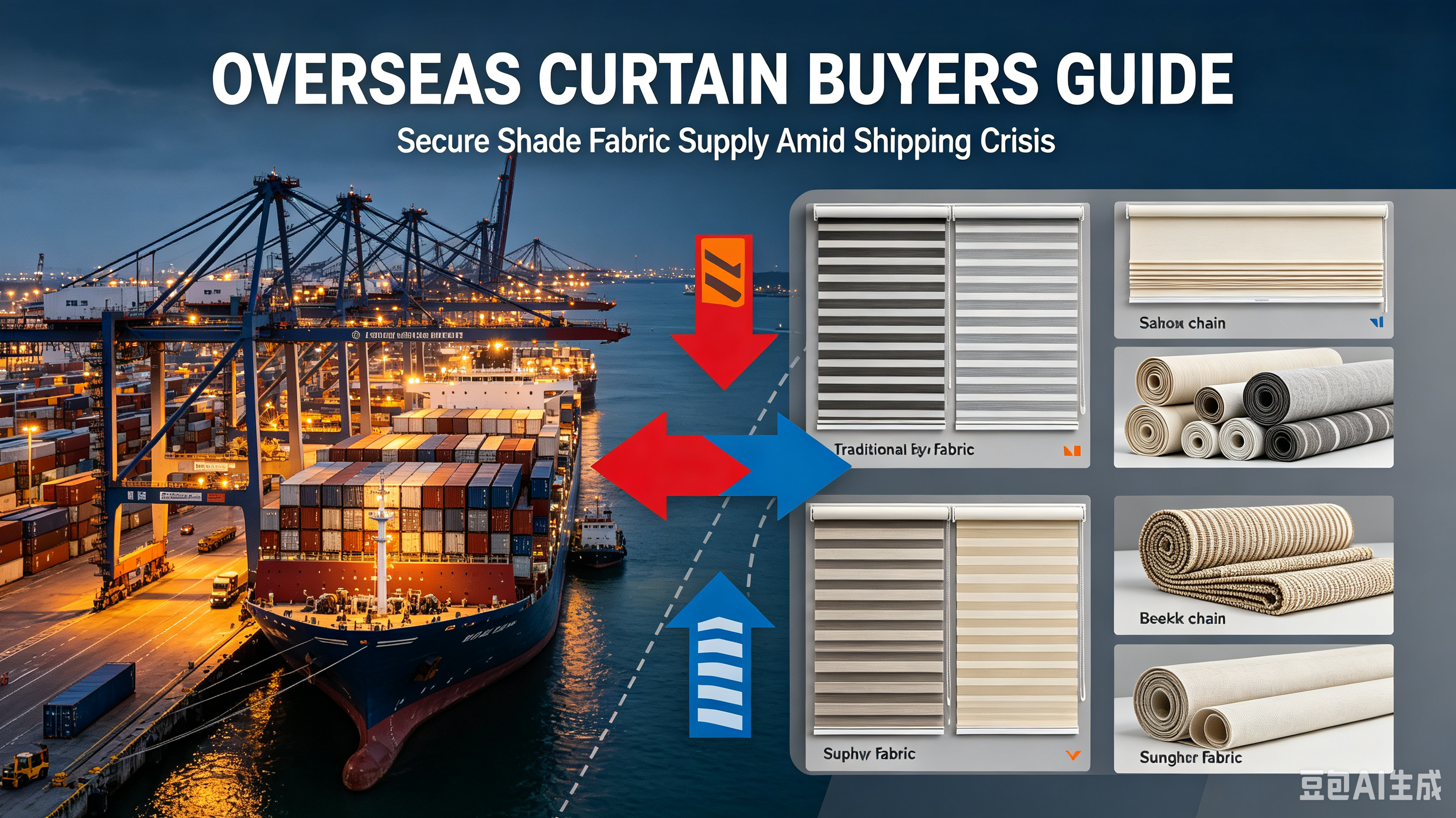
Red Sea port congestion raises freight, Keqiao shade fabric factory offers multi-modal supply for MENA Europe Africa buyers
shade fabric importroller blind wholesalemiddle east textile shippingwindow curtain suppliermulti-modal logistics
The global shipping market in 2026 continues to be impacted by geopolitical tensions in the Red Sea and Persian Gulf. Increased military deployments by the US in the Middle East have tightened channel control over straits, resulting in container congestion, scarce vessel space and skyrocketing war surcharges at core Middle Eastern ports including Jebel Ali, Dammam and Jeddah. Latest data from the International Textile Chamber of Commerce shows that total China’s export orders for Middle Eastern sun roller blinds and functional curtain fabrics rose by 21.6% year-on-year in the first half of this year, yet over 62% of overseas wholesalers report out-of-control shipping lead times, with logistics costs eroding profit margins sharply.
Saudi Arabia’s Vision 2030 new city construction boom, European hotel renovation waves and expanding commercial real estate projects across Africa keep driving purchasing demand for full blackout roller blinds, outdoor waterproof sun shade fabrics, honeycomb blinds and zebra blinds. However, sole reliance on Red Sea sea freight can no longer guarantee stable delivery cycles. A large number of engineering contractors and curtain retailers across the Middle East, Europe and Africa are urgently seeking alternative, highly stable fabric procurement channels.
As a fully integrated Keqiao manufacturer of sun shade fabrics and finished roller blinds, Shaoxing Wanbo Import & Export Co., Ltd. has engaged in overseas window covering trade for years. Supported by self-owned fabric production capacity, multi-modal logistics networks and multilingual foreign trade services, we deliver one-stop solutions to resolve three core pain points of overseas buyers: unstable supply, shipping delays and excessive logistics costs. Combined with 2026 shipping industry news and global sun shading market statistics, this article sorts out low-cost, fast-turnaround procurement solutions for curtain purchasers worldwide.
I. Middle East Port Shipping Crisis: Four Major Actual Losses for Curtain Import Trade
1.1 Extended Delivery Cycles Lead to Liquidated Damages for Overdue Engineering Projects
Traffic control over the Bab-el-Mandeb and Hormuz Straits has cut direct sailings to Saudi Arabia and the UAE by 50%, forcing cargo vessels to detour around the Cape of Good Hope. Standard transit time from Shaoxing to the Middle East has stretched from 22 days to 38–45 days; European routes face an additional 8–15 days of transshipment.
Shipping analytics firm Alphaliner records that over 130 textile containers were stranded in Middle Eastern port yards as of July 2026. Real case of a large soft furnishing contractor in Riyadh, Saudi Arabia: bulk procurement of zebra blind fabrics for hotel projects scheduled for delivery in 30 days was detained at port for 46 days, incurring liquidated damages exceeding 120,000 Dirhams due to delayed hotel opening.
1.2 Sharp Surge in Comprehensive Sea Freight Shrinks End-user Profit Margins Dramatically
War surcharges and vessel insurance premiums for Middle East routes have risen simultaneously, adding an extra USD 1,600–4,200 per full container load of textiles. Overall logistics costs have soared from 4.8% of cargo value to 18%–27%. Sun shade fabrics fall under low-margin light industrial goods; if European and Gulf small & medium dealers refrain from raising retail prices, single-item profit will plummet by over 42%. Many buyers are forced to downgrade fabric quality, losing premium clients such as high-end hotels and office buildings.
1.3 Single Sea Freight Channel Without Alternatives Causes Broken Inventory Turnover
90% of local Middle Eastern curtain wholesalers solely rely on Red Sea shipping for restocking, leaving no backup transport solutions once waterways are restricted. China Customs data for Jan–June shows China’s exports of curtain fabrics to the six Gulf Cooperation Council states dropped 28.7% month-on-month. The core driver is overseas purchasers hesitating to place large-batch orders, with fragmented small orders pushing up unit transport costs. Outdoor sun shade fabric buyers in South Africa and Nigeria also face stock replenishment disruptions caused by volatile Asia-Europe shipping lanes.
1.4 More Frequent Port Inspections Double Cargo Detention Risks
Driven by regional security control policies, textile container random inspection rates at major Middle Eastern ports have tripled. Average inspection time for roller blinds and solar fabrics lasts 7–10 days, further prolonging overall delivery cycles, pushing the churn rate of time-sensitive engineering clients up by 35%.
II. Full Industrial Chain Advantages of Shaoxing Wanbo Import & Export: Eliminate Procurement & Logistics Risks From the Source
2.1 Self-developed Full-range Sun Shade Fabrics With Mass Spot Stock Shorten Production Lead Times
The enterprise integrates independent fabric R&D, weaving, dyeing and finished roller blind manufacturing, covering a complete lineup: full blackout roller blinds, electric adjustable sheer blinds, zebra sheer blinds, Shangri-La blinds, honeycomb blinds, venetian blinds and outdoor waterproof sun shade fabrics, customized for residential, hotel, office, retail and small window scenarios.
- Spot inventory reserve: Over 200 hot-selling fabric types stocked year-round. Saudi heat-insulating UV-resistant solar cloth, minimalist European sheer fabrics and African UV-proof outdoor roller cloth can be shipped the same day, eliminating 15–50 days of production scheduling wait time;
- Flexible customized production capacity: Custom thickened blackout, waterproof & mildew-proof, sound-insulating flame-retardant functional fabrics available on demand, with full finished blind processing completed within 12 days — far faster than Southeast Asian OEM factories;
- One-stop bundled shipment by scenario: Fabrics + finished roller blinds + complete installation accessories packed together, removing secondary processing work for overseas clients and cutting labor costs.
Fabric performance tailored to local climates: heat-insulating heavy-duty variants for hot Middle Eastern regions, waterproof versions for rainy European areas, UV-resistant heavy-duty cloth for Africa, with combined sound insulation, fire resistance and anti-aging performance.
2.2 Three Independent Multi-modal Logistics Schemes to Bypass Congested Middle Eastern Ports
To address instability of Red Sea shipping lanes, Wanbo offers three separate independent transport routes for clients to choose freely, breaking reliance on sole sea freight:
- Cross-border Central Asia Railway (Top Pick for Saudi Arabia, UAE, Qatar)
"Keqiao-Central Asia" international freight train departs from Qianqing, Keqiao, passing Xinjiang border ports to reach inland Middle Eastern warehouses in 26–32 days. Unaffected by strait blockades with no temporary war surcharges, ideal for large-volume engineering orders;
- Sea-Rail Intermodal Mediterranean Line (For European & North African Clients)
Direct shipment from Shaoxing ports to the Mediterranean and Durban, South Africa, bypassing congested Persian Gulf ports. Terminal loading & unloading efficiency improved by 50%, drastically cutting container detention risks;
- Urgent Air Freight Channel (For time-sensitive hotel renovation orders & sample shipments)
Fabric samples and small-batch finished blinds delivered to major global airports within 7 days, resolving critical schedule delays for rush projects.
2.3 Dedicated Multilingual Foreign Trade Service Aligned With Local Middle Eastern / European / African Procurement Habits
- Trilingual Chinese-English-Arabic sales team: Full Arabic-language communication available for Saudi & UAE clients, with precise matching of locally popular window covering styles;
- Real-time shipping alert service: Synchronized updates on global port congestion, freight rate adjustments and inspection policies, enabling advance planning of optimal shipping routes to avoid extra charges and delays;
- One-stop consolidated procurement: Centralized sourcing of full-series sun shading window coverings to combine multiple orders into single containers and split logistics overheads, effectively slashing per-meter fabric transport costs.
III. Region-specific Optimal Procurement Solutions (Exclusive for Saudi Arabia / Europe / African Clients)
3.1 Procurement Plan for Saudi Arabia, UAE & Gulf Cooperation Council Countries
Pain points: High demand for heat-insulating full blackout fabrics due to year-round extreme heat; severe delays for direct Red Sea sailings
Recommended solution: In-stock heat-blocking solar fabrics + Central Asia railway direct delivery to inland warehouses. Highest cost-performance for large engineering orders, unaffected by port congestion to guarantee on-time delivery for hotel and new city construction projects.
3.2 Procurement Plan for European & Mediterranean Countries
Pain points: Market preference for sheer zebra blinds and Shangri-La blinds; soaring detour sea freight rates
Recommended solution: Mediterranean sea-rail intermodal transport, full-container shipments of finished roller blinds with stable long-term freight rates, suitable for long-term cooperation with chain soft furnishing stores and hotel wholesalers.
3.3 Procurement Plan for South Africa & West African Nations
Pain points: Strong demand for outdoor waterproof roller blinds; frequent volatility on Asia-Europe shipping lanes
Recommended solution: Direct sea freight line to Durban paired with in-stock waterproof UV-resistant outdoor fabrics, reducing losses from transshipment detention, tailored for outdoor real estate and resort projects.
IV. Long-term Risk Mitigation Strategies for Overseas Curtain Purchasers
- Prioritize self-owned integrated domestic manufacturers to avoid markup by middlemen, with sufficient spot inventory acting as a buffer against logistics delays;
- Avoid sole dependence on Red Sea sea freight; pre-plan backup transport alternatives including railway and Mediterranean sea-rail intermodal routes;
- Consolidate bulk full-container orders to split sea freight surcharges and cut unit procurement costs;
- Maintain real-time logistics updates with suppliers to predict freight hikes and channel blockades, placing orders during off-peak shipping windows.
Conclusion
Maritime pressure stemming from 2026 Middle East geopolitical conflicts cannot be alleviated in the short term. Port congestion and freight hikes across the Red Sea and Persian Gulf will continuously disrupt import trade for curtains and sun shade fabrics. If curtain wholesalers and hotel engineering purchasers from the Middle East, Europe and Africa continue relying on traditional sea freight middlemen, they will sustain compound losses including overdue liquidated damages, shrinking profit margins and lost clients.
As a large-scale integrated Keqiao manufacturer of sun shade fabrics and finished roller blinds, Shaoxing Wanbo Import & Export leverages a complete self-owned industrial chain with abundant spot stock, diversified cross-border logistics channels and dedicated trilingual foreign trade services to deliver all-in-one stable supply, controllable lead time and transparent quotation sun shading solutions for global window covering purchasers. We provide tailored schemes regardless of full-container large orders for major new city projects in Saudi Arabia, small-batch restocking for European home furnishing retail stores, or customized sun shading projects for African outdoor resorts. Feel free to contact our overseas sales specialists to request fabric color cards, samples, latest logistics quotations and complete product catalogs.