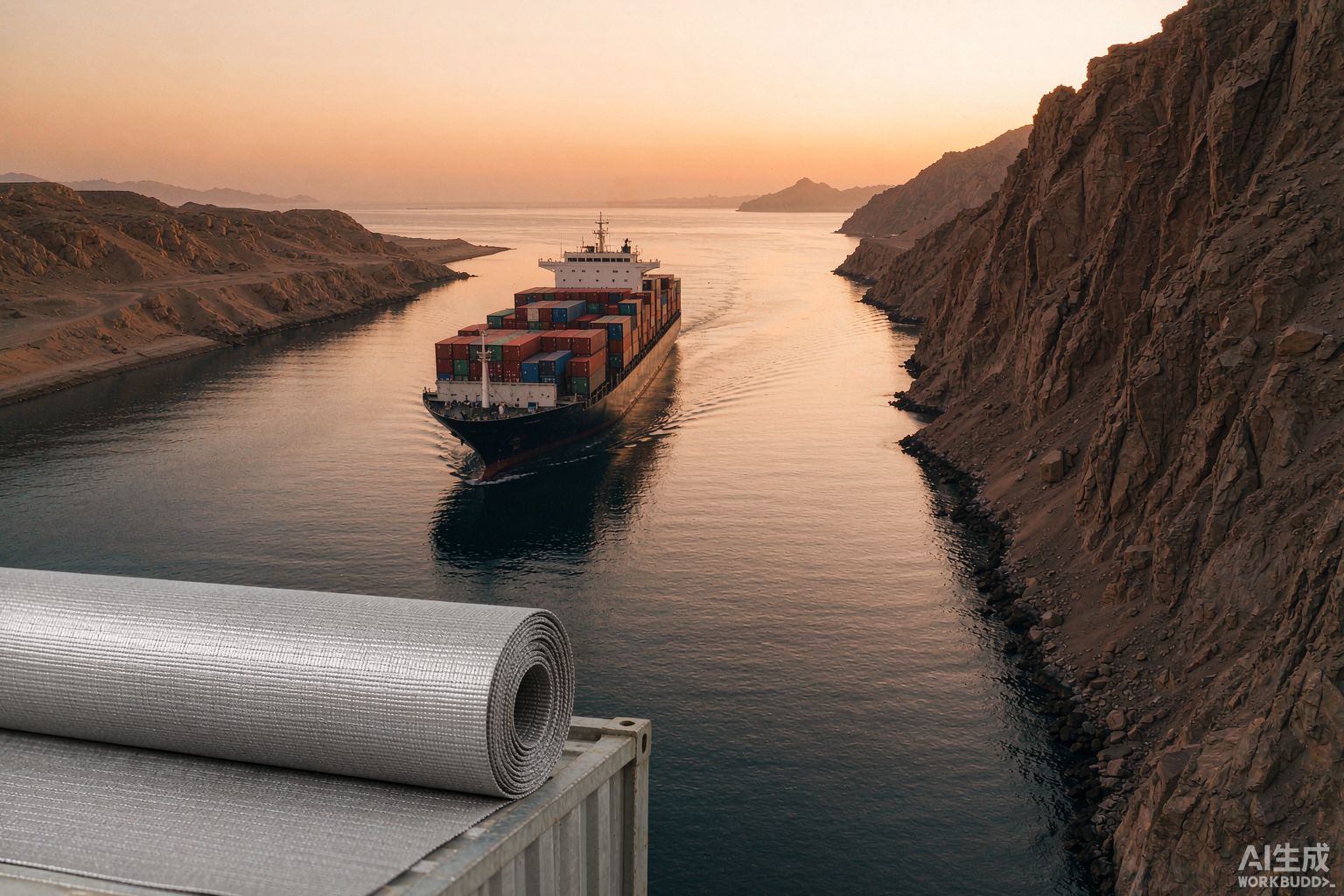
Houthi advances near Bab el-Mandeb, a 20% EFS hike at Maersk and a coordinated 19 October rate push — even as carriers return to Suez faster than expected. Based on early-October data from Drewry, Sea-Intelligence and Xeneta, here are eight practical moves for fabric exporters.
In October 2026, the global shipping industry is living through an unusual tug-of-war: container carriers are returning to the Suez Canal faster than expected, while at the same time the security situation around Bab el-Mandeb, the southern gateway to the Red Sea, has clearly deteriorated over the past month. For roller blind and sun-shading fabric exporters shipping to Europe, the Middle East and North America, this means bookings, insurance and contract terms all need a fresh look. This article is based on public data published in early October by Drewry, Sea-Intelligence, Linerlytica and Xeneta. Rates and the situation change daily; this article is intended to explain the structure, not to replace a quote of the day.
1. Bab el-Mandeb: from routine diversion back to the front line
Several events over recent weeks have been significant enough to change routing decisions at the southern end of the Red Sea. According to multiple public reports, around 10 September Houthi forces captured Mokha, a Red Sea town roughly 80 kilometres from the Bab el-Mandeb Strait; the number of vessels transiting the strait reportedly collapsed from about 30 the previous day to just 6. The Houthis subsequently announced a maritime embargo against Saudi Arabia and repeatedly attacked Saudi-linked targets in the Red Sea and the Gulf of Aden. The situation did not calm down in October: on 3 and 9 October, explosions were heard across the Saudi capital Riyadh, including near King Khalid International Airport, and the Saudi authorities reported casualties. Meanwhile Yemeni government forces backed by a Saudi-led coalition launched a counter-offensive, claiming to have retaken parts of the coastline around the strait; competing claims over control of the area remain unresolved.
On 8 October, the US Navy-led Joint Maritime Information Center (JMIC) issued a warning that attacks against commercial shipping had become "more frequent" and urged heightened crew vigilance. Think tanks such as the International Crisis Group remind us that Bab el-Mandeb carries roughly 30% of global container traffic, 15% of oil and shipping transits and 12% of annual global trade; a prolonged closure would have consequences far beyond the shipping industry itself. Piracy off Somalia has also re-emerged in the Gulf of Aden, exposing merchant vessels to a double threat of long-range missile and drone strikes plus boarding attempts by fast craft close to shore.
2. Risk is being re-priced: from premiums to freight rates
The first place a changing security situation shows up is risk pricing. According to trade reporting, daily earnings for Suezmax tankers briefly exceeded 680,000 US dollars, roughly five times their level at the start of October; insurance brokers have disclosed that single-transit war-risk premiums for the high-risk area have surged from around 250,000 US dollars before the escalation to as much as 10 million US dollars in extreme cases (premiums vary enormously by vessel type, owner and deductible; these figures reflect public industry reporting, not a standard tariff).
For container services, Drewry's 8 October report offers a straightforward calculation: for a container ship valued at 225 million US dollars, a war-risk premium of 0.3% of hull value would add about 1.35 million US dollars for two transits of the designated risk area; at 1%, the extra cost reaches 4.5 million US dollars — far more than the voyage-cost saving between the Cape of Good Hope and the Suez route. In other words, the level of war-risk premiums is now directly determining whether carriers dare to use Suez at all.
Fuel is the other cost being pushed up by the Middle East conflict. On 8 October, Maersk announced that from 12 October it would raise its Emergency Bunker Surcharge (EFS) to 20% on all export pickup and import delivery services, citing rising fuel costs caused by the continuing conflict. Fuel, insurance and longer routings stack on top of each other, which means every container shipped in the coming weeks may carry new surcharge lines on its invoice.
3. The paradox: carriers are accelerating their return to Suez
Remarkably, even as risk escalates, the list of carriers returning to Suez keeps growing. Drewry's 8 October report concludes that carriers are returning to the Suez Canal faster than expected. On pure cost grounds the choice looks unattractive: a 24,000 TEU container ship transiting Suez rather than rounding the Cape saves roughly 1 million US dollars per round voyage, only about 43 US dollars per slot. But Drewry argues that carriers value the shorter voyage (Asia–Europe round trips shrink from 124 to 97 days, a saving of 27 days and about 7,800 nautical miles), higher vessel utilisation, and competitive pressure more than the direct cost saving.
The recovery at service level is clearly visible: ONE's 8,110 TEU "ONE Continuity" sailed from Laem Chabang, Thailand on 17 October and is scheduled to transit the Suez Canal later in the month, making ONE the latest major carrier to resume Red Sea routings. CMA CGM, Maersk, MSC, Hapag-Lloyd and COSCO/OOCL had already restored partial Red Sea calls; CMA CGM's OCR service, Gemini's NE4 and AE5 services and the Premier Alliance's FE1 service have all officially returned. The recovery is nonetheless gradual: Maersk has restored only about one third of its normal Suez transits, and Evergreen remains entirely on the Cape of Good Hope route. Sea-Intelligence's measure shows roughly 27% of Asia–Europe capacity routed via the Red Sea/Suez in September, and Drewry's base case projects container transits of the Suez Canal recovering to 80% of pre-diversion levels by February 2027.
It is worth stressing that Drewry explicitly describes the current return as "a cautious operational adjustment, not a judgement that the Red Sea is fully safe" — carriers are generally keeping their Cape routings as a fallback. For cargo owners this means the same trade lane can carry two transit times and two price levels at the same time.
4. Freight rates: after 13 weeks of decline, a coordinated 19 October rate push
Rates present a complicated picture of falling meets rising. The Drewry World Container Index (WCI) stood at 4,351 US dollars per 40ft container on 8 October, down 2% week on week; Shanghai–Los Angeles fell 3% to 7,624 dollars, Shanghai–New York slipped 2% to 10,220 dollars, Shanghai–Rotterdam dropped 2% to 3,337 dollars and Shanghai–Genoa held at 3,696 dollars. Asia–Europe rates have now declined for 13 consecutive weeks, a cumulative fall of about 60% since July. The Shanghai Containerised Freight Index (SCFI, 30 September) closed at 3,662.30 points, with the Europe leg at 2,199 dollars per TEU (-4.9%); on Xeneta's measure, spot rates from the Far East to the Mediterranean are down 43% since 1 July, and to North Europe down 34%.
Carriers are now trying to reverse the trend: Maersk, CMA CGM, Hapag-Lloyd and MSC have announced FAK increases on Asia–Europe/Mediterranean services from 19 October, with announced targets concentrated at 4,000–4,500 US dollars per FEU; Maersk opened at 3,200 dollars, slightly below expectations, while MSC's week-43 opening rate is 3,840 dollars per FEU (up 700 dollars sequentially) plus a carbon-limitation surcharge of 20 dollars per TEU and a North Europe carbon-review surcharge of 88 dollars per TEU. At the same time, Drewry expects about 5% of planned East–West sailings to be cancelled across weeks 41–45 (39 out of 710), and around 13% of Asia–North Europe capacity to be withdrawn in November through post-Golden-Week blank sailings. Whether the increases stick depends on a race between the rate push and the pace of the Suez return.
5. Congestion and the 2027 capacity wave: structural pressure has not gone away
Even if the Red Sea improves, the other half of the supply-chain problem still sits in Asia. Industry monitoring shows Asian ports now account for close to two thirds of global port congestion, with schedule reliability on main lanes at only about 32.3% — Shanghai and Ningbo have at times fallen to 12–17%. Multiple transpacific and Asia–Europe services were blanked during the Golden Week holiday, and with almost 200,000 TEU of new vessels delivered in September against zero demolitions, Linerlytica's market barometer has moved into negative territory.
The bigger warning concerns 2027: BIMCO data show the container-ship orderbook above 14 million TEU, roughly 42% of the existing fleet, and its September outlook expects fleet capacity growth of about 9% in 2027, while the IMF projects global trade volume growth of only 3.5% in 2026 and 4.3% in 2027. Newbuild deliveries, congestion relief and shortened Suez rotations stack on top of each other, so "effective capacity" will be released faster than headline fleet growth suggests — pointing to a lower freight-rate centre in 2027, but with sharp volatility along the way.
6. An eight-point action list for fabric exporters
Against this backdrop, we recommend that exporters of roller blind, curtain, sheer, sofa fabric and carpet products work through the following arrangements together with their overseas buyers:
- Separate the "service" from the "transit time". On the same FAK service, Suez and Cape routings can differ by 10–27 days. Confirm the actual routing of the vessel/voyage when booking, and state in the delivery clause that lead times are calculated on the actual routing used.
- Put surcharges inside the validity of your quotation. EFS, war-risk surcharges and carbon-related surcharges (such as MSC's 20 dollars/TEU carbon-limitation and 88 dollars/TEU North Europe carbon-review charges) can change at short notice. State clearly on quotations which surcharges are included and which are not.
- Watch the 19 October increase window. Four major carriers have announced coordinated FAK increases on Europe lanes. If your container ships in late October or early November, lock space and rates by mid-October; negotiating room narrows sharply once the increases take effect.
- Check insurance clause by clause. Under CIF/CFR terms, verify the scope and deductibles of war-risk and strikes cover; for high-value contract shading fabrics consider separate cover, and keep VGM and stuffing photos as a claims evidence chain.
- Keep a dual-path backup. For European and Middle Eastern customers, evaluate rail–sea combinations; if Red Sea risk escalates again or Suez tightens, rail and Cape routings back each other up.
- Use the soft market to pre-position stock. Asia–Europe rates are down about 60% since July. If Q1 2027 volumes are firm, booking earlier can dilute logistics costs; otherwise keep FOB flexibility.
- Prepare for the 2027 contract season. If the effective-capacity release scenario for 2027 holds, contract rates should settle below spot. Complete your annual volume planning before December and negotiate with a lane-by-lane, month-by-month volume structure.
- Synchronise production schedules with your factory. In periods of routing uncertainty, "ability to load" becomes scarcer than "low price". Agree production reservations for the post-Golden-Week and pre-Christmas periods with your supply-chain partner so that you are not caught out by scarce space.
Closing note
Escalating risk at Bab el-Mandeb and the accelerating return to Suez are two sides of the same coin: the market is using shorter voyages to hedge higher uncertainty. From the final quarter of 2026 into the first half of 2027, logistics planning will be worth more to overseas buyers than any single price negotiation. Wanbo, based in the Shaoxing Keqiao fabric belt of China, has long supplied customers across Europe, the Middle East, Latin America and Southeast Asia with roller blind, curtain, sheer, sofa fabric, carpet, jacquard, high-shrinkage, coated and woven fabric products, supported by sampling and sealed samples, booking coordination, documentation and inspection services. If you are looking for a steadier supply-chain partner for your 2027 purchasing plan, contact us for shipping-rhythm recommendations adapted to the current lane situation and our latest best-seller list.