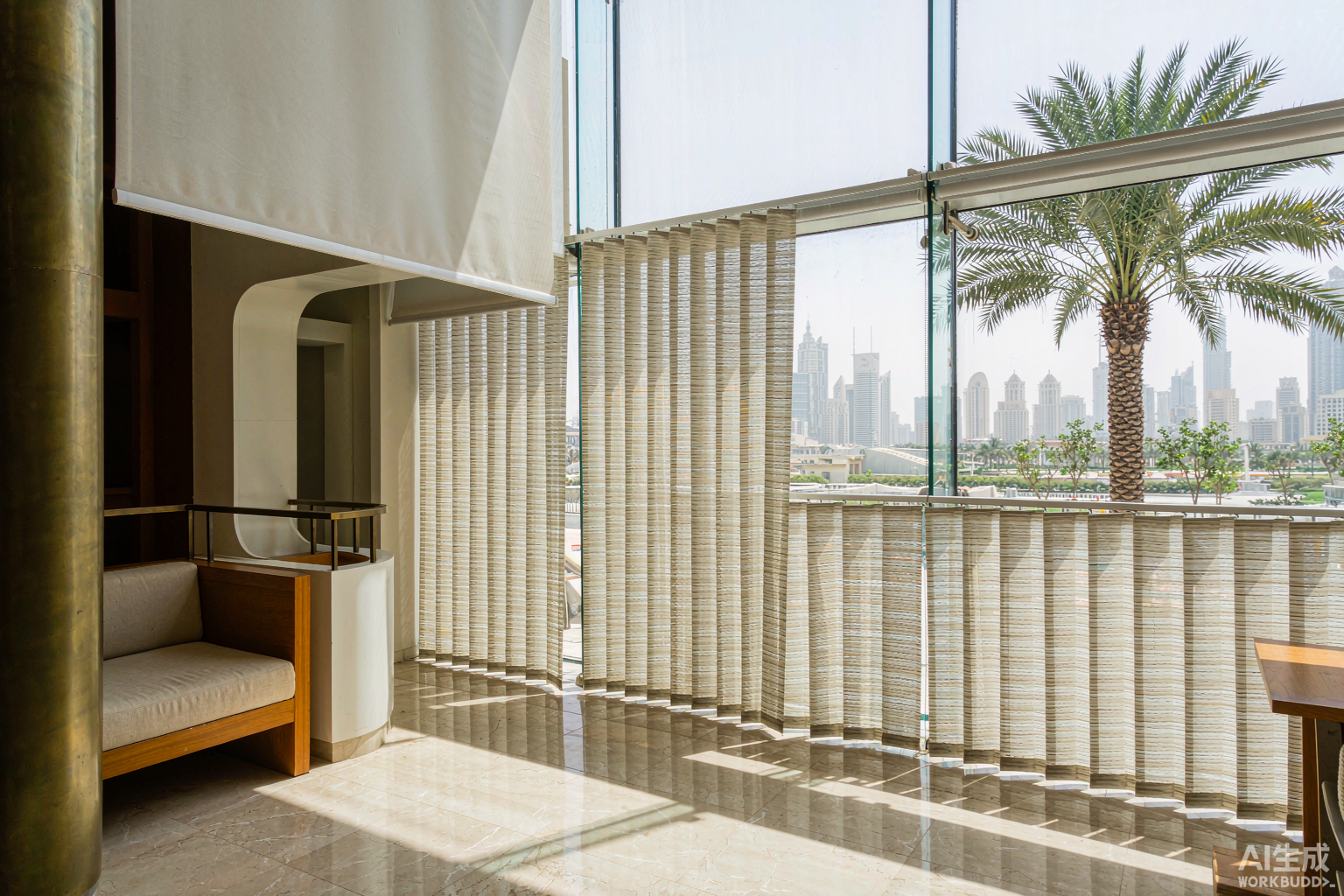
The 47th Big 5 Global Dubai runs 23–26 November 2026 with 65,000+ buyers and 1,800+ exhibitors expected. This guide decodes MENA’s three demand engines, a four-zone sourcing map, a 30-day preparation checklist and the mid-October freight picture, turning four show days into 2027 project-season orders.
Ninety-Six Hours in Dubai That a Fabric Buyer Should Not Miss
From 23 to 26 November 2026, the 47th edition of Big 5 Global returns to the Dubai World Trade Centre (DWTC). Founded in 1980 and organised by dmg events, it is the largest and longest-running construction, building-materials and services show in the Middle East and North Africa. For Chinese suppliers of roller blind fabric, curtain fabric, window sheer, upholstery fabric and outdoor shading textiles, it is far more than a “construction fair”: the co-located events — Windows, Doors & Facades, HVACR World, Urban Design & Landscape, Future FM and others — assemble the entire demand chain of project owner, designer, window-system fabricator and facility manager under one roof. According to the organiser, the 46th edition in December 2025 attracted 85,000 attendees, and the 2026 edition is expected to gather more than 65,000 global buyers, over 1,800 exhibitors, 55,000+ innovative products, 450+ industry speakers and participants from more than 165 countries. The four themes for 2026 are supply-chain resilience, technology advancement, sustainable transformation and a future-ready workforce — and two of them, sustainability and supply-chain resilience, map directly onto what Chinese fabric mills are best positioned to sell: compliance and reliable delivery.
The rhythm of the fair itself is telling. On 7 October 2026 the organiser announced the finalists of the Big 5 Global Impact Awards 2026, with sustainable materials and low-carbon products among the most represented categories. Gulf buyers are weighting environmental claims, certification files and traceability data more heavily every year. If your sample book still contains only patterns and grammages without a credible page of performance and compliance data, you will visibly lose ground at the Dubai negotiating table.
Why MENA: Three Engines of Project Demand
The first engine is Saudi Arabia's gigaproject pipeline. Industry estimates put the total value of under-construction and planned megaprojects in the Kingdom above 1.3 trillion US dollars, with flagship developments such as NEOM, the Red Sea Global scheme and Qiddiya generating acute demand for high-performance building-envelope systems. The Middle East windows, doors and facades market is projected to grow at a compound annual rate of roughly 7.2% between 2025 and 2030, with Saudi Arabia accounting for close to 40% of that growth; local facade and window manufacturing capacity is still maturing, and import dependence exceeds 65%, leaving substantial long-term room for Chinese and other global suppliers.
The second engine is regulation. Saudi Arabia recently revised its building energy code, requiring the heat-transfer coefficient (U-value) of external windows in new commercial buildings to fall by more than 30% versus the previous standard. In the region's extreme solar exposure, shading is not a “soft furnishing” decision but an energy-engineering one: solar-control fabric can cut a large share of incoming solar heat gain and directly reduces cooling load. This is why the smart window shade device market is forecast to grow from about 3.8 billion US dollars in 2026 to 14.91 billion by 2035 (MarkWide Research, CAGR around 16.4%); regionally, Stats N Data projects the UAE smart window shade market to expand from about 120 million dollars in 2026 to 240 million by 2033, and Saudi Arabia's from about 95 million to 220 million. Zooming out, Grand View Research estimates the global window coverings market at 34.5 billion dollars in 2023, reaching 60.16 billion by 2030 at an 8.5% CAGR, while Global Market Insights puts the 2025 blinds-and-shutters market near 69.9 billion dollars. The third engine is hospitality: in January 2026, Marriott and Al Qimmah Hospitality announced plans for more than 2,700 additional hotel rooms across Jeddah, Makkah and Madinah — one slice of a broader tourism strategy that converts directly into demand for hotel blackout curtains, contract-grade flame-retardant fabrics, motorized tracks and large-format custom work, the most profitable project categories of all.
A Field Map: Where to Spend Your Four Days
Big 5 Global covers more than 110,000 square metres; wandering without a plan is the biggest waste of a ticket. Depending on your buyer profile, lock roughly 70% of your time onto four zones:
- Windows, Doors & Facades: the main arena for window systems and shading. The system-level buyers of roller blind fabric, vertical blind fabric, outdoor zip-screen and awning textiles — window-system houses and finished-blind brands — concentrate here. Their order signature is “few SKUs, large volume, repeat business.”
- Interiors & Finishes: decorative fabric, wallcovering, upholstery and soft-furnishing buyers — hotel owners, interior design studios and fit-out contractors. Jacquard decorative fabrics, high-shrinkage textured yarns and ice-crackle (crushed-texture) upholstery fabrics attract the most design-side attention in this zone.
- Future FM (facilities management): replacement and refurbishment demand from the installed base. A large stock of Dubai and Riyadh hotels and offices delivered around 2010 is entering a fabric-replacement cycle; small-batch, fast-turnaround roller shade replacement orders hide here.
- Urban Design & Landscape: the entry point for outdoor shading — awnings, pergolas and exterior blinds. Outdoor dining and resort expansion across the Gulf is rapid, and UV-stable, fade-resistant, dust-tolerant outdoor fabric is a hard requirement.
On best-selling categories to showcase: full-blackout and translucency-graded roller blind fabrics (including fluorine-free coated options), contract flame-retardant curtain fabrics (BS 5867 / NFPA 701), solar-screen sheers, high-abrasion upholstery fabric at Martindale 30,000+, UV-stable awning fabric, and shading fabrics published with EN 14501 / SHGC thermal data. As the revised Saudi energy code takes effect, “fabric with thermal data” is shifting from a bonus to an entry ticket.
A 30-Day Preparation Checklist: Turn Four Days in Dubai into Orders
- Lock target projects and buyers early: screen the exhibitor directory for 50–80 matching window-system houses, shading brands and contractors, and book 15–20 one-to-one meetings through the official platform in advance.
- Make compliance bilingual: assemble an Arabic + English certification pack — flame retardancy (BS 5867, NFPA 701, EN 13501-1), environmental (OEKO-TEX STANDARD 100, GRS), thermal (EN 14501, SHGC/g-value) and composition declarations. Requirements for Arabic documentation and local authorised representation are tightening in Saudi Arabia; one missing page can stall customs clearance or project submittals.
- Layer your samples: bring three sample sets — a full-range display book, a leave-behind set for key prospects (with wide cuts and grammage ladders), and a live-demo set (on-the-spot water beading, tear and light-block tests). Gulf buyers trust what they can touch and test far more than catalogue pages.
- Prepare pricing and MOQ scenarios: Gulf buyers negotiate hard and stage payments. Prepare three quotes (FOB ex-works / CIF Jebel Ali / DDP trial order), state a 500–1,000-metre trial MOQ and a 30–45-day lead time.
- Stage payment terms: for new accounts, 30% deposit plus 70% against copy of B/L; sight L/C for established ones; for government-linked projects in Saudi Arabia and the UAE, keep room for longer tenors and bank guarantees.
- Pull logistics into your quotation: write the current freight window into your offer sheet (next section) and show buyers that landed cost is already engineered into your price.
Stocking for the 2027 Project Season: Freight and Ports as of Mid-October
The ordering peak that follows the Dubai show collides with the December-to-February delivery season for Gulf projects, so the logistics window needs to be read now. On rates: the Drewry World Container Index stood at 4,351 US dollars per 40-ft container on 8 October, down 2% week on week, with the Asia–Europe trade down for a 13th consecutive week — Shanghai–Rotterdam at 3,337 dollars and Shanghai–Genoa at 3,696; the transpacific held firmer, Shanghai–Los Angeles at 7,624 and Shanghai–New York at 10,220. Carriers are attempting higher FAK rates in the second half of October, but the faster-than-expected return to Suez remains the biggest brake on Asia–Europe rates.
On structure: Maersk and Hapag-Lloyd (the Gemini Cooperation) have confirmed the return of four services — AE5, AE11, AE12 and ME2 — to Suez routings (reported 9 October), with AE12's first westbound Suez sailing, Umm Qarn 642W, expected to depart Tanjung Pelepas on 27 October. Xeneta/eeSea analysis puts the Suez saving on AE12 at roughly two weeks, cutting the voyage from 98 to 84 days. The Suez Canal Authority reports container net tonnage of 72.1 million tonnes for the first eight months of 2026, up 54.2% year on year, and Drewry's base case sees Suez container transits back to about 80% of pre-crisis levels by February 2027. For fabric shippers to the Middle East this means two things: released effective capacity on Asia–Europe services should ease pressure on connected Gulf and Red Sea feeders, while Red Sea risk has not fundamentally changed — war-risk premiums remain elevated (over 1% on some southern Red Sea voyages, with Saudi-linked vessels quoted as much as 3% near Jizan in August), so always verify the insurance geographical scope and any notice-of-cancellation terms.
On surcharges and reliability: Maersk's Mediterranean peak season surcharge is 250 dollars per dry or reefer container from 1 November; its South America East Coast to North America PSS is 1,000 dollars per container from 5 November; CMA CGM applies a 500-dollar PSS from South America East to Europe and other destinations from 1 November through 31 December. Asian port congestion is still absorbing about 12% of global container capacity — a four-year high — and August schedule reliability was just 49.9% with average delays of 6.81 days (Drewry). Practical advice for Gulf project orders: book 3–4 weeks ahead, plan production by the week rather than the month, and write freight volatility and destination demurrage responsibility explicitly into the contract. Rates and conditions change daily; this article explains structure and does not replace a live quotation.
Three Pitfalls That Cost Gulf Buyers Real Money
A brief word on what goes wrong, so it does not happen to you. First, documentation gaps at submittal stage: Gulf project consultants routinely reject fabric submittals for missing Arabic labels, untranslated test reports or expired certificates, burning weeks of the approval clock. Second, sample-versus-bulk drift: colours approved under the exhibition hall's LED lighting shift under the Gulf's intense daylight and warm interiors — always approve under D65 plus a defined interior illuminant and keep sealed lab dips as the contract reference. Third, logistics optimism: quotes that ignore war-risk insurance scope, Gulf feeder transhipment time and Ramadan-season port rhythm routinely turn a 30-day promise into a 50-day delivery. Build buffers into the plan, not into the apology.
Closing: One Ticket, an Entire 2027 Season
MENA demand for shading and home-textile fabric is shifting from transactional spot orders to project-based programs: buyers now weigh the certification pack, thermal data, delivery certainty and after-sales response as heavily as unit price. Big 5 Global 2026 is the year's closest point of contact with exactly those buyers.
Wanbo is rooted in Keqiao, Shaoxing — China's largest textile trading hub — and specialises in the development and production of roller blind, curtain, sheer, sofa upholstery and carpet fabrics. We support buyers end to end: flame-retardant and environmental certification, thermal performance testing, sampling and counter-sampling, FCL/LCL export, and destination documentation. Whether you plan to walk the Dubai show in person or prefer to receive our sample books and quotation before the fair, contact the Wanbo team and lock in your 2027 project season early.