The EU PFHxA restriction took effect 10 October 2026, France’s national ban is live, and California drops to 50ppm in January 2027. This guide maps the 2026–2028 EU and US rules rule by rule, flags high-risk fabric categories, compares four fluorine-free C0 routes, and delivers a buyer’s testing and factory-audit checklist.
The Countdown Has Started: Three Key Dates
On 10 October 2026, EU Regulation (EU) 2024/2462 formally entered into force, restricting PFHxA (perfluorohexanoic acid and related substances) in consumer textiles, leather and footwear — 25 ppb for PFHxA and its salts, 1,000 ppb for related substances. From that same day, compliance departments at overseas buyers began re-auditing every coating and finishing formulation in their supply chains. This is no isolated event: France already implemented a nationwide PFAS ban on 1 January 2026, and California will tighten its total organic fluorine limit for textile articles from 100 ppm to 50 ppm on 1 January 2027. For Chinese suppliers of roller blind fabric, curtain fabric, sheer, sofa upholstery, carpet and outdoor shading textiles, “forever chemicals” have moved from NGO reports into hard clauses on purchase specifications. This article lays out the 2026–2028 EU and US regulatory map, the concrete impact on fabric categories, fluorine-free technical alternatives and a buyer's sampling and factory-audit checklist — all in one place.
The Regulatory Map, Rule by Rule
France: Europe's first nationwide consumer PFAS ban. France passed Law No. 2025-188 (“protecting the population from PFAS”) on 27 February 2025 and supplemented it with Decree No. 2025-1376, published on 28 December 2025: from 1 January 2026, the manufacture, import, export and sale of products containing PFAS — cosmetics, ski waxes, textiles, footwear and waterproofing agents — is prohibited; protective and safety textiles are exempted; a broader textile ban follows in 2030. For Chinese suppliers exporting to Europe, this directly affects stain- and water-repellent (triple-proof) fabric and outdoor DWR fabric destined for the French market.
The European Union: PFHxA is live; the universal restriction is coming. Beyond Regulation 2024/2462, the EU-wide universal PFAS restriction proposal is still progressing. The final scope covering thousands of substances is not settled, but the regulatory direction is clear — and brand owners' “de-fluorination timelines” generally run ahead of legal effective dates.
The United States: a state-by-state patchwork with different dates. California's AB 1817 has governed new textile articles since 1 January 2025: PFAS intentionally added for a functional or technical effect are banned at any concentration, or total organic fluorine must stay below 100 ppm; the threshold drops to 50 ppm on 1 January 2027. Outdoor apparel for severe wet conditions is exempt until 1 January 2028 but must carry a “Made with PFAS chemicals” disclosure; carpet and vehicle textiles fall outside the law's scope. New York has banned intentionally added PFAS in new apparel since 1 January 2025, with a numerical threshold due by 1 January 2027 and severe-wet outerwear following in 2028. Maine's textile ban took effect 1 January 2026 (widening in 2032 to almost all intentionally added PFAS products); Vermont applies 100 ppm total organic fluorine from 2026, tightening to 50 ppm after 1 July 2027; Connecticut's apparel ban started 1 July 2026; Washington restricts apparel and accessories from 1 January 2027 at a 50 ppm total-fluorine threshold, with a separate category and date for textile furnishings; Colorado's textile ban begins 1 January 2028; and Minnesota's first prohibitions from 1 January 2025 name 11 categories that explicitly include fabric treatments and textile furnishings. At federal level, TSCA requires reporting of PFAS-containing articles to the EPA. On certification, OEKO-TEX STANDARD 100 has carried a general PFAS ban since its 2023 rule update, and bluesign has fully restricted PFAS from January 2025 outside essential uses.
What It Means for Fabric Procurement: The High-Risk Categories
Three categories are hit first and hardest. Triple-proof sofa fabric and easy-clean fabric: oil and stain repellence depends heavily on fluorinated finishes, making this the category under the greatest replacement pressure. DWR finishes on outdoor awning, zip-screen and pergola fabric: exports to the EU or California now need fluorine-free formulations with stable supply. Premium coated roller blind fabric and children's-room fabric marketed on “water-repellent” claims: the marketing language must match the chemical facts, or delisting and claims risk follow. Relatively safe are conventional acrylic, PU and foam-coated blackout fabrics: the coating resin itself typically contains no fluorine, and blackout performance comes from coating opacity rather than fluorochemical finishes — but beware that some “anti-stain” versions may add fluorinated auxiliaries on top. Two wording traps belong in every purchase specification. First, “PFC-free” may refer only to a subset of the fluorocarbon family and “PFOA-free” only proves that one compound is absent — neither equals PFAS-free. Second, under California's rule, intentionally added PFAS is a zero-tolerance test: do not read the 100 ppm threshold as a safe harbour. If a finish is deemed an intentional functional treatment, any concentration is non-compliant.
Fluorine-Free Alternatives: the C0 Performance Ledger
The industry shorthand for fluorine-free water repellence is C0. Four routes are commercially scalable today, each with its own performance and cost trade-offs:
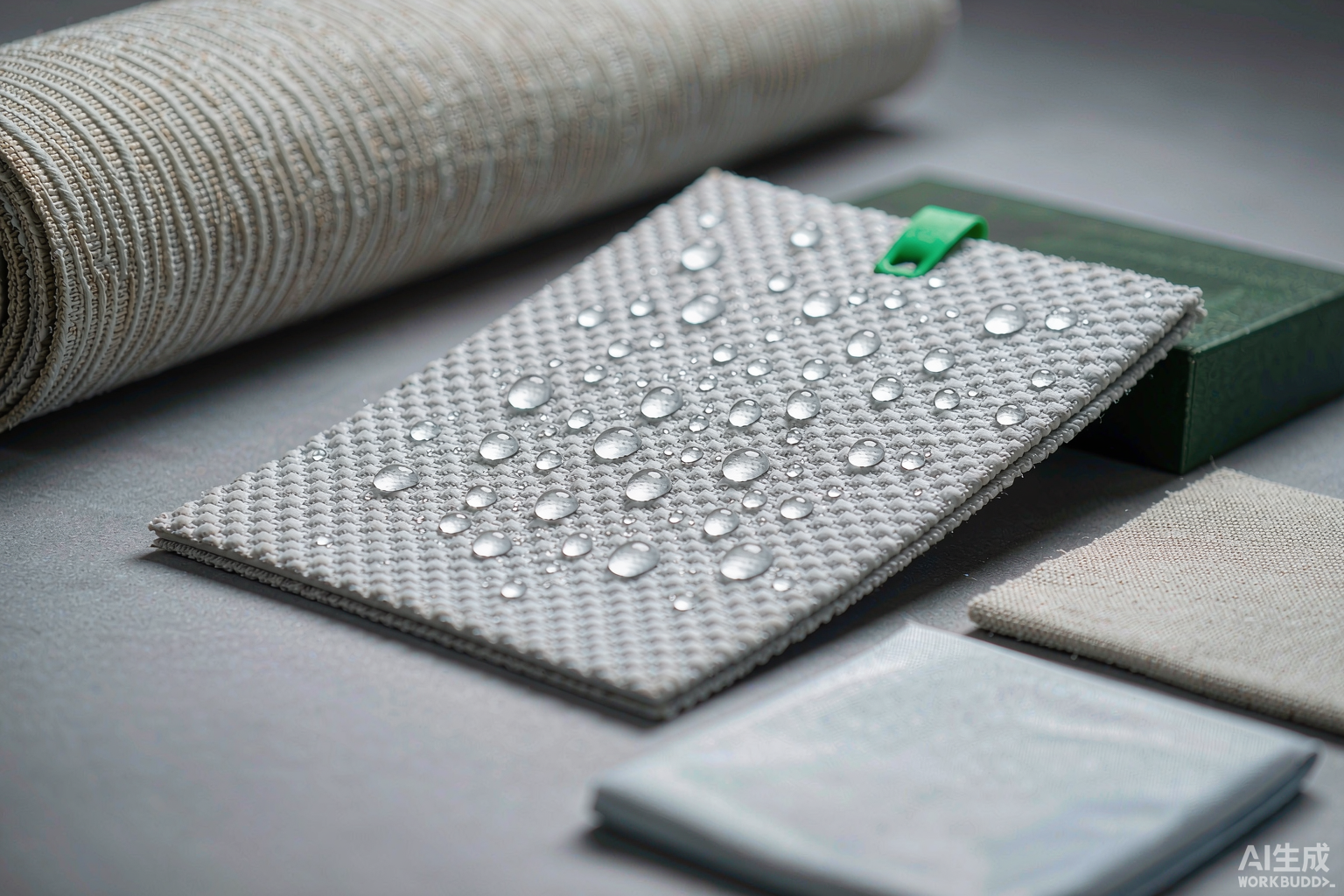
- Wax-based / paraffin–stearic chemistries (the C0 mainstream): lowest cost and the most mature supply chain; initial spray ratings reach 80–90 on the AATCC 22 scale, but oil repellence is close to zero. Best for roller blind and sofa fabric sold on “water beading” rather than “oil and stain” claims.
- Silicone-based (PDMS and modified grades): soft hand feel and good hydrolysis stability; often blended with wax chemistries to improve wash durability (good retention after 10–20 home launderings). The caveat: possible interference with downstream coating or printing adhesion.
- Fluorine-free polyurethane / blocked-isocyanate systems: share a chemistry base with PU-coated roller blind fabric so “coating plus top finish” can run in one line; the best overall wash-and-abrasion durability, at roughly a 10–30% cost premium.
- Dendritic / hyperbranched polymers: repel water through micro-nano surface structure with the highest ratings — and the highest prices; currently mostly for premium outdoor and brand-specified projects.
Do the performance ledger honestly: fluorinated C6 finishes typically survive 30+ launderings and repel oil; C0 systems generally lose visible water repellence after 10–20 washes and offer almost no oil repellence. When talking to end customers, write “number of machine washes” and “performance decay curve” into the technical agreement — never let C0 goods be accepted against C6 acceptance criteria. In some applications, mechanical finishing (calendering, embossing) and weave construction can supplement apparent hydrophobicity and minimise the cost increment.
The Buyer's Sampling and Factory-Audit Checklist: Build Compliance into the Order
- Agree test methods first: measure total organic fluorine (TOF) by combustion ion chromatography (CIC); quantify specific PFAS by LC-MS/MS. Require third-party reports per production batch, matched one-to-one with retained samples.
- Verify performance in parallel: water repellence by AATCC 22 spray rating or ISO 4920; hydrostatic head per ISO 811 for coated goods; colour change controlled by ΔE before and after finishing; retest everything after laundering.
- Close the certificate loop: California's AB 1817 includes a manufacturer certificate mechanism — demand a signed certificate naming the product and batch, not a verbal assurance; check the scope and validity of OEKO-TEX and bluesign certificates.
- Fix the sale state and category before fixing the evidence pack: the same SKU can fall into different categories (apparel / fabric treatment / textile furnishing) in California, Washington or Minnesota, with different dates and thresholds. Write the sale states, category, effective dates and matching evidence into the purchase specification.
- Put PFAS clauses into the purchase contract: dual-track “no intentional addition plus threshold,” batch retention obligations, notification duty for formulation changes, and cost-sharing for recalls — so no one renegotiates the facts after a problem.
Category Playbook: Translating the Rules into a Product Matrix
At the product level, re-rank your 2027 matrix along two axes: regulatory risk versus selling claim. Roller blind fabric: full-blackout and translucency-graded acrylic/PU coated lines are essentially unaffected and remain your volume drivers; switch the “water-repellent” upgrade tier to C0 wax–silicone blends and print measured “PFAS-free” data on the hangtag, turning compliance into a premium claim. Curtain and sheer fabrics: conventional jacquard, high-shrinkage and woven sheers never depended on fluorinated finishes — the priority is completing OEKO-TEX and composition declarations to capture the “worry-free” positioning; add BS 5867 flame retardancy for hospitality projects and you have a “fluorine-free plus flame-retardant” double certification pack. Sofa fabric: the most formulation-sensitive category — the C6 “repels coffee and wine” pitch must be rewritten; replace “chemical stain-proofing” with “easy-clean coating plus removable-washable design” while defending the quality story with Martindale abrasion and pilling grades. Carpets and rugs: California AB 1817 explicitly excludes carpet, but Maine and Minnesota textile-furnishing categories and retailers' own chemical policies can be stricter — verify channel by channel before shipping to the US. Outdoor shading (awning / zip screen / pergola): prioritise the switch to fluorine-free polyurethane systems and build a one-page technical sheet combining wash-cycle durability, UV-resistance grade and the fluorine-free declaration — it will be the first page European and North American buyers turn to in 2027 RFQs.
Two closing notes for buyers building shortlists: first, treat the certificate as a living document — reformulations, subcontracted coating lines and chemical suppliers change, so schedule an annual re-confirmation of the PFAS evidence pack alongside your usual lab-dip and bulk approvals. Second, use the regulatory timeline as a negotiation lever: suppliers who can already ship C0 goods with full documentation today are worth a modest price premium, because the alternative in 2027 is a warehouse full of unsellable inventory in California, New York, Maine and Minnesota. The suppliers who invest now will set the benchmark price for compliant fabric; the ones who wait will end up discounting to move risk.
Export Window and the Wanbo Playbook (mid-October 2026 snapshot)
On logistics: the Drewry World Container Index stood at 4,351 US dollars per 40-ft container on 8 October, down 2% week on week, with Asia–Europe down a 13th consecutive week (Shanghai–Rotterdam 3,337 dollars; Shanghai–Genoa 3,696). Maersk and Hapag-Lloyd have returned four services (AE5, AE11, AE12, ME2) to Suez routings, with AE12's first westbound sailing on 27 October — released effective capacity helps late-year bookings; but Red Sea war-risk premiums remain elevated (above 1% on some southern Red Sea voyages), so verify notice-of-cancellation terms when insuring. Asian port congestion is absorbing about 12% of global capacity and August schedule reliability was just 49.9% (Drewry), so pre-Christmas European orders should book 3–4 weeks ahead. Rates and conditions change daily; this article explains structure and does not replace a live quotation.
Wanbo, based in Keqiao, Shaoxing, specialises in roller blind, curtain, sheer, sofa upholstery and carpet fabrics. We have built out fluorine-free C0 water-repellent finishing, fluorine-free coating systems and a third-party PFAS testing channel, and can issue the matching compliance evidence pack for the destination market — OEKO-TEX, bluesign, California AB 1817 certificates, EN/NFPA flame retardancy — supporting one-stop delivery from sampling and bulk production to FCL/LCL export and destination documentation. When your customer asks “does this fabric contain fluorine?”, hand the question to Wanbo — we turn chemical compliance into your closing advantage.