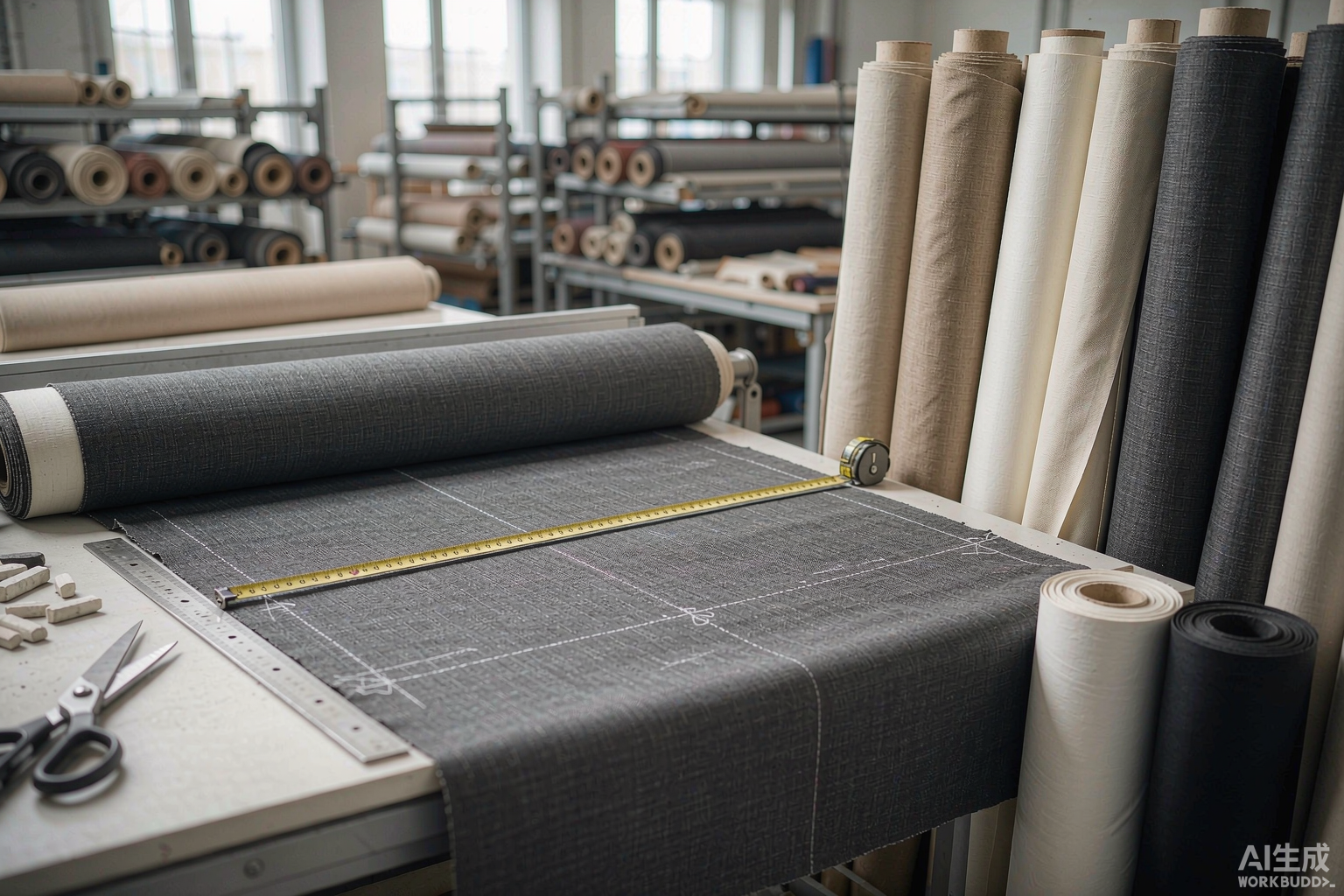
With the WCI up 166% year on year, freight lands at about USD 0.14 per square metre — width and cutting yield are now a hidden margin line. Three real cutting cases (hotel pair curtain, roller panels, zebra repeat) unpack the value of the 280 cm double width, with the roll-diameter formula, container-fill and freight-per-square-metre arithmetic, five nominal-value traps, six 2027 best-seller specs and nine buying clauses.
Start with three numbers
On 15 October Drewry's World Container Index rose 3% to USD 4,485/FEU, roughly 166% above the same week last year: Shanghai–Rotterdam at USD 3,522, Shanghai–Genoa at USD 3,945, Shanghai–Los Angeles at USD 7,884. In the same week China's textile and apparel exports for the first nine months of 2026 came in at USD 232.96 billion, up 5.1%, with September alone at USD 29.66 billion, up 21.5%. Cargo is moving, prices are climbing — and most buyers at the negotiating table watch a single number: the price per metre.
But the price per metre has never been the cost. What decides your margin is the landed cost per square metre, and that number is the product of four variables: unit price, fabric width, cutting yield and freight per unit. The first two are printed on the quotation. The last two are usually nobody's job.
A quick illustration. A 2.8 m wide, 250 g/m² full-blackout coated roller fabric at FOB USD 2.10/m works out to USD 0.75/m². A 40ft high-cube carries roughly 32,000 m² of it, so at USD 4,485/FEU freight adds about USD 0.14/m² — 18.7% of the goods value. Now suppose a width choice and a cutting plan waste 12% of the fabric. You are actually paying USD 0.85/m², a silent 13% increase. That is what this article is about: width is a hidden margin line.
1. The width system: why 280, not 300
Widths for curtain and roller fabric are not arbitrary. They are reverse-engineered from the finished sizes the market actually buys.
- 150 cm — the traditional single width. Universal equipment, flexible stock, good for small orders and colour blocking, but large curtains must be seamed.
- 280 cm — the mainstream "double width" in Europe and the Middle East. Residential floor-to-ceiling heights are commonly 2.4–2.8 m, so one double-width drop covers a whole wall with no vertical seam. This is the default for contract and hotel work.
- 300 cm — for ceilings above 3 m, double-height villas and commercial interiors. Uses less metreage, but demands better setting, shrinkage control and roll handling.
- Roller-specific roll widths of 200/250/280/300 cm — roller blinds are cut across the width, so the roll width sets the maximum finished blind width directly. 2.5 m is the watershed: anything wider either moves to 3 m stock or becomes a dual-roller installation.
- Upholstery at 140/145 cm — limited by rapier and jacquard loom widths, and sofa panel pieces are small, so wider greige buys little.
So "which width is best" is the wrong question. The right one is: what is the distribution of your finished sizes? A fabricator making 2.2 m roller blinds gets 88% yield from 2.5 m stock. The same roll sold to a fabricator making 1.6 m blinds yields 64%. Same goods, same price, a 24% cost gap.
2. Three cutting cases: putting a number on waste
Case one: hotel pair curtain, 2.4 m wide × 2.6 m drop, 2.2× fullness
Total finished width is 2.4 × 2.2 = 5.28 m, split into two panels of 2.64 m.
- On 280 cm width: each panel is 2.64 m, which fits inside 2.8 m. Each needs 2.75 m of length including 15 cm of hem allowance, so 5.5 running metres in total. Fabric consumed 15.4 m², finished area 13.7 m², yield 89%, and zero vertical seams.
- On 150 cm width: each 2.64 m panel must be joined from two 1.32 m pieces — four pieces, three vertical seams, 11 running metres. Fabric consumed 16.5 m², yield 83%, plus three seams of labour and the pattern-matching loss that comes with them.
The conclusion is blunt: 280 cm halves the metreage (5.5 versus 11 running metres) and takes seams from three to zero. At USD 2.10/m that saves USD 11.55 per window; across 200 hotel rooms with two windows each, USD 4,620 — before counting sewing labour and the rework that seam shade variation causes.
Case two: roller blind panels, 2.0 m wide window
Roller blinds are cut across the width, so the roll width decides everything.
- From 250 cm stock, a 2.0 m blind leaves 0.5 m of selvedge. If that offcut goes into 0.45 m narrow blinds or valance strips, effective yield lands between 80% and 90%.
- From 300 cm stock, the offcut is 1.0 m and yield drops to 67%. Unless you have orders to absorb the offcut, do not run 2 m blinds off 3 m stock.
- From 200 cm stock, theoretical yield is 100% — with no trimming allowance at all. Roller blinds need 3–5 mm trimmed from each side, so the finished blind falls below 199 cm and comes up short. An order that exactly equals the roll width is the order most likely to end in a claim.
Worth writing into your buying rules: finished width should sit between 72% and 92% of the roll width. Below 72% you are buying selvedge; above 92% you have no trimming allowance.
Case three: the repeat constraint on zebra blinds
Zebra (banded) blinds alternate sheer and opaque horizontal bands, with a repeat commonly 7.5 cm. The cut height must be an integer multiple of the repeat, or the bands misalign and the panel is scrap.
A 1.80 m finished height: 1.80 ÷ 0.075 = 24 repeats, exact. If the customer wants 1.85 m: 1.85 ÷ 0.075 = 24.67, so you must run 25 repeats = 1.875 m, and 2.5 cm is unusable. Zebra blinds quoted by the metre should really be costed by repeat count — a price difference many buyers only discover after the order is placed.
3. Roll diameter, container fill and freight per square metre
Fabric is a low-density cargo: light and bulky, so ocean freight is almost always charged on volume rather than weight. That makes roll packing a direct lever on unit freight.
Roll diameter estimate: D = √(d² + 4Lt/π), where d is the core outside diameter (76 mm is standard), L is roll length in metres, and t is the effective thickness in metres including interlayer air — for coated fabric, roughly 0.6–0.8 mm.
For a 2.8 m × 50 m, 250 g/m² coated roll: the theoretical diameter is about 19 cm, and with winding tension and core variation the measured figure usually lands at 22–28 cm, weighing 35 kg for 140 m².
A 40ft high-cube measures about 12.03 × 2.35 × 2.39 m internally, 67.6 m³ nominal and 62–65 m³ usable. Rolls 2.8 m long placed along the container length give roughly 230–260 rolls by volume, or 32,000–36,000 m², total weight 8–9 tonnes — far below the 26 t payload limit. Fabric is always volume-limited, never weight-limited, except for heavy upholstery above 600 g/m².
- US West Coast at USD 7,884/FEU → about USD 0.22–0.25/m²
- Europe at USD 4,485/FEU (WCI composite) → about USD 0.13–0.14/m²
- LCL is priced per cubic metre and typically costs 1.8–2.5× the FCL unit rate — factor that into small replenishments
Now the 20ft: about 28 m³ usable, roughly 100 rolls, 14,000 m². Unit freight lands 40–60% higher than in a 40ft high-cube. Container choice is itself a cost decision.
Which is why "can you get to USD 1.95/m" is usually worth less than "can you keep roll diameter under 25 cm and load 20 more rolls per container". The first saves 5% out of the supplier's margin; the second saves 8% out of physics.
4. Five traps hidden in nominal values
- Nominal versus actual metreage. A roll marked 50 m measuring 48.5 m is routine, a function of winding tension. Contract for ±1% and settle on actual metres or make up the difference.
- Shrinkage. Coated fabric commonly shrinks 3–5% warp-wise after washing or dry cleaning. Cut at 2.6 m and you finish at 2.47 m — 13 cm short, and the batch is reworked. Cut length must be back-calculated as finished size ÷ (1 − shrinkage), with setting allowance on top.
- Grammage tolerance. Nominal 250 g/m² may legitimately measure 235–265. At the same price, 5% less weight means less opacity and a different hand — invisible in the buyer's cost sheet.
- Width tolerance. ±2 cm is normal. A "280 cm" roll measuring 277.5 cm leaves your 2.64 m panel only 13.5 cm of margin, which disappears the moment there is any centre-to-selvedge variation.
- Splices. One or two splices per roll are permitted. In roller blinds a splice inside the visible area is a defect; in curtains it can be hidden. Agree splice count and position in the contract, or the return dispute has no resolution.
5. The 2027 best-seller specs, matched to width and use
Based on this year's order mix and fair feedback, Wanbo has consolidated six specifications with steady sell-through overseas. What they share: the width matches mainstream finished sizes, the grammage matches the function, and they can be mixed within one container.
- Full-blackout coated roller, 280 cm / 250–270 g — the residential mainstay in Europe and the Middle East, 99.9% opacity, cuttable for 3 m ceilings, ideal for mixed-colour full containers.
- Dimout textured roller, 250 cm / 180–200 g — office and rental market, light without see-through, friendly price band, the workhorse for e-commerce and contract.
- Two-tone zebra, 180 g / 7.5 cm repeat — one of the strongest B2C movers in North America and Australia; off-white with light grey, sand with ivory.
- Chenille upholstery, 140 cm / 320–380 g — Martindale 30,000+ cycles, 1.5–3 mm cut pile, aligned with the AW26/27 texture direction.
- Jacquard blackout, 300 cm / 300 g — hotel and villa full-wall solutions, double width with no seams, the highest premium in the range.
- High-shrinkage linen-look sheer, 280 cm / 60–85 g — breathable, good drape, the fastest-growing slice of Europe's light-filtering demand, where the goal is privacy and glare control rather than full blackout.
None of this is guesswork. A specification sustains volume when three things hold: it achieves zero or single seaming at the target market's standard window width and ceiling height; its grammage carries the local light and heat requirements; and its roll diameter lets a 40ft high-cube load 230 rolls or more. Pass all three and it is worth holding stock.
6. Nine clauses for the buying desk
- Specify width and tolerance (for example 280 ±2 cm) and define it as usable selvedge-to-selvedge width, not nominal.
- Require measured shrinkage figures, warp and weft, separately for washing and dry cleaning, written into the acceptance criteria.
- Fix minimum roll length and splice rules: no roll below 99% of nominal, no more than two splices, none in the first 5 m.
- Set a maximum roll diameter, say 28 cm, to match your racking and container stacking plan.
- Ask for a container loading table: rolls, square metres and gross weight per container, so unit freight can be calculated before you quote.
- Put grammage tolerance in the contract (±5%) with third-party testing as the reference.
- Agree colour difference ΔE ≤ 1.0 within a batch and ≤1.5 across batches, and retain sealed samples.
- Define ownership of offcuts: who keeps the selvedge from roller orders, and whether it can be returned, changes the real yield.
- Quote freight and surcharges separately from FOB. Do not bury ocean freight in the unit price — freight can move 3% in a week; your unit price cannot.
7. Price the time as well
Back to the market. Rates have just turned up after three weekly declines, but the security picture in the southern Red Sea and Bab el-Mandeb heated up again around 18 October: about 12 developments in the preceding fortnight, an emergency session of Egypt's parliament on support for Saudi Arabia, and tighter Saudi–UAE defence coordination. If attacks persist, routing via the Cape of Good Hope adds 10–14 days. At the same time the Suez return continues: in the first two weeks of October container capacity through the canal averaged about 753,000 TEU a week — still below the 1.457 million TEU of the same period in 2023, but far above the 141,000 TEU weekly average that prevailed from early 2024 to mid-2026.
Two forces pull in opposite directions: returning capacity suppresses rates, escalation tightens effective capacity and lifts them. The procurement implication is simple — do not build your Q1 2027 arrival plan on a single freight assumption. Budget a ±20% band and weigh the cost of pulling one container forward against the cost of two weeks out of stock.
Width, grammage, roll diameter, shrinkage, container type: these parameters look like detail, but they are what makes two quotations for the "same" fabric differ by 15–25% in real cost. In a year when freight has more than doubled year on year and raw material stays high, that 15% is often the line between net profit and loss.
What Wanbo can provide
Wanbo, in Keqiao, Shaoxing, manufactures and exports roller-blind fabric, curtain fabric, upholstery, sheer, coated fabric, jacquard and high-shrinkage ranges. On the parameters above we supply verifiable data rather than adjectives: every roll is marked with dye lot, grammage, measured width, actual metreage and splice position; shrinkage and colour-difference reports travel with the goods; we recommend width combinations against your finished-size distribution; and before loading we give you rolls and square metres per container so landed cost per square metre can be calculated at quotation stage.
If you are choosing widths for the 2027 range, send us your finished-size table. We will back-calculate the least-waste combination for your cutting plan — which is usually worth more than another 2% off the price.
Freight rates, indices and policy data here are drawn from public sources as of mid-October 2026 and change daily. Dimensions and consumption figures in the cases are illustrative; production should follow sealed samples and approved cutting markers.