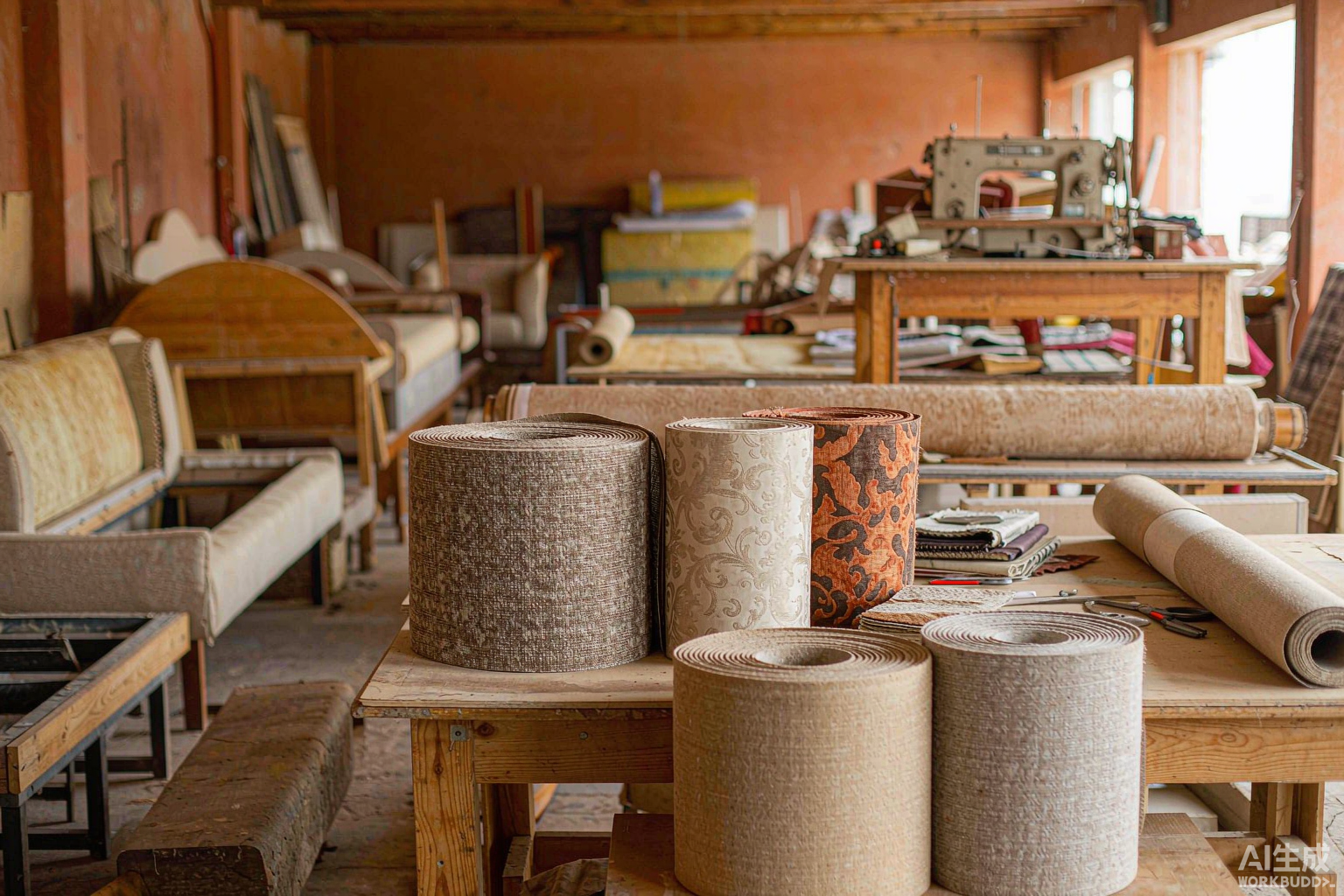
In 2026 Mexico added duties of 10–50% across 1,463 tariff lines — textiles at 25–35%, apparel up to 45%; Chinese textile imports fell 21.4% in January–May to $1.499 billion while local output still contracted 7%. Import substitution is replacing finished goods, not fabric-making capacity. This briefing maps the three tariff rounds, the 19%→33.5% courier rate, IMMEX/PROSEC temporary import and USMCA origin routes, product and semi-finished-form strategies for sofa upholstery, blackout roller fabric, sheers and rugs, plus the buyer window at Expo Mueble Internacional in Guadalajara on February 17–20, 2027 — with ten practical steps.
Through 2026, Mexico has raised its tariff wall against Chinese textiles round after round — yet the counterintuitive fact is that while imports fell, Mexico's domestic textile output did not fill the gap. Calculations based on Banco de México foreign-trade data show that between January and May 2026 Mexico imported US$1,498.7 million of textiles and textile manufactures from China, down 21.4% year-on-year from US$1,907.9 million in the same period of 2025. Yet national statistics show that domestic production of textile inputs, articles and apparel kept contracting over the same window, with output falling by as much as 7%. For Chinese fabric mills and global soft-furnishings buyers, this pair of opposing signals points to a new corridor: the old model of selling finished curtain fabric directly into Mexico is being rewritten by tariffs, while a new model — semi-finished fabric plus nearshore processing in Mexico — is opening up.
First, the timeline of the three tariff rounds. Round one: on December 29, 2025, Mexico published a decree in the Official Gazette of the Federation (DOF) imposing additional import duties on 1,463 eight-digit tariff lines effective January 1, 2026 — roughly 12% of the national tariff schedule across some 17 industrial sectors, with rates of 10% to 50% on imports worth about US$52 billion, or 8.6% of Mexico's total annual imports. Textiles and apparel were the epicenter: more than 700 tariff lines — close to half (about 49%) of all lines covered — relate to textiles and garments. Textile rates rose to 25–35%, apparel peaked at 45%, and yarns, greige goods, fabrics and finished garments were all swept in. Round two: on April 23, 2026 a presidential decree added another 185 tariff lines at six tiers of 5% to 35%, effective April 24, keeping chemicals, textiles, apparel, hats, steel and aluminum products and auto parts on the protected list. Round three: from August 2026, Bloomberg and multiple outlets reported that Mexico's Economy and Finance ministries were evaluating a new round of restrictions explicitly aimed at non-FTA economies — China, South Korea, India, Vietnam and Indonesia — with textiles, apparel fabrics and home textiles on the key-control list, while the United States, Canada and the EU remain untouched. The same adjustment raised the flat courier rate for low-value parcels from 19% to 33.5% and removed de-minimis duty-free treatment for parcels not of USMCA origin.
Now the structural opportunity behind the numbers. In June, Economy Minister Marcelo Ebrard reported that imports from China across the tariffed categories fell 28.4%, with textiles down 13.9% and footwear down 59%; China's Ministry of Commerce has characterized the measures as a trade barrier, reserved the right to retaliate over more than US$30 billion of affected exports, and opened its own investigation into Mexico's trade and investment barriers. But the decisive fact is this: China is Mexico's largest source of textile and apparel imports, holding more than 30% of that market in 2024 — and once imports are suppressed, local capacity, constrained by skilled-labor shortages and an incomplete fabric supply chain, cannot take up the slack. Many nearshore factories still source greige and semi-finished goods from Asia. In other words, Mexico's "import substitution" is substituting finished goods and simple processing; it cannot substitute the manufacture of fabric itself. That is precisely the whitespace where Chinese suppliers can re-price and re-position. Over the past five years China's share of US textile imports has fallen about 8 percentage points, with Mexico and Turkey together capturing nearly half of that transfer — and the precondition of their gain is importing intermediate goods from Asia.
Translated into business models, three routes are viable today. Route one: export of fabric and greige as semi-finished goods, cut and laminated locally in Mexico — the exporter supplies blackout roller-blind fabric, sheer curtain fabric or sofa-fabric greige by the meter or roll, and the Mexican importer processes it into finished goods under the IMMEX temporary-import regime, aiming at USMCA qualification for the US and Canadian markets depending on processing depth and rules of origin. Note that since 2026 Mexican customs has visibly tightened scrutiny of "simple assembly and re-export" under IMMEX, and the local value-added share has become the decisive variable for North American origin. Route two: a forward warehouse with light processing in Mexico — Chinese fabric plus local cutting, sewing and lamination, serving the three consumption hubs of Mexico City, Monterrey and Guadalajara. Route three: selling directly into Mexico's furniture and soft-furnishings manufacturing base — Mexico is one of North America's major furniture-producing countries, and its factories' demand for sofa upholstery, blackout and decorative fabrics has long depended on imports, with China as the number-one source.
The product-side opportunity list is equally clear. Sofa upholstery: the Mexican market favors heavy hand-feel and earth tones — chenille, jacquard, high-shrinkage yarns and linen-look wovens are the workhorses, with stain-resistant coating and removable/washable specs as differentiators. Roller blackout: high-blackout fabrics on white-greige bases are in steady demand for office and hotel projects, and shipping white-greige rolls for local slitting and converting materially reduces both per-unit duty exposure and freight. Sheer curtains: cross-weave and jacquard sheers fit Mexico's large-window housing stock. Carpets and mats: flatweaves and printed tufted greige pair well with local finishing. Crackle-ice (crush/ice-crack) effects and embossed finishes are retail-level differentiators in finished curtains. The one-line summary: sell high-craft fabric in low-processing form to Mexico, and leave the labor-intensive steps — cutting, sewing, packaging — to the nearshore side.
For buyers and exporters planning a 2027 Mexico entry, trade fairs are the shortest path. Expo Mueble Internacional, Mexico's largest and most professional furniture fair organized by the national furniture manufacturers' association, holds spring and autumn editions in Guadalajara, with the spring edition the larger of the two and the industry's yearly benchmark. The 2027 spring edition is scheduled for February 17–20, 2027 at Expo Guadalajara, with roughly 54,000 square meters of exhibition space; the previous edition gathered about 415 exhibitors and 15,800 trade visitors. Furniture manufacturers, soft-furnishings plants, fabric importers and distributors all attend — making it the most efficient venue for a fabric mill to meet Mexican finished-goods buyers. Exhibiting in February, right after Chinese New Year, also allows side visits to the furniture and soft-furnishings belts around Guadalajara and León.
Buyer profiling deserves equal attention. The Mexican fabric market has three main buyer types: import distributors, who buy in full containers on longer terms but respond quickly to new patterns and colors and are the natural channel for jacquard and printed lines; procurement departments of furniture and soft-furnishings factories, who buy back-to-back against orders and reward schedule discipline and batch-to-batch consistency — sofa upholstery and blackout fabrics show the strongest repeat purchase; and project contractors plus finished-curtain assemblers, who order small and often and are best served with stock greige plus rapid local slitting. All three speak Spanish and think in peso terms: a Spanish-language color card, specification sheet and quotation template will open more doors than a ten-point discount.
Compliance and logistics are the two gates of the Mexico business. On labeling, Mexico applies its own NOM commercial-information labeling requirements to textiles; imported fabric and finished goods must carry Spanish-language labels to the prescribed format, so reserve a labeling station in your packing process. On customs, Mexico's pedimento declaration system and digital traceability were visibly strengthened in 2026, and undervaluation now carries back-duty and penalty risk — declare real values and budget for clearance. On logistics, mainline services from China call at Manzanillo and Lázaro Cárdenas with transit times of roughly 25–35 days, then move by rail or truck to Mexico City, Monterrey and Guadalajara; peak-season space should be booked ahead. On payment and FX, peso volatility and policy uncertainty argue for clearly stated price-validity and currency clauses — a three-to-six-month open account simply amplifies the risk.
Ten practical recommendations for overseas buyers and Chinese suppliers evaluating the Mexican market:
- Run the tariff-line drill first. Verify the Mexican eight-digit HS code and duty for every product you sell (most fabrics fall in the 25–35% band), and check exposure to the 185 lines added in April and to the third-round evaluation list.
- Redefine the product as a semi-finished form. Work with the customer to assess greige, white-base and semi-coated intermediate forms, and move the duty-heavy deep-processing steps to the nearshore side.
- Verify the importer's IMMEX/PROSEC credentials. Ask for the program registry and accounting evidence of temporary-import status and duty relief; audits have tightened since 2026, so do not rely on stale documents.
- Write rules of origin into the cooperation plan. If the goal is onward shipment to the US, model with the customer whether local value-added can satisfy USMCA origin, and guard against "simple assembly" being invalidated.
- Lock the February 2027 Guadalajara window. Expo Mueble Internacional's spring edition (February 17–20, 2027) is the highest-efficiency meeting point with Mexican furniture and soft-furnishings manufacturers; have samples and color cards ready six weeks before opening.
- Declare true values. Mexican customs strengthened digital traceability and valuation in 2026; the cost of an undervaluation finding far exceeds the duty saved.
- Front-load Spanish labeling. Design NOM-compliant Spanish hangtags and shipping marks before shipment to avoid rework charges at destination.
- Lock ocean space and price. Peak-season space on China–Manzanillo/Lázaro Cárdenas is tight; book three to four weeks ahead and state freight validity in quotations.
- Control payment terms and FX exposure. For first orders, a conservative structure of 30% advance plus 70% against copy of bill of lading is prudent; quote in US dollars with an FX-adjustment clause.
- Build a dual-quotation system. Offer the same customer both FOB China and DAP Mexico City/Monterrey pricing, letting them choose the customs and tax arrangement — it measurably speeds up contract closing.
The current decree runs from January 1 to December 31, 2026; whether it will be extended, and whether the third round lands, awaits official confirmation in the DOF — treat the Mexican Official Gazette and your customs broker's latest guidance as the controlling source. The trend, however, is unambiguous: Mexico is shifting from a "transshipment springboard" to a "manufacturing base facing North America", and demand for intermediates in the North American furniture and soft-furnishings chain will persist. As a source supplier of Chinese curtain and home-textile fabrics, Wanbo of Keqiao, Shaoxing supplies the full range — blackout roller-blind fabric, sheers, sofa upholstery, carpets and rugs, plus jacquard, high-shrinkage, coated and woven collections — and supports greige/white-base/semi-finished export formats, small-lot sampling, full-container direct service to Manzanillo, plus Spanish labeling, documentation and fair-sample support. Contact Wanbo for the 2027 Mexico selection handbook and latest quotations — and find your new corridor on the other side of the tariff wall.