India commerce ministry data show FY2025-26 textile imports from China at USD 4.46 billion, up 22.5%, as the man-made-fibre fabric gap widens; Heimtextil India 2027 is set for 25-27 February at the Bombay Exhibition Centre, Mumbai. This guide unpacks India shading and home-textile market structure, the HS 6303 duty math, the QCO labelling draft and anti-dumping compliance wall, five category bets and a ten-step fair playbook, with Wanbo South Asia supply solutions.
Two pieces of news in October 2026 point to the same market. First: according to India's Ministry of Commerce foreign trade data for FY2025-26, India's textile imports from China reached USD 4.46 billion, up 22.5% from USD 3.64 billion the previous fiscal year — and the increment is concentrated in man-made-fibre fabrics and functional trims that India's domestic industry cannot yet supply. Second: Messe Frankfurt has confirmed that Heimtextil India 2027 will take place on 25-27 February 2027 at the Bombay Exhibition Centre in Mumbai, co-located with Paperworld India and Ambiente India. On one side, import data confirming a structural demand gap; on the other, South Asia's most focused home-textile buying event. For suppliers and buyers of roller blind fabrics, curtains, sofa upholstery and rugs, the Indian market is entering a rare overlap of rising demand and a clearly dated sourcing window. This guide covers the market structure, the duty math, the compliance risks and a practical fair playbook.
1. Where the demand comes from: unpacking the 22.5% import growth
The essence of this surge is a supply-chain gap, not a simple recovery in end consumption. India's garment-export industry has expanded continuously in recent years, but domestic capacity in man-made-fibre fabrics and functional textile inputs lags far behind, forcing downstream factories to import Chinese fabric to fill the hole. One figure captures the dependence: in the first half of 2026, China supplied 94.3% of India's polyester yarn imports — a structural reliance with no realistic near-term substitute. India is the world's largest cotton producer and its third-largest textile exporter, but its strength lies in the cotton-based base layer. In precisely the categories that matter to the shading and home-textile trade — coated blackout, woven shading, jacquard, sheer — the Chinese supply chain is a full step ahead in depth and finish.
The import dependence shows up at product level too. By IndexBox estimates, India's interior shading systems market depends on imports for roughly 40-50% of total market value, with China the principal source for synthetic fabrics and basic tubular motors; in coated blackout curtain fabric, China is estimated to hold 55-65% of India's imports by value, with South Korea and Turkey sharing the remainder. The distribution layer is modernising fast: online channels (Amazon India, Flipkart and vertical home platforms) already account for an estimated 30-35% of home-textile retail revenue, while institutional buyers — hotels, hospitals, developers — run predictable 8-16 week procurement cycles at meaningful volumes.
2. Heimtextil India 2027: the facts and the positioning
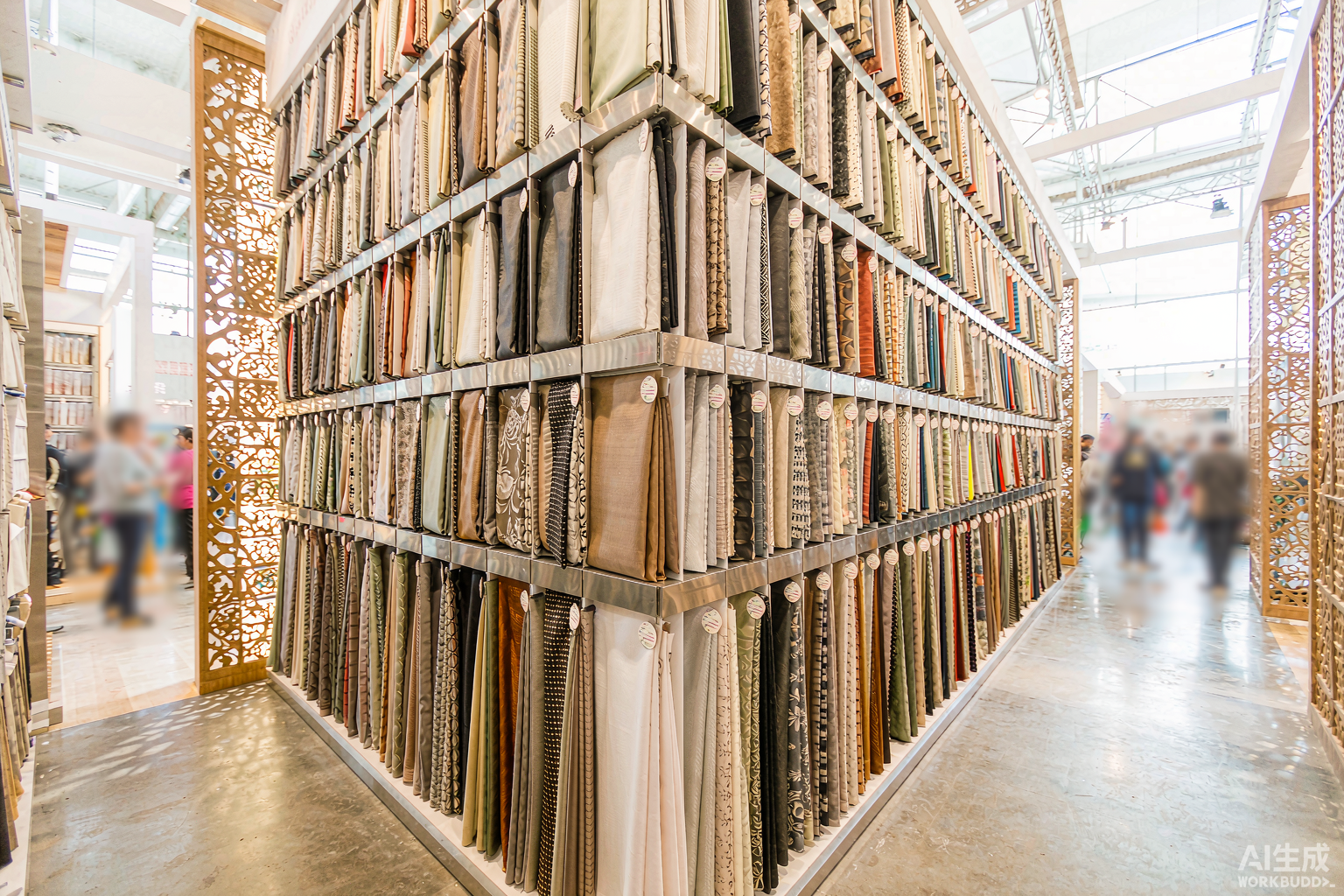
Heimtextil India is part of Messe Frankfurt's global Heimtextil series, organised by Messe Frankfurt, held annually, and is India's most professional and internationally oriented home-textile trade fair. Key details for the 2027 edition: dates 25-27 February 2027; venue Bombay Exhibition Centre (NESCO, Goregaon East, Mumbai); exhibition space of approximately 13,000 square metres; roughly 250-450 exhibitors; 10,500-12,000 trade visitors; and co-location with Paperworld India (stationery and office), Ambiente India (consumer goods) and the Corporate Gifts Show, creating a one-stop home-and-consumer buying environment. The product range spans bedding, curtains and decorative fabrics, sun-shading and UV-protection products, upholstery fabrics, rugs and carpets, wall coverings and accessories — roller blind fabrics, coated blackout, jacquard and sheer are all core exhibits.
Compared with the fairs in Dubai or Frankfurt, Heimtextil India has a distinct character: the audience is dominated by Indian importers, wholesalers, brand owners, converters and project buyers whose buying intent is direct. Orders typically start as small, multi-batch programmes, but repeat-purchase loyalty is strong. For Chinese fabric mills aiming to enter South Asia — or to supply India's garment and home-textile export industry with intermediate goods — this is the single best-matched event of the year.
3. The duty math: what landed cost really looks like
Quoting into India credibly requires three layers of duty to be modelled up front. Taking HS heading 6303 — curtains (including drapes) and interior blinds — as the reference (63031200 for synthetics): Basic Customs Duty (BCD) is 10%, the Agriculture Infrastructure and Development Cess (AIDC) adds 10%, Social Welfare Surcharge (SWS) is levied on the aggregate of customs duties, and 18% IGST applies on top; on an assessable value of INR 100, the indicative combined incidence is about INR 32.3. For coated blackout fabrics under HS 630312/630392, IndexBox reports an effective BCD range of roughly 20-25% and a total duty incidence of 35-45% of landed cost. The exact rate depends on the 8-digit classification and notifications in force on the date of import — always have your Indian customs broker verify against the latest CBIC notification before signing. Fabrics and greige (Chapter 54/55/60) carry their own BCD and AIDC schedules. The practical advice: quote both CIF and DDP assumptions side by side with the duty basis stated, to avoid disputes at the port.
4. The three-layer compliance wall: QCO, labelling and anti-dumping
Indian authorities have stated publicly that they will respond to the import surge with customs enforcement, mandatory certification and trade remedies. Both exporters and Indian importers should build a firewall now:
Layer one: customs enforcement. The Directorate of Revenue Intelligence (DRI) runs targeted investigations into undervaluation, misclassification and transshipment-based duty evasion, with powers to seize goods, recover duty and prosecute. Low-ball invoice values must be off the table entirely.
Layer two: QCO certification and labelling. On 16 July 2026, India's Ministry of Textiles issued a draft Quality Control Order — the "Labelling and Marking for Textiles, Apparels and Made-Up Articles (Quality Control) Order, 2026" — requiring covered products to conform to IS 667 (methods for identification of textile fibres) and the IS 15798 series and to bear the BIS ISI mark, with foreign manufacturers applying through the Foreign Manufacturers Certification Scheme (FMCS). Implementation dates are not yet notified, but the direction is clear. In parallel, India has notified the draft "Textiles and Apparel and Made-up Articles Labelling and Marking Rules" to the WTO, imposing mandatory labelling on textiles entering the market — fibre composition, care symbols and country-of-origin marking costs should be budgeted in advance.
Layer three: anti-dumping and trade remedies. In March 2026 India issued three definitive anti-dumping rulings on Chinese textile inputs: elastomeric filament yarn at USD 880-2,033 per tonne, viscose filament yarn above 75 denier at USD 386-1,071 per tonne, and nylon filament yarn at USD 236-782 per tonne, each for five years. Note the "precision" design: cooperating major exporters receive the minimum rate while "other producers" face rates up to three times higher. Fabric-level AD measures have not yet been imposed, but the trade expects investigations to extend into man-made-fibre fabrics and trims. Fabric exporters should keep complete cost and export-price records to be ready to respond.
5. What actually sells in India: category selection
- Coated blackout fabric for roller blinds and curtains. India is one of the fastest-growing blackout fabric markets, and domestic coating and lamination capacity falls short — Chinese goods dominate imports. Hotel and residential demand run in parallel; be ready with flame-retardancy certificates (hotel projects commonly specify NFPA 701 or equivalent).
- Woven shading fabrics and sheer curtains. India's strength is cotton; man-made-fibre woven shading and linen-look sheers are its visible weak spot — and the main categories behind the FY26 import growth.
- Jacquard and high-shrinkage decorative fabrics. India's middle-class housing and hotel renovation cycles (peak seasons January-March and September-November) drive decorative fabric demand; jacquard texture and the drape of high-shrinkage yarns suit local aesthetics. Custom-order lead times in peak season run 6-8 weeks, so stock ahead.
- Sofa upholstery and rug fabrics. These ride both the spillover of Western restocking and local retail growth — start with small multi-colour trial orders, then scale.
- Fabric rolls plus local cut-and-sew. India's cutting and stitching capacity is abundant and inexpensive; "Chinese fabric, Indian conversion" is the most validated cooperation model today and naturally absorbs part of the finished-goods duty differential.
6. Fair playbook: ten steps from pre-show to post-show
- Apply for a business visa 8-10 weeks ahead; book hotels in Goregaon East early — rates double during the fair week.
- Clear exhibit samples under an ATA Carnet or the fair's temporary-admission channel, never as dutiable commercial cargo.
- Prioritise sample cards and hangers for blackout, sheer and jacquard; print weight, width and fire-rating data on the back of every swatch card.
- Prepare bilingual (English/Hindi) company brochures and price ladders on FOB Shanghai/Qingdao terms.
- Qualify visitors fast at the stand with three questions: MOQ, lead time, payment terms.
- Indian buyers negotiate hard on the spot; quote with an 8-12% negotiation margin and a stated validity period.
- Hold to 30% advance and balance before shipment; avoid usance D/P and open account on first orders.
- Log every lead with its HS codes and monthly volumes so post-show quotations land on target.
- Send the first follow-up email within 48 hours of the fair closing, with the quotation and the courier tracking number for samples.
- Structure the calendar: November-December for sampling and development, February for reorders, with replenishment worked back against the pre-Ramadan (early February 2027) shipping window.
7. Logistics note and closing
On the water, China's main calls for India's west coast are Nhava Sheva and Mundra. Notably, from 16 October 2026 the Shanghai Shipping Exchange formally began publishing a 20ft India-Pakistan (Nhava Sheva) lane index and folded it into the re-weighted composite — the trade finally has an official benchmark for India rates, and 2027 contract formulas can be pegged to it directly. When peak-season space tightens, compare transshipment routings via Singapore and Colombo against direct calls from smaller carriers. Freight rates and market conditions change daily; the figures in this article are for understanding structure, and actual transactions should always be based on same-day quotations.
The opportunity window in India is real — but it rewards the prepared: model the duties precisely, hold the compliance line, and pick the right categories and fair rhythm, and South Asia's demand gap turns into stable, repeatable orders. Wanbo, based in Shaoxing Keqiao, China's largest textile hub, manufactures and exports roller blind and sun-shading fabrics, sheer curtains, jacquard, high-shrinkage yarn fabrics, coated and woven fabrics, sofa upholstery and carpet fabrics as a one-stop supplier, with OEM/ODM customisation and small-batch quick response. Buyers across India and South Asia are welcome to contact us for our sample book and dedicated quotations.