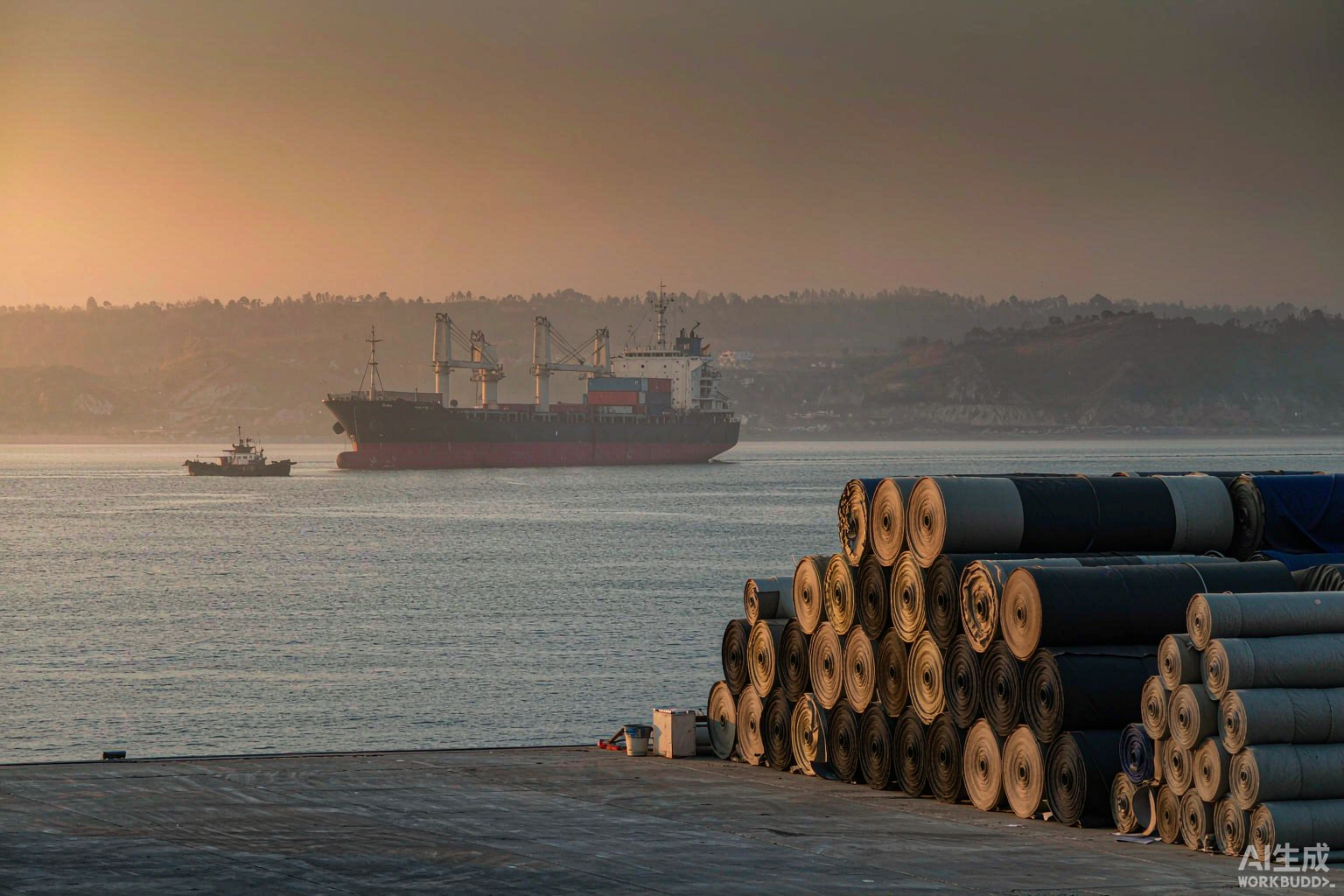
In October 2026 two ships sank at Hormuz while Suez capacity recovered past 51.5% of pre-crisis levels. As the market reprices risk, overseas fabric buyers must rebuild landed costs around dual corridors, insurance confirmations and buffered lead times.
In October 2026, the global shipping map presented a scene unseen in the past two years: within the same month, two commercial vessels sank in the Strait of Hormuz and war-risk premiums were pushed to 6–10% of hull value — while a thousand kilometres away, weekly container ship capacity transiting the Suez Canal recovered past 51.5% of pre-crisis levels for the first time. One waterway is closing; another is reopening. For buyers in the Middle East, Europe, Africa and North America sourcing roller-blind fabric, curtain fabric, sofa upholstery, carpets and sheers from China, these are not two unrelated headlines. They are two new variables on the same landed-cost ledger. Risk is being re-priced by the market, and the difference in that pricing directly determines which route your next 40ft container should take, which insurance you buy, and which line of your purchase contract the delivery date belongs to.
1. Hormuz: Ten Ships Attacked in Four Days, Two Sinkings, War-Risk Premiums Back at Historic Peaks
The bad news first. According to data published on 14 October by the International Maritime Organization (IMO), the UK Maritime Trade Operations (UKMTO) and maritime security firm Vanguard, at least ten vessels were attacked in or near the Strait of Hormuz between 11 and 13 October — the highest tally since the US–Iran conflict erupted. Singapore's Maritime and Port Authority (MPA) confirmed that the Singapore-flagged feeder container ship GFS Pride (2,824 TEU) was struck by an unidentified projectile on 13 October, caught fire and sank; all 21 crew were safely evacuated. The following day, GFS Giselle — managed by the same UAE-based manager — was also hit, with all 22 crew unharmed. Separately, the IMO reported that the Antigua and Barbuda-flagged bulk carrier Cape Dao, hit on 23 September with the loss of one Indian crew member, sank in mid-October. These are the second and third confirmed commercial vessel losses since the conflict began on 28 February 2026.
The structure behind the numbers has deteriorated. Roughly 23 attacks were recorded in the first two weeks of October — nearly double the monthly average since the war began. Vanguard analysts note that Tehran is demonstrating, through higher attack frequency, its capacity to disrupt the region's trade recovery. The insurance market reacted fastest: as brokers told the Financial Times, additional war-risk premiums for tankers entering the Gulf now run at 6–10% of hull value — up to USD 20 million for a single supertanker voyage, against roughly 0.25% before the war. Reinsurance broker Howden Re estimates that market-wide claims across war, terror and political-violence lines have reached USD 2–3 billion since the conflict began, exceeding the segment's estimated annual global premium of USD 1.5–2 billion. In other words, the market has already baked "normalised Red Sea and Hormuz risk" into baseline pricing.
For cargo owners, the more immediate signals are these: Kpler data shows crude exports through Hormuz down nearly 40% from pre-war levels, to roughly 8.5 million barrels per day in the week to 12 October. Kuehne+Nagel's 14 October advisory confirms that mainline container services through Hormuz have largely stopped, with only regional feeder operations continuing; Jebel Ali, Khalifa Port and Sharjah are "operational but constrained", while Fujairah and Khor Fakkan are congested from diverted cargo. Expeditors' 14 October Middle East operational update adds that Jeddah remains congested with landside delays of 10–12 days after discharge, King Abdullah Port is likewise congested, and Dammam is comparatively better placed.
2. Suez: The Other Side — Returns Cross the 50% Line for the First Time
At the other end of the Red Sea, good and bad news arrived almost simultaneously. According to BIMCO data released on 14 October, citing Clarksons Research, average weekly container ship capacity transiting the Suez Canal reached 753,000 TEU in the first two weeks of October 2026, against 1.457 million TEU in the same period of 2023 — the first time since the Red Sea crisis began nearly three years ago that Suez container capacity has exceeded half of pre-crisis levels (51.5%). The share of container capacity choosing the canal over the Cape of Good Hope jumped from an average of 8% between 2024 and mid-2026 to 36% in early October, versus roughly 80% before the attacks. Suez Canal Authority figures corroborate the trend: 166 medium and ultra-large container ships transited in Q3 2026, against just 16 in Q3 2025; large-container net tonnage rose from 2.4 million to 29 million tons.
The inflection came in July: on 6 July, Maersk and Hapag-Lloyd, through their Gemini cooperation, were first to announce the resumption of Suez transits on the AE15 Asia–Mediterranean service, followed by MSC, the Ocean Alliance and the Premier Alliance. BIMCO counts 16 services announcing routing changes since early July. The Premier Alliance's FE1 Southeast Asia–North Europe service, jointly operated by ONE, HMM and Yang Ming, has also committed to return, with the 8,110-TEU ONE Continuity executing the first westbound sailing, expected to complete its first Suez transit on 9 November. Linerlytica believes that after ONE and Hapag-Lloyd's return, Evergreen, Yang Ming and ZIM will be the only major carriers yet to switch back, with full restoration pointed toward Q1 2027.
But the other side of the coin must be stated: the return releases capacity and exerts downward pressure on rates, while simultaneously reopening the war-risk ledger. Drewry estimates that a 24,000-TEU vessel saves only about USD 1 million per round trip through Suez — roughly USD 43 per slot — whereas at current Red Sea war-risk rates, a single round-trip premium can reach USD 1.35–4.5 million. For large mainline vessels, the "savings" of Suez and the "cost" of war risk currently offset each other; what truly drives carriers back is fleet-turnover economics — shorter voyages mean more round trips per ship — rather than per-slot cost. In the week of 15 October, Drewry's World Container Index rose 3% to USD 4,485 per FEU, ending thirteen consecutive weeks of decline: Shanghai–Rotterdam USD 3,522 (+6%), Shanghai–Genoa USD 3,945 (+7%), Shanghai–Los Angeles USD 7,884 (+3%), Shanghai–New York USD 10,075 (−1%). Multiple carriers pushed Asia–Europe FAK rates to USD 4,500–4,800 per FEU effective 19 October, but Drewry explicitly cautions that implementation remains uncertain as Suez returns keep releasing capacity.
3. The Fabric Buyer's New Logistics Ledger: Five Numbers to Recalculate Your Landed Cost
Placed side by side, these two stories demand a recalculation from every overseas buyer sourcing roller-blind fabrics, blackout coated fabrics, sheers, jacquards, high-shrinkage yarn fabrics, wovens, sofa upholstery and carpets from China:
- The Gulf routing account. Containers bound for Saudi Arabia (Dammam, Jeddah), the UAE (Jebel Ali), Qatar and Kuwait should now default to a "mainline + feeder/transshipment" model, or a second-leg routing via Salalah (Oman) or Aqaba (Jordan). Kuehne+Nagel expects cargo flows to redistribute toward Jeddah, Aqaba and Salalah as Jeddah congestion eases. Building in a 15–30 day buffer is mandatory for Saudi importers ahead of the Ramadan and Hajj peaks.
- The Red Sea routing account. Suez's return restores Asia–Europe transit times, and the November FE1 return adds capacity on the Southeast Asia–Europe corridor. But war risk has not disappeared: BIMCO and carriers alike state they will switch back to the Cape if conditions deteriorate. When negotiating 2027 annual contracts, include a dual-corridor clause (Suez/Cape dual-scenario rates) to avoid being locked into a single scenario.
- The insurance and surcharge account. On Drewry's numbers, Suez saves about USD 43 per slot; war risk at 1% of hull value can cost USD 4.5 million per round trip — far above the saving. FOB buyers must confirm whether quotes include war-risk and emergency bunker surcharges; CIF buyers should require written confirmation of Red Sea/Gulf coverage and the rate basis date from their insurer.
- The delivery-terms account. Expeditors reports 10–12 days of landside delay after discharge at Jeddah, and Kuehne+Nagel expects Khor Fakkan and Fujairah congestion to persist for weeks. Structure contracts to separate "port demurrage" from "inland delay", negotiate demurrage & detention free days above 14, and clarify cost allocation when carriers reroute.
- The stocking-rhythm account. Ramadan 2027 is expected to begin around 7 February, stacking in the same week as Chinese New Year on 6 February. Middle East buyers' Q4 ordering window is roughly four weeks earlier than in past years; combined with Hormuz uncertainty, locking vessel space by mid-December and shipping out before mid-January is this year's safety line for Middle East replenishment — a full month earlier than before.
4. Category View: Which Fabrics Are Being Re-Priced
Risk premiums are written not only into freight invoices but into product selection. IndexBox's Saudi Arabia Curtains Market Report (May 2026 edition) notes that 70–80% of Saudi curtain supply is imported from China, Turkey and the Indian subcontinent, with blackout and thermal curtains the fastest-growing sub-segment at 8–12% annually, driven by extreme summer temperatures, residential energy-efficiency subsidies and the Vision 2030 hotel renovation cycle. 6Wresearch puts the Saudi curtains and window blinds market at USD 433 million in 2025, reaching USD 643 million by 2032 (CAGR 5.8%), with 2026 growth of 7.3% led by hospitality demand. Against this backdrop, three fabric categories show the greatest logistics elasticity:
Blackout coated roller-blind fabric — low unit value and bulky, with freight a high share of landed cost and maximum sensitivity to Asia–Europe rate swings; the current window of Suez-driven rate softness is the moment to lock FOB prices and Q1 space. Fire-rated blackout curtain fabric — a hospitality and mosque-project staple where SASO fire standards are raising technical barriers; IndexBox notes compliance adds 5–10% to importer sourcing costs, but that is precisely the justification for certified suppliers to secure long-term contracts at firm prices. Sheers and heavyweight jacquard sofa fabrics — Gulf project-market favourites with the highest time cost under Jebel Ali and Jeddah congestion; shift to a "full container + overseas warehouse" model to strip the last mile out of peak season.
5. Eight Action Points for Overseas Buyers
- Work back 90 days from Ramadan 2027 (expected to start in early February); complete Q1 Middle East ordering and deposits by mid-December.
- Sign with two forwarders on different corridors simultaneously: one Asia–Europe Suez direct channel and one Gulf feeder/transshipment channel, as mutual backup.
- Require insurers to issue written war-risk coverage confirmations for Red Sea/Persian Gulf legs on all CIF quotes, stating the rate basis date and a rate cap.
- Add a "dual-corridor clause" to purchase contracts: clear rules on additional transit time and cost allocation if carriers divert via the Cape.
- For Jeddah and King Abdullah Port imports, negotiate demurrage & detention free time above 14 days and budget 10–12 days of landside delay.
- Operate blackout and coated roller fabrics on FOB + nominated-forwarder terms to keep war-risk surcharge pricing control in your own hands.
- Watch Asia–Europe rates after ONE Continuity's first sailing on 9 November — if FAK 4,500–4,800 sticks, close Q1 annual contracts by December; if rates fall back, wait until January 2027 to lock.
- Build a per-container landed-cost model with freight, war risk, port congestion surcharges and inland delay as four weekly-refreshed dynamic variables, replacing the static annual budget.
Conclusion: The sinkings at Hormuz and the returns through Suez look contradictory but are in fact the same market reallocating risk premiums. For overseas fabric buyers, the winning move is not predicting geopolitics — it is writing the risk-pricing mechanism into your own procurement and logistics contracts. Wanbo, a source fabric mill based in Keqiao, Shaoxing, China, has long supplied customers across the Middle East, Europe, Africa and North America with full-blackout coated roller-blind fabric, sheers, jacquard, high-shrinkage yarn, coated and woven fabrics, sofa upholstery and carpets. We understand the vessel-space rhythm of the Red Sea and Persian Gulf corridors, the structure of war-risk surcharges and the SABER compliance path, and we help buyers rebuild their 2027 procurement plans around "dual corridors + split shipments + dynamic landed cost". Contact us for the latest freight briefing and fabric sample books.