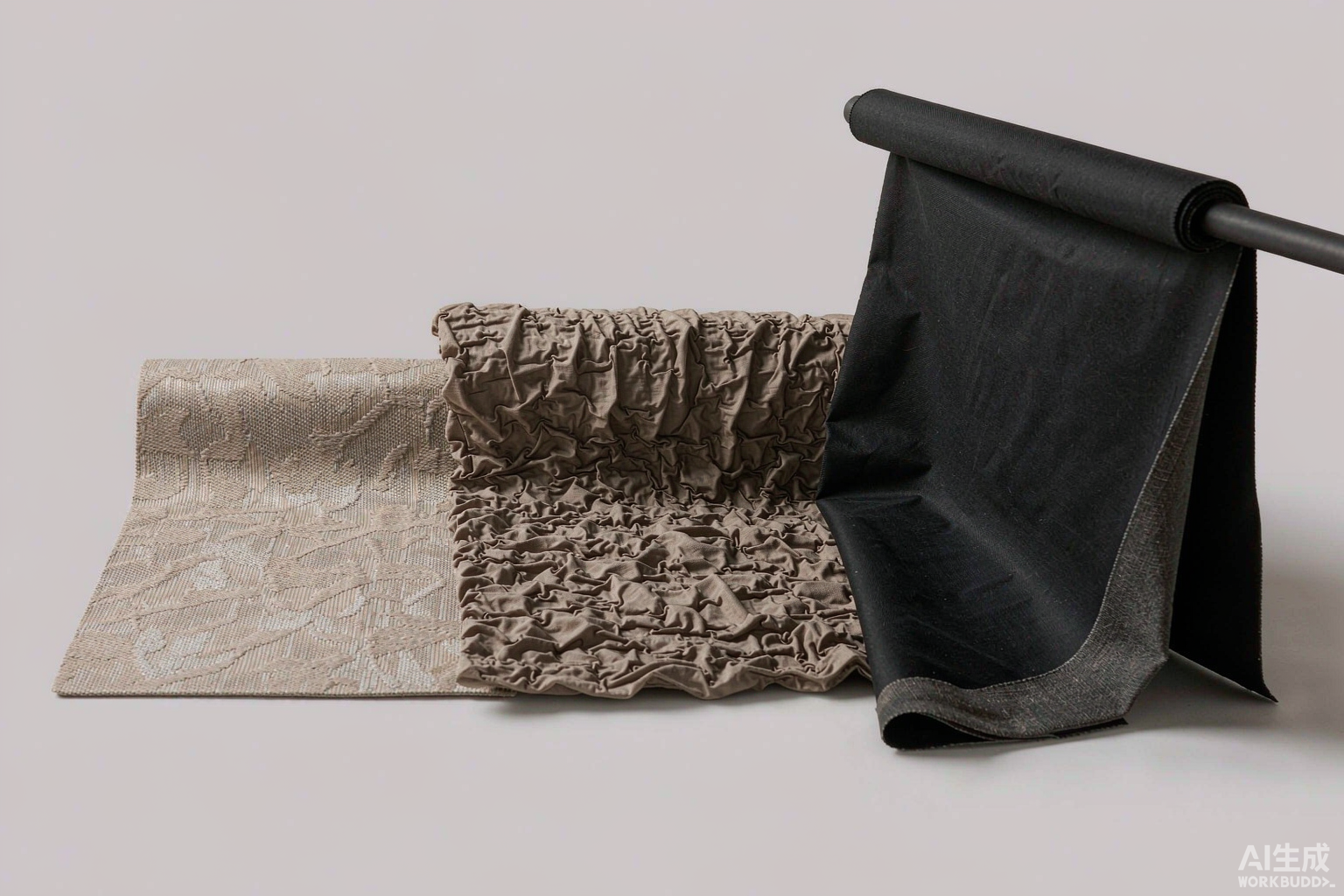
“Jacquard” names a machine rather than a material, high-shrinkage crinkle is engineered rather than pressed, and blackout depends on coating passes. This handbook gives repeatable checks — a ten-second flip test for jacquard, a thirty-second crush test for crinkle — plus export compliance essentials.
Jacquard, High-Shrinkage Yarn and Coated Woven Fabric: A 2027 Buyer's Handbook on Structure and Finishing
The sentence you hear most often at a trade fair is: “This is jacquard.” Then you turn the sample over and the back is a plain ground. The supplier says “this is high-shrinkage yarn” and after one wash the crinkle is gone. The quotation says “coated fabric” and when you weigh it, it comes in 15% under the declared grammage.
The problem is not always dishonesty. The problem is that jacquard, high-shrinkage, coated and woven describe how a fabric was made, not what it is made of. The same word can point to completely different costs and performance. For overseas buyers, not being able to read these three layers means you can only compare prices. Being able to read them means you can compare value. This handbook opens the three layers separately — weave architecture, yarn engineering, and finishing and coating — and for each one gives you a check you can complete in five minutes, either on the fair floor or when a sample parcel lands on your desk.
1. Jacquard: It Names a Machine, Not a Material
The word comes from Joseph-Marie Jacquard, whose mechanism around 1805 made individually controlled warp ends industrial, and with them complex figured patterns at scale. So jacquard describes a weaving mechanism, not a fibre. A jacquard can be polyester, cotton, viscose, linen, wool, silk or any blend, and it can be woven or knitted.
Technically the difference is this: a conventional loom lifts groups of warp ends and can therefore only make simple structures such as plain or twill. A jacquard head controls warp ends individually, so one cloth can carry a satin ground, a ribbed border and a floral motif at the same time. Modern electronic jacquard machines, in the 8,192 to 14,336 hook range on current high-end models, have turned the pattern into a software file: changing the design no longer means changing mechanical parts.
On-the-spot check (10 seconds): turn it over. A genuine jacquard shows the pattern in reverse on the back, with the yarn floats visible where the motif sits on the face. A print shows blank or faded backing. Embroidery leaves stitch and backing evidence. That one movement filters out most “jacquard” that is really a print.
What this means commercially: jacquard carries structurally higher MOQs than plain weave, because loom set-up is long and the design repeat must be ordered in whole repeats. If a buyer only wants the look of a pattern, high-definition digital print is usually cheaper and faster. But where the pattern must be three-dimensional and abrasion-resistant — upholstery, dining chairs, contract seating — the jacquard premium is defensible, because the design is grown out of the structure and will not rub down to a pale patch.
2. High-Shrinkage Yarn: The Crinkle Is Engineered, Not Ironed
High-shrinkage yarn is a filament that has been specially drawn and heat-set so that it contracts significantly at a defined temperature. It is used in two ways, and understanding the two explains why two fabrics that look alike can differ threefold in price.
Route one: differential shrinkage creates permanent crinkle. High-shrinkage yarn and standard low-shrinkage yarn are interwoven in a planned ratio. The greige fabric then passes through hot water or steam; the high-shrinkage yarn contracts, the low-shrinkage yarn does not, and the tension differential crushes the surface into a three-dimensional bubble, ice-crack or water-ripple effect. This crinkle is structural. It does not wash out and does not press flat, because it is physical setting, not chemical setting.
Route two: high-shrinkage yarn as a decorative or filling thread, creating local relief on the surface or raising bulk and hand feel.
Four parameters control the result: the shrinkage differential, which sets crinkle height and density; setting temperature and dwell time, which set stability; the gap between greige width and finished width, which sets whether the final grammage is actually achieved; and the dyeing sequence — yarn-dyed versus piece-dyed — which drives both colour drift and crinkle evenness.
On-the-spot check (30 seconds): take a small piece, crush it hard in your palm, then flatten it out. Structural crinkle returns to form and the folds run in a consistent direction. Setting-agent or heat-pressed crinkle opens into chaotic, directionless lines, and the hand feel is usually stiffer. Separately, ask for post-wash shrinkage data, commonly to ISO 5077, rather than only “greige grammage”.
What this means commercially: the price difference in high-shrinkage fabric comes mostly from shrinkage differential and the repeatability of the setting process, not from the yarn cost. The trap buyers fall into is “the first order was perfect and the repeat went flat”, usually because the mill changed the high-shrinkage yarn lot or moved the setting temperature. Write crinkle height and density into the approved-sample standard with photographs, and re-test on every repeat order.
3. Coated Woven Fabric: The Layer That Decides Blackout, Hand Feel and Compliance
A coated fabric is a woven base cloth carrying a polymer layer. That layer decides the three most expensive things about the product: blackout performance, hand and drape, and flammability plus environmental compliance. The common systems are acrylic coating, polyurethane coating, PVC coating and, increasingly, foamed coating.
Blackout is about how many passes and on how many faces. A single thin pass normally achieves only semi-blackout. Full blackout usually requires multiple back-side passes, for example a silver, black and white build-up, or an internal blackout film. Do not settle for the words “blackout” or “non-blackout”. Ask three things instead: the number of coating passes, the total coating weight in g/m², and the measured light transmittance or openness, tested to an EN 14501 or EN 410 basis.
Coating weight uniformity is a frequent defect source. Thin spots become pinhole light leaks, plainly visible when the blind is backlit. Thick spots feel stiff, stop the blind rolling tightly, and can crack. Inspecting a full width against a light box or a strong backlight is the fastest way to catch this class of defect.
Flame retardancy splits into two technical routes. The first is topical or coating-based FR, where flame retardants are added to the coating or padding; it is cheaper but limited in wash durability. The second is inherently flame-retardant fibre, which resists repeated laundering and suits healthcare, care homes and education facilities that clean frequently. These fabrics typically also need high dimensional stability, very low smoke toxicity and anti-mould performance.
Peel strength and weathering are the two properties to verify for exterior and semi-exterior applications: pergolas, sunrooms, outdoor blinds. Coastal markets should add a salt-spray requirement.
4. Woven versus Knit: Why This One Distinction Decides Applications
Woven fabric interlocks warp and weft at right angles. It is dimensionally stable, tear-resistant and holds a flat plane, which is why it suits anything that hangs, needs flatness, or must roll smoothly — solar shading, curtains and sheers, upholstery and rug constructions. Knit fabric is built from interlocking loops: elastic, soft, and best for stretch and next-to-skin applications.
For shading and soft furnishings there is one easily missed implication: anything that must stay flat over the long term should almost always be woven. A knit structure creeps under its own weight and under repeated rolling. Twelve months later the hem is out of level and the responsibility is nearly impossible to assign.
5. A Repeatable Sample Vetting Routine for Showrooms and Fair Booths
Buyers spend very little time on the fair floor, yet many decisions are effectively made there. Turn the routine into a card and follow it in order every time:
- Turn it over: decide whether the jacquard is woven, printed or embroidered.
- Crush it: decide whether the crinkle is structural shrinkage or pressed-in setting.
- Backlight it: hold a phone torch against the back and look for pinhole leaks and uneven coating.
- Weigh it: carry a portable cutter and check declared against post-wash grammage on the spot.
- Pull it: stretch gently in the weft direction to detect excessive elastic recovery from knit content or over-use of low-elasticity yarn.
- Ask for four numbers: composition, post-wash shrinkage, number of coating passes and coating weight, and the certificate numbers for FR and eco labels.
- Record it: number every sample, photograph it, note the booth number, and enter it into a spreadsheet the same evening before the details blur.
- Verify it: once you have a certificate number, check it against the issuing body's public registry. Never accept a PDF image as proof.
6. Export Compliance: The Different Doors Each Fabric Family Faces
Eco and chemistry. OEKO-TEX STANDARD 100 addresses harmful substances, and its requirements vary by product use and skin contact. When you receive the certificate, confirm that the product class on the certificate actually covers your application. Recycled content can be supported through GRS. For the EU, watch the SVHC candidate list as it is updated.
Flammability. Test methods differ by market: BS 5867 is common in the UK, NFP 92-503 in France, NFPA 701 in the United States, and EN 13501 for European construction classification. A result under one standard does not transfer to another, so certificates must be obtained per destination market.
Optical and thermal performance. Where fabric is used for solar control, buyers increasingly expect optical and thermal parameters such as visible light transmission and total solar energy transmittance, tested and classified under EN 14501 and EN 410 in the European convention.
Traceability and packing. Coated fabric needs packing that prevents pressure marks and moisture ingress. On long ocean voyages, heat and humidity make coatings tacky and crush roll edges, so core diameter and outer wrap selection are genuine procurement decisions rather than logistics details.
7. Eight Practical Recommendations
- In your specification, break “jacquard”, “high-shrinkage” and “coated” into verifiable parameters instead of using them as adjectives.
- For jacquard, seal two samples — face and back. The back photograph is the most effective anti-counterfeit evidence you will hold.
- For high-shrinkage constructions, test post-wash shrinkage and crinkle stability, and require a fresh sealed sample before every repeat order.
- For coated fabric, always backlight for pinholes and require both the number of passes and total coating weight.
- Certify flame retardancy against the destination market's standard; do not let one report stand in for several.
- Request certificate numbers and verify them online rather than accepting a certificate image.
- At the fair, record sample numbers and booth numbers, and complete the data entry the same day you return.
- Write the ocean-packing method into the order so coatings do not go tacky and roll edges are not crushed.
What Wanbo Can Do for You
Wanbo's weaving and finishing operation in Shaoxing covers the four constructions discussed here: jacquard wovens, high-shrinkage crinkle, coated blackout and polyester woven base cloth. What we supply is not only rolls of fabric but a sealed-sample-grade process record: composition, usable width, grammage, post-wash shrinkage, coating passes and coating weight, plus flame-retardant and eco-textile test reports issued for the destination market.
For overseas buyers who need upholstery fabric, rug backing, sheers, roller blind blackout fabric and curtain fabric, we can develop colourways and constructions project by project and keep every production lot on file so repeat orders stay traceable. If you want to tell apart, before your next buying season, the fabrics that look identical and cost three times as much, send us your samples and we will return a line-by-line technical evaluation.