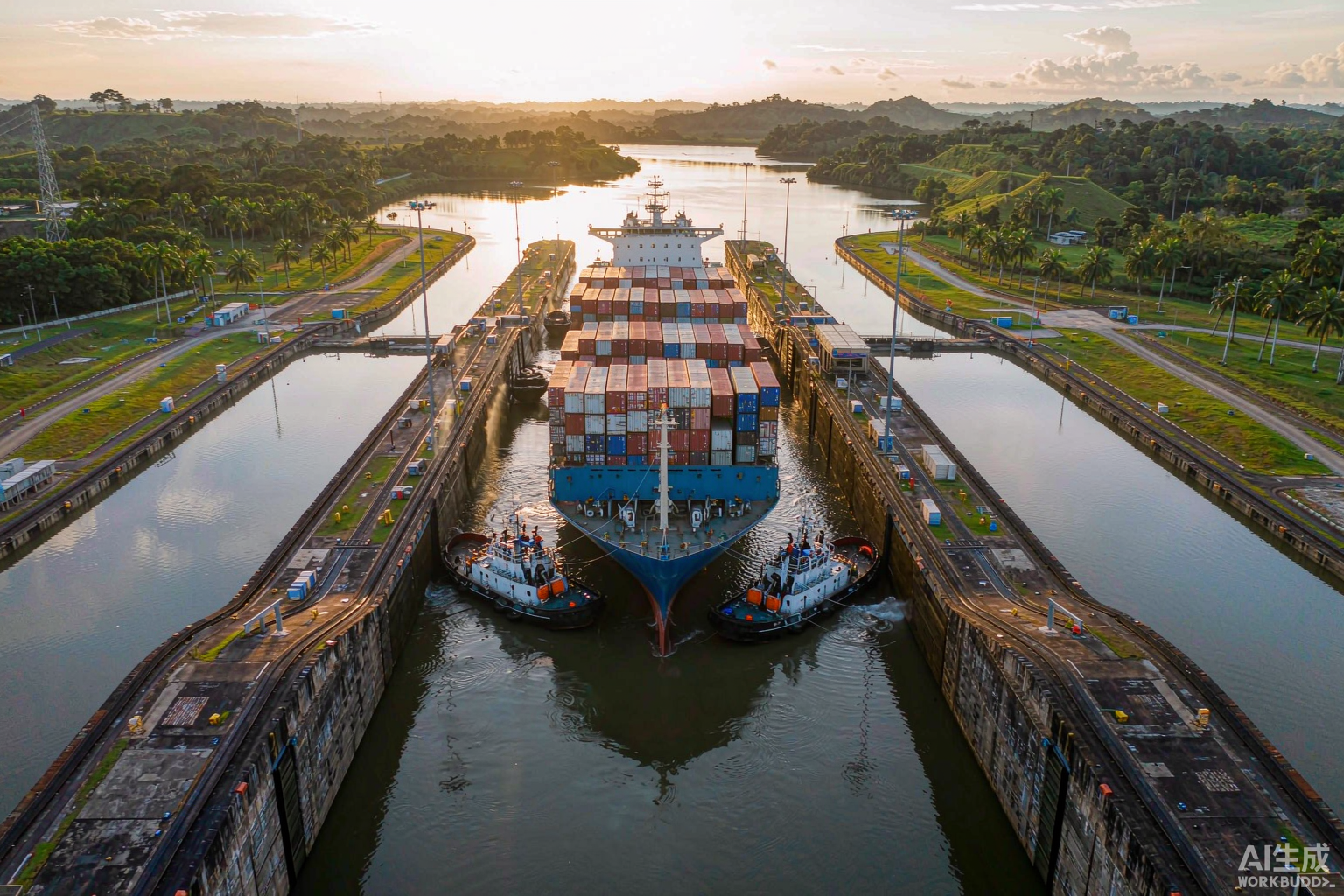
From October 15 the Panama Canal returns to 33 daily transits and a 49-foot draft, while Asian port schedule reliability sits near 32 percent. This guide unpacks the Suez/Panama/Cape rebalance, the 2027 capacity wave and blank sailings, plus six practical booking moves and best-seller loading advice for fabric importers.
Two Opposing Headlines, One Planning Problem: Panama Is Loosening While Asian Ports Are Clogging Up
October 2026 delivered two shipping headlines that point in opposite directions. On one side, the Panama Canal Authority announced that from October 15 the number of daily bookable slots at the Neopanamax locks rises from nine to ten, total daily transits across both lock systems reach 33, and the maximum authorised draft returns to 14.94 meters (49 feet). On the other side, industry data shows that severe congestion at East Asian ports persists, with regional schedule reliability of only about 32 percent — and barely 12 percent at Shanghai — while late vessels are running an average of 6.8 days behind schedule. Read together, these two stories sketch the real logistics picture facing fabric importers heading into 2027: the corridors themselves are recovering, yet uncertainty around transit times and available capacity may actually increase. For overseas buyers of roller blind fabrics, sheer curtain fabrics, sofa upholstery and rugs, understanding this pair of "contradictory signals" matters far more than memorising any single freight rate. This article brings together the latest canal data, the rebalancing logic across the three major corridors, the 2027 capacity structure, and practical booking and replenishment advice you can apply directly to your Q4 2026 and 2027 shipping plan.
1. The Panama Canal: The Drought Alarm Is Fading, and Capacity Is Coming Back Slot by Slot
Start with Panama. According to the Panama Canal Authority's Advisory to Shipping A-36-2026, issued on September 28: from October 15, 2026, daily bookable slots at the Neopanamax locks increase from nine to ten, bringing total daily transit capacity across the Neopanamax and Panamax locks to 33 transits per day; and the maximum authorised draft at the Neopanamax locks is raised from 14.63 meters (48.0 feet) to 14.94 meters (49.0 feet). The draft restoration matters enormously for container shipping: large containerships can now transit much closer to full loading instead of sailing light, which means a single 13,000 TEU vessel can carry several hundred more loaded containers across the isthmus on every voyage.
The reservation rules have been relaxed in parallel. Of the 33 daily slots, 30 are allocated through the booking system and 3 through the daily auction. From October 15, the limit on how many slots a single customer may obtain per date or per week is removed, and bookings for consecutive dates are now allowed. Containerships received an explicit guaranteed allocation: at least six slots per day, or 42 per week, distributed across three size bands — vessels below 9,000 TEU, vessels between 9,000 and 13,499 TEU, and vessels of 13,500 TEU or more — with two slots per band per day. Compare that with the tension of mid-year, when in August a single LPG carrier reportedly paid a record of about 5.3 million US dollars at auction for one transit slot. The ACP attributes the relaxation to September rainfall that was close to the watershed average, the effectiveness of the water-saving measures applied at the locks, and the current and forecast level of Gatun Lake.
Two caveats, however, deserve emphasis. First, the water deficit in the canal watershed has not been fundamentally solved. The ACP is explicit that the reservation system remains the only way to secure a confirmed transit date; vessels without a booking may still transit, but face the prospect of lengthy or even indefinite delays. Second, El Nino-related rainfall risk remains on the horizon, and both draft limits and slot numbers can be tightened again if conditions deteriorate. In other words, Panama is offering "recovery", not "worry-free" — and a recovery window is precisely the moment to ship, not the moment to wait.
2. The Other Side of the Coin: Asian Port Congestion, Blank Sailings and the 2027 Capacity Wave
Now turn to the export end. Industry data indicates that in October the East Asian port network remains the single biggest constraint on the global container system: regional schedule reliability stands at roughly 32.3 percent, with Shanghai at only about 12.2 percent, and late vessels averaging 6.81 days behind schedule. Vessel bunching at anchorages, port omissions and delayed departures have reduced effective weekly service frequency, so even where nominal capacity looks ample, the usable slot supply is diluted. Drewry's tally of global port throughput shows growth of about 2.2 percent year on year through July — demand growth is moderating, but congestion is effectively locking a portion of usable capacity at anchorages and berths. That is precisely why "softening cargo volumes" and "hard-to-book space" can coexist in the same market.
At the same time, carriers are scheduling blank sailings aggressively for the fourth quarter. Drewry expects about 39 of roughly 710 planned sailings on the major East-West trades — around 5 percent — to be cancelled across weeks 41 to 45, with approximately 49 percent of those cancellations concentrated on the Transpacific, reflecting weaker demand on the Asia–US East Coast and Asia–Europe trades. The supply side tells a different story: nearly 200,000 TEU of new container capacity was delivered in September alone, against zero demolitions; the industry orderbook exceeds 14 million TEU, equivalent to roughly 42 percent of the existing fleet; and BIMCO expects fleet capacity growth to accelerate to 9 percent in 2027, while the IMF projects global trade volume growth of just 3.5 percent in 2026 and 4.3 percent in 2027. Sea-Intelligence estimates that about 27 percent of Asia–Europe capacity was already routing through the Suez/Red Sea corridor in September. Accelerating supply, moderating demand and recovering corridors together point the medium-term direction of freight rates downward through 2027 — but for importers, falling rates do not automatically mean an easier job, because they arrive bundled with denser blank sailings, port omissions and schedule reshuffles.
3. The Three-Corridor Rebalance: Suez, Panama or the Cape of Good Hope?
For China-origin fabric exports and the overseas buyers who purchase them, 2027 will be the first year in which routing decisions genuinely return to a three-corridor landscape, with each corridor suited to different cargo types and strategies.
Asia–Europe via Suez: with CMA CGM, Maersk, MSC, Hapag-Lloyd, COSCO and ONE all having resumed Suez transits, the Asia–Europe voyage has shortened from the 38–45 days of the Cape of Good Hope diversion back to roughly 28–32 days. Drewry quoted Shanghai–Rotterdam at about 3,399 USD per FEU and Shanghai–Genoa at about 3,702 USD per FEU on October 1; MSC announced new Asia–North Europe FAK rates of 3,150 USD per TEU and 4,500 USD per 40ft effective October 19; and the Shanghai Containerised Freight Index stood at 2,199 USD per TEU on October 2, with Asia–Europe rates down roughly 60 percent from their July peak. This is currently the best-value corridor, although war-risk surcharges and insurance terms must still be confirmed shipment by shipment. Asia–Americas via Panama: US West Coast demand has stayed relatively resilient — Drewry put Shanghai–Los Angeles at about 7,835 USD per FEU and Shanghai–New York at about 10,428 USD per FEU on October 1, both far above Asia–Europe levels. The return of Panama slots will progressively improve space and schedule reliability on US East Coast services, yet the Transpacific carries the highest share of blank sailings, so slot volatility there remains the highest of any trade. The Cape of Good Hope as the backup: on fuel and schedule economics the diversion no longer makes sense, but for cargo sensitive to insurance terms — or in case the Suez situation deteriorates again — every serious shipper should keep a Cape contingency plan on the shelf. One-line summary: take Suez for Europe, watch Panama for the US East Coast, and keep the Cape as your fallback.
4. Six Practical Recommendations for Fabric Importers
- Stretch your booking lead times again. With congestion plus blank sailings, book your mainline orders 3–4 weeks ahead in Q4, and 5 weeks ahead for peak-season best-sellers and project cargo, to avoid being rolled onto more expensive or slower services.
- For Panama-routed cargo, always confirm a reservation exists. Ask your forwarder or carrier for the canal booking confirmation; unbooked vessels can still face long waiting times, and that directly determines the inbound date at your US East Coast warehouse and everything that follows in your distribution calendar.
- Add a 1–2 week congestion buffer to every schedule. With Shanghai's reliability at roughly 12 percent, any delivery date promised to your sales channel should carry an extra 10–14 days on top of the theoretical transit time, protecting you against both replenishment gaps and penalty clauses.
- Re-verify insurance terms on every shipment. Notices of Cancellation (NOC) issued for war-risk coverage in the Red Sea, Gulf of Aden and Strait of Hormuz high-risk areas remain in force; confirm the geographic scope of your policy matches the actual routing — especially under FOB terms where the buyer arranges cover.
- Turn the 2027 capacity wave into negotiating leverage. With the orderbook above 42 percent of the existing fleet and 2027 fleet growth forecast at 9 percent, rates are on a downward path — annual framework agreements and contract rates negotiated now will beat anything you can secure in the peak season of 2027.
- Recalculate your replenishment rhythm and safety stock. A 10-day-plus shortening of the Asia–Europe voyage means safety stock in days can be lowered by one notch; redeploy the freed-up capital into wider SKU coverage or deeper stock of your fastest-moving colours.
5. What to Load First: Fabric Categories That Deserve the Recovery Window
A corridor-recovery period usually offers the best value-per-container window of the year, because the combination of easing rates and released capacity rarely lasts long. Based on current sell-through at the retail and project level in our key markets, we recommend prioritising three families of goods. First, full-blackout coated roller blind fabric: the evergreen workhorse of home decoration and contract projects worldwide, with uniform coating and a stable blackout rate above 99 percent — European and Middle Eastern buyers traditionally top up their annual shortfall in Q4, making it the category most worth fighting for space right now. Second, UV-resistant high-shrinkage polyester sheer fabric: a hot seller in Australian and Southeast Asian retail, resistant to sun-induced ageing and unlikely to yellow on long ocean voyages, well suited to staged shipments through the comparatively roomy transpacific space. Third, cracked-ice textured sofa fabric and jacquard woven fabric: steady repurchase in hotel soft-furnishing and project channels, with an ice-crack woven jacquard and excellent colour fastness, ideal for consolidating in the same container as roller blind fabric to dilute the unit freight cost. One special reminder for buyers shipping into high-humidity, high-UV destinations such as Southeast Asia, West Africa and the Red Sea coast: invest in moisture-proof packaging and container desiccants before loading — every extra week a container waits at anchorage during congestion raises the risk of internal condensation and mildew.
Turning Uncertainty into Rhythm: Plan Your 2027 Shipping Calendar with Wanbo
Shaoxing Wanbo Textile has long served wholesalers, project contractors and window-covering brands across the Middle East, Europe, Australia and Southeast Asia, with a main line of roller blind blackout fabrics, sheer fabrics, jacquard and woven curtain fabrics, sofa upholstery fabrics and carpet fabrics — covering full-blackout coated, dim-out, UV-resistant high-shrinkage, cracked-ice texture and more, in both stocked items and custom development, with full support from sampling and sealed counter-samples through to bulk shipment. Facing a 2027 defined by "recovering corridors plus congested ports", Wanbo commits to three things you can actually plan around: locked capacity and lead times (15–25 days from order confirmation, no vanishing promises in peak season), multi-port and multi-corridor shipping plans (dual outlets at Shanghai and Ningbo, matched to destination congestion and insurance terms), and small-batch rolling replenishment (LCL and FCL alike, with best-selling colours held as ready stock). Rates and port conditions change daily; the figures in this article reflect a snapshot of early October 2026 and are intended to explain market structure, not to replace a live quotation. Send us your destination ports, annual volumes and category list, and let us build a 2027 shipping calendar you can actually count on.