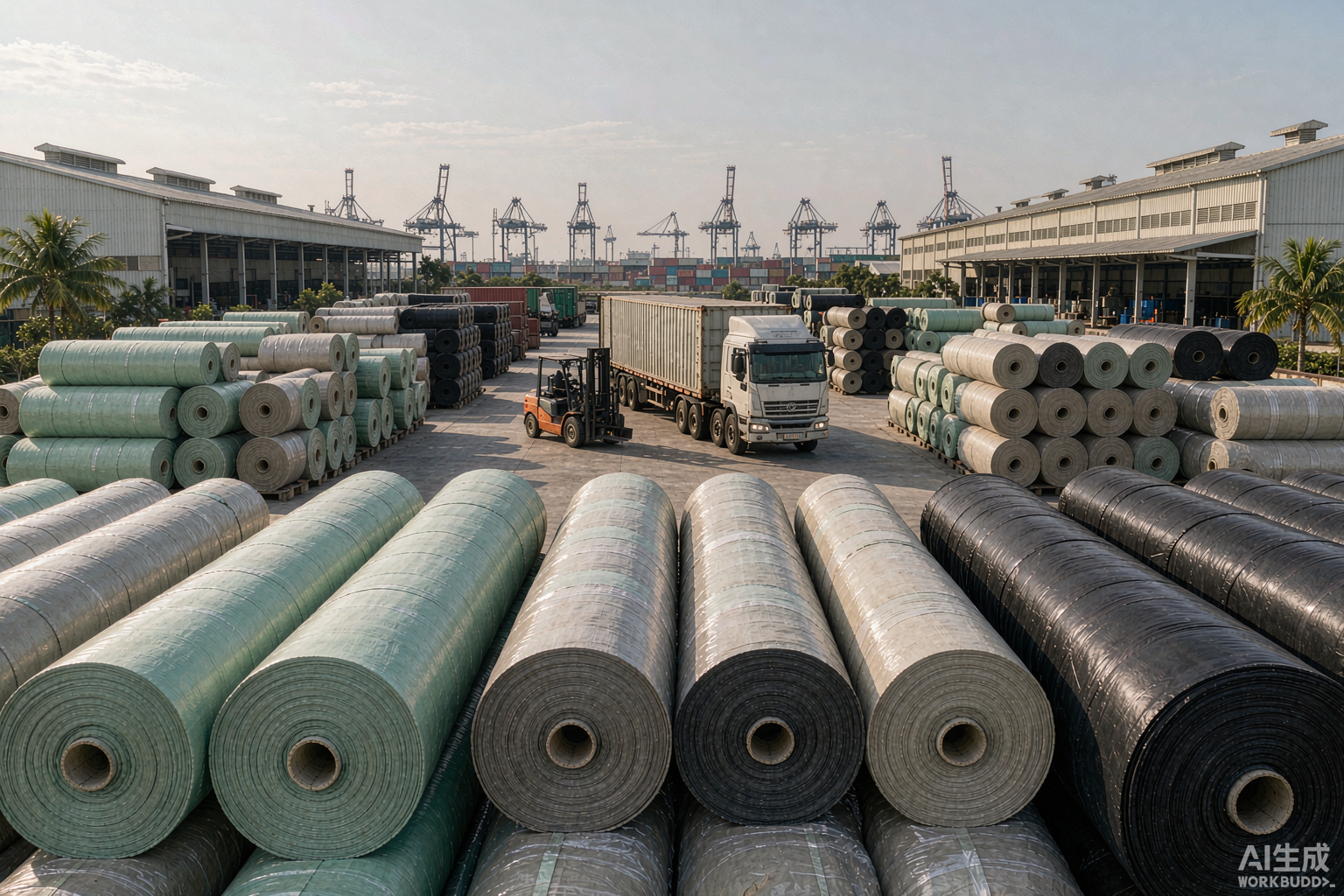
Vietnam exported USD 35.72 billion of textiles in the first nine months, and China fabric exports to Vietnam lead at USD 6.27 billion — sewing moved, fabrics stayed. This guide unpacks the right dual-sourcing design, Form E and RCEP origin practices, Vietnamese tariff and anti-dumping risks, a three-country comparison and the three buyer traps — an implementation roadmap of "China core + Southeast Asia complement".
In 2026, "supply-chain shift" is the most-quoted phrase in global textile procurement circles — but the data tells a more nuanced story: the sewing and assembly stages of garments and made-up products are indeed migrating to Southeast Asia, while upstream fabrics, yarns and process capabilities remain firmly anchored in China. According to the Vietnam Textile and Apparel Association (VITAS), Vietnam's textile and garment exports reached USD 35.72 billion in the first nine months of 2026, up 3.3% year-on-year, including USD 28.24 billion in garments (+2.2%) and USD 3.61 billion in fibers and yarns (+13.08%); meanwhile China's fabric-export data show Vietnam as China's largest single fabric export market, at USD 6.27 billion for January–July, or 15.6% of China's total fabric exports. For overseas buyers in the curtain and shading-fabric industry, the question is no longer "should we look at Vietnam" but "how to design a dual-sourcing chain in which China and Southeast Asia collaborate". This article answers it across four layers: capacity landscape, the data reality, rules of origin, and implementation paths.
1. The real picture: sewing moved, fabrics stayed
Start with three sets of numbers. Set one: China's yarn-and-fabric exports reached USD 42.68 billion in the first half of 2026, up 2.8%, with June alone at USD 7.82 billion, a 13% surge — intermediate goods outgrew the overall textile and apparel market (total exports of USD 145.96 billion, up just 1.4%). Set two: China's yarn-and-fabric exports to ASEAN totaled USD 14.47 billion (+4.4%); yarn exports to Vietnam grew 17.2%, polyester yarn to Vietnam 30.2%, and knit fabrics to Vietnam 30.9%; fabric exports to Cambodia rose 15.3%, and yarn exports to India soared 52.7%. Set three: Luthai Textile, an industry flagship, reported in its 2026 interim results that 67% of its fabric capacity remains domestic (Shandong) while 71% of its garment capacity has moved to Vietnam, Cambodia and Myanmar — fabrics with high technical content and demanding process requirements stay at home, while labor-intensive sewing goes overseas. All three sets point to the same conclusion: global textile procurement is not relocating the entire chain intact; it is re-arranging each link's position. The hotter Vietnam's textile industry runs, the stronger China's fabric exports to Vietnam become — and the shading-fabric industry is no exception: the core weaving and finishing capacity for roller shades, zebra blinds and blackout coatings has no substitute region in the short term.
One caveat on statistics: Vietnam Customs figures put the same nine-month export at USD 30.32 billion, up 1.9% — the gap with VITAS mainly reflects coverage and timing. Both directions agree, however: growth continues, raw-material categories outpace garments, and demand for upstream supply is real and urgent. For shading-fabric suppliers, the next two years are the golden window to plug into Vietnam's and Southeast Asia's finished-product supply chains.
2. Vietnam's opportunity and four risks to price in
Vietnam's opportunity is genuine: labor costs below coastal China, tariff and FTA conveniences toward the EU, Japan and other markets, and a full-year export target of USD 47.0–47.5 billion that could touch 48 billion. But for fabric buyers, at least four risks belong in the decision model. First, tariff disadvantage: the US applies a 12.5% tariff on Vietnamese textiles, above the 10% applied to some competitors — VITAS vice president Truong Van Cam has publicly acknowledged that this gap is squeezing Vietnamese quotes. Second, upstream dependence: Vietnam's domestic fabric self-sufficiency remains limited; blackout coating, functional finishing and specialty constructions (jacquard, crushed-ice textures, high-shrinkage yarns) are almost entirely import-dependent — VITAS's October 2026 remark that "fabric delivery delays are lengthening production cycles" is precisely evidence of that upstream fragility. Third, anti-dumping and trade remedies: Vietnam already levies anti-dumping duties of 3.36%–17.45% on some Chinese polyester filament yarns; base import duties on fabrics generally run 5%–20% (cotton cloth around 12%), plus VAT at 8% of CIF — cost models must be complete. Fourth, the rules-of-origin trap, covered next.
3. Rules of origin: "relabeling" will not dodge tariffs
US and EU customs apply strict origin tracing to textiles, and origin is not determined simply by where sewing happens. In the US case, if an item's core fabric or fiber inputs come from China and only cutting and sewing occur in Vietnam, a customs audit will still treat it as Chinese-origin — after the US normalized its 12.5% additional tariff on Chinese textiles on July 24, 2026, any "origin-laundering" transshipment risks back-duty, seizure and blacklisting. The correct path is substantive origin management using the two applicable frameworks: the China–ASEAN FTA (Form E certificate of origin) and RCEP. Under Form E, Chinese goods meeting regional value content (RVC) of 40% or tariff-classification-change criteria enjoy a 0%–5% preferential rate in Vietnam (versus MFN 5%–20%). RCEP additionally allows cumulation of raw materials across all 15 member states when calculating origin — a decisive advantage for cross-border supply chains, e.g., fabrics using Japanese auxiliaries or Korean yarns reach the threshold more easily. Since May 1, 2026, Vietnam's new origin rules allow qualified enterprises (registered REX numbers in the eCoSys system) to self-certify origin, cutting textile and garment tariffs from 10% to 0% — Chinese exporters are the prime beneficiaries of this reform. Three operational essentials: HS codes, product descriptions and quantities on the certificate must match the bill of lading, invoice and customs declaration exactly; third-country transshipment requires proof of non-manipulation; and the certificate must be in hand before vessel arrival — retroactive issuance is restricted.
Self-protection advice for exporters and buyers: allocate declaration responsibility for composition and origin explicitly in contracts; retain complete document chains — greige purchase, dyeing and finishing, export declaration — for at least three years; require Vietnamese processing partners to provide worksheets on processing steps and value-added calculations; insure high-risk orders with export credit insurance and stipulate liability for certificate discrepancies. A clean document chain is both a customs passport and a credit asset in price negotiations.
4. Designing dual sourcing properly: China as the core, Southeast Asia as the complement
For the curtain-fabric industry, we recommend a division of labor: "China for depth, Southeast Asia for width". Keep in China: high-weight blackout fabrics and triple-weave construction, coating and embossing finishing, differentiated categories such as jacquard and high-shrinkage yarns, sampling and rapid small-order turnaround — stages with high equipment and process barriers and batch-sensitive quality, where China's industrial clusters (Shaoxing, Haining, Wujiang and others) have no equal. Move to Southeast Asia: labor-intensive finished-goods sewing and tube assembly, cutting and packing of commodity items, and consumer-market-adjacent assembly and distribution. Practical steps for buyers:
- Decompose your SKUs first: separate "process-sensitive" items (blackout coating, jacquard, functional finishes) from "processing-intensive" ones (hemming, tube assembly, packing). Lock the former with China; evaluate Vietnamese or Indonesian processing partners for the latter.
- When exporting fabric to Vietnam, proactively obtain Form E or RCEP certificates, saving your customer 5%–20% in import duty — and put that saving on the table in price talks.
- Vet Vietnamese partners on three things: reliable access to Chinese fabric supply (lead time and quality), in-country customs and certificate-of-origin capability, and a track record of capacity ramp-up and quality consistency.
- Beware pure transshipment schemes: any "relay" that does not change the origin determination evades nothing and adds compliance risk; demand full evidence chains of raw-material sources and processing steps.
- Use Southeast Asian fairs for ground-truth checking: DOMOTEX Southeast Asia in Bangkok covers flooring and rugs, and the Ho Chi Minh City International Textile & Garment Industry Exhibition (24th edition in 2026, 400+ brands) reveals Vietnam's equipment and capacity trajectory.
- On logistics, direct ocean services from China to Haiphong and Ho Chi Minh City take only 3–7 days — a dual-source system restocks far more flexibly than Euro-American lanes, fitting a "China as main supplier, Vietnam for overflow" hybrid.
5. Three-country comparison: Vietnam, Indonesia or Cambodia?
The three popular relocation destinations differ sharply in endowment. Vietnam wins on scale and ecosystem: a USD 35.7 billion export base spanning 137 destination markets, with order books full through Q4 2026 and partially into early 2027 (per Vinatex), the most mature workforce and management systems — suited to scaled assembly of mid-to-high-end shading products; its weak points are low fabric self-sufficiency and fast-rising wages and land costs. Cambodia wins on tariffs and elasticity: fabric imports from China grew 15.3% (Jan–Jul) and its least-developed-country status brings EU Everything-But-Arms treatment — suited to high-volume assembly of basic items; its industry is shallow, importing virtually all fabric, and workforce skill levels are still maturing. Indonesia wins on population and domestic demand: a 280-million-person market with culturally driven, essential demand for curtains and shading, room for local brands and project channels; but customs complexity and local-content requirements are higher, and foreign operation costs should not be underestimated. A pragmatic test: look at your product mix — orders with high blackout-fabric content and complex processes should source fabric directly from China with certificates in place regardless of assembly location; only pure processing deserves talk of Southeast Asian localization.
6. The three traps buyers fall into
Trap one: mistaking transshipment for transfer. Some intermediaries peddle "Chinese fabric via Vietnam, swap container and certificate" schemes claiming to dodge US-EU tariffs on China — that is textbook origin fraud. US customs enforcement on textile transshipment has tightened markedly in the past two years; once confirmed, back duties and fines follow and the entire supply chain gets flagged. Trap two: comparing sewing wages instead of total cost. Vietnamese sewing labor may run 20–30% cheaper than China's, but adding inbound fabric logistics and time costs, round-trip freight for rework, and management overhead, the total advantage often shrinks to single digits; only large, highly standardized volumes justify the move. Trap three: underestimating ramp-up time. A new plant typically needs six to twelve months from commissioning to stable quality, and Western brand clients follow the standard three steps — audit, trial orders, volume. Expecting "full migration by next Q1" is a schedule accident waiting to happen. The right posture is dual-track: China guarantees delivery and new-product development while Southeast Asian capacity climbs, completing the structural adjustment over two to three years.
7. The 2027 window: first to build the collaborative chain wins
Industry consensus holds that Vietnam extending upstream is only a matter of time, and Chinese fabric enterprises must upgrade from "fabric exporter" to "technology and standards exporter" before Vietnam completes its full-chain build-out. For overseas buyers, 2027 is the optimal window to lay out dual sourcing: on one hand, Chinese fabric prices and lead times stabilized in the second half of 2026 — China Customs reports January–September textile and apparel exports of USD 232.96 billion, up 5.1%, with September alone up 21.5%, a same-period record, signaling ample supply capacity; on the other, Vietnam's ramp-up needs exactly what mature fabric partners and process input provide. Wanbo's position in this landscape is clear: as a source factory in Keqiao, Shaoxing, we supply global customers with stable exports across roller shades, zebra blinds, sheers, blackout fabrics, jacquards and coated fabrics; we support Form E / RCEP certificate handling and shipping programs for Vietnam and neighboring markets, and can provide fabric customization and technical support wherever your processing base sits — China or Southeast Asia. Whether you are a brand assessing dual sourcing or a manufacturer building shading-product capacity in Vietnam, contact Wanbo for product handbooks, certificate-of-origin samples and a one-stop supply proposal.